

On October 3, interstellar comet 3I/ATLAS flew past Mars. This encounter was monitored by a fleet of spacecraft studying the Red Planet.

Comet 3I/ATLAS was discovered in early July. It became the third confirmed object of interstellar origin found in our Solar System. At the same time, it differs significantly from its predecessors in many of its characteristics. 3I/ATLAS is larger than Borisov’s interstellar comet and the asteroid Oumuamua, moves at a higher speed, and is most likely several billion years older than the Solar System.
On its journey through the Solar System, 3I/ATLAS will make several relatively close flybys of planets. One of them took place on October 3. On that day, 3I/ATLAS passed 30 million km from Mars.

Space agencies decided to take advantage of this unique opportunity to learn more about the visitor from another star system. In its statement, ESA reported that between October 1 and 7, the Mars Express and TGO spacecraft orbiting Mars would monitor the comet using their cameras and spectrometers. On NASA’s side, the LRO spacecraft will participate in tracking the interstellar visitor, as well as the Psyche mission, which is heading towards the asteroid Psyche.
Current observations are very important, as 3I/ATLAS is rapidly approaching the Sun. In the coming days, this will make it impossible to track it using ground-based observatories, and astronomers will have no choice but to rely on spacecraft.
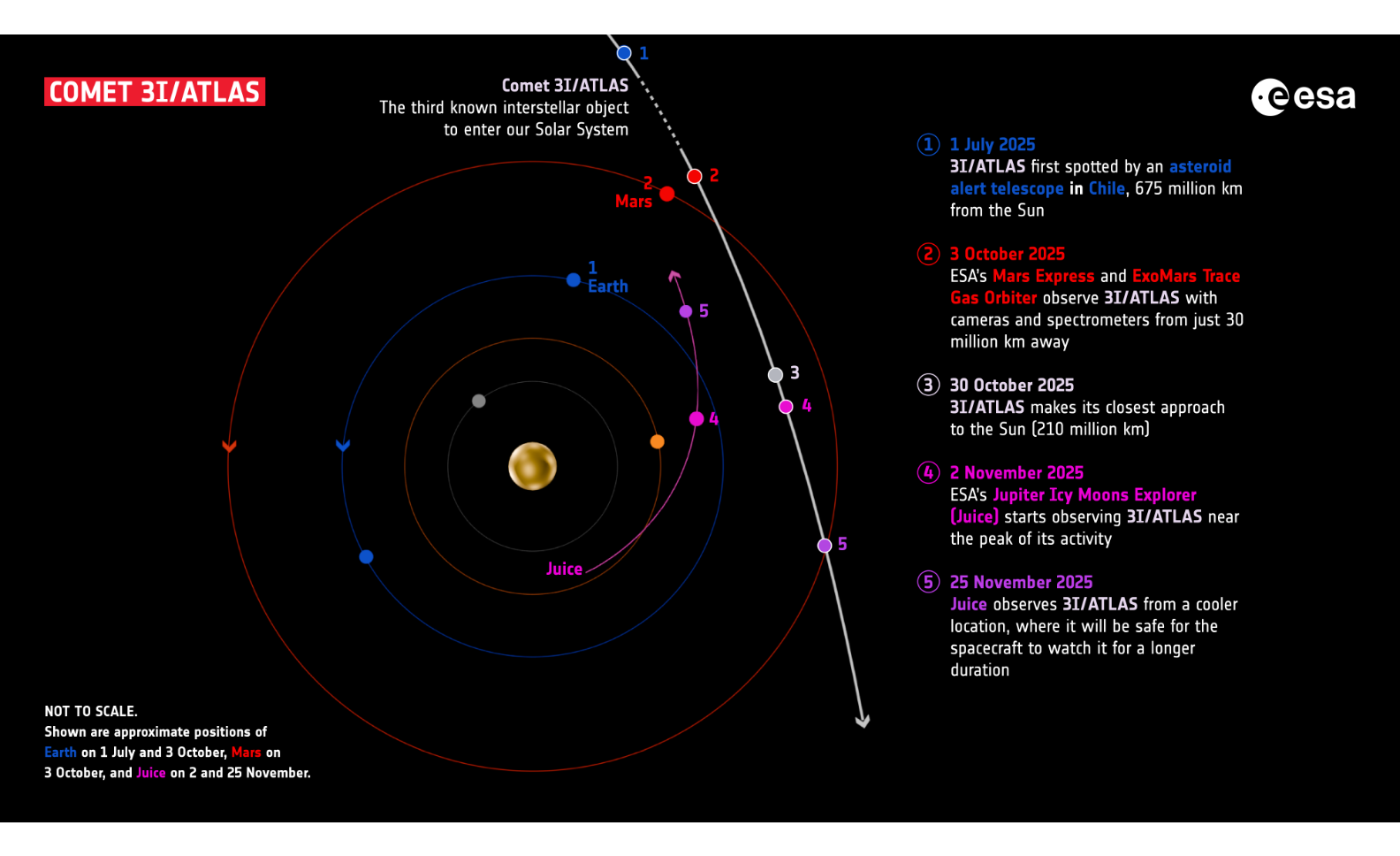
On October 29, 3I/ATLAS will reach the perihelion of its orbit, approaching the Sun at a distance of 203 million km. At this point, the comet will reach its peak activity. By studying the composition of the gases evaporating from its nucleus, scientists will be able to learn about the structure of other star systems. At this point, the comet will still be inaccessible to ground-based telescopes, but fortunately, one spacecraft will be in a suitable position to make observations. It is about the European JUICE mission. It will monitor the comet between November 2 and 25.
By December, 3I/ATLAS will once again be visible to Earth-based telescopes. The comet will not approach our planet. The minimum approach distance will be 269 million km, which is almost twice the distance between the Earth and the Sun.
In March 2026, 3I/ATLAS will fly by Jupiter at a distance of 53 million km. In theory, the Juno spacecraft, which is exploring the gas giant, could participate in its observations. After that, 3I/ATLAS will head off into deep space and never come back to the Solar System.

