

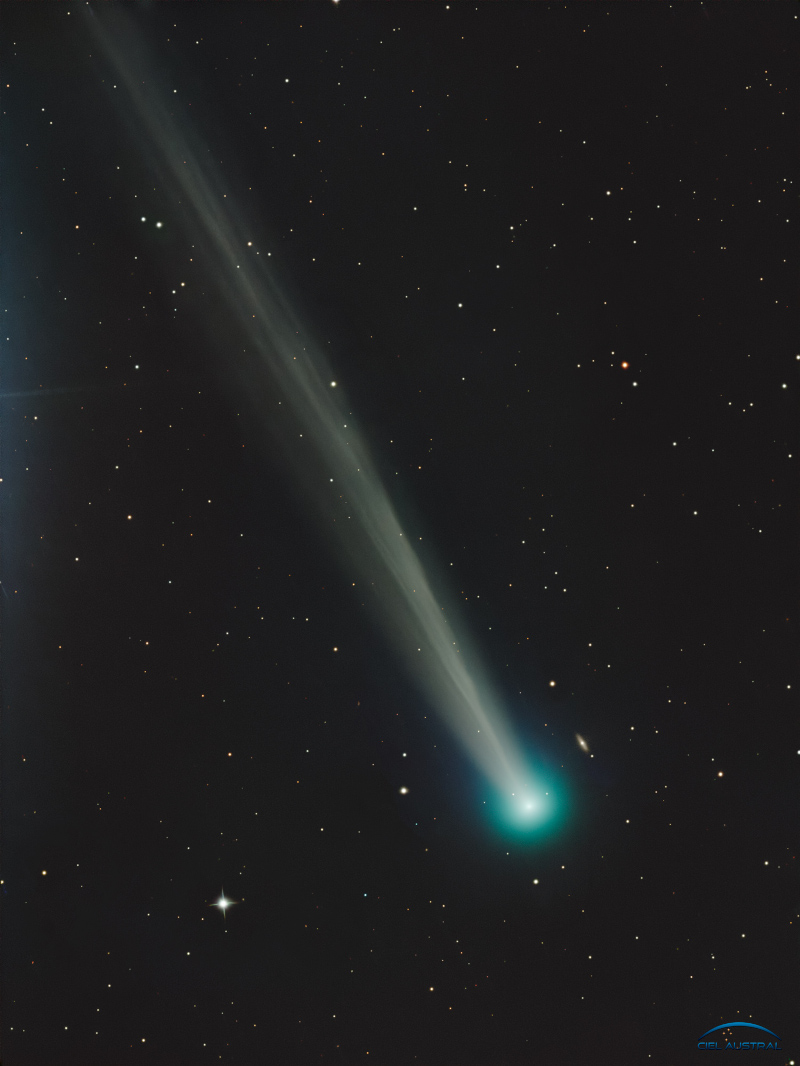
NASA has published images of comet 2025 R2 (SWAN) obtained by the recently launched PUNCH mission. It was discovered by Ukrainian astronomer Volodymyr Bezugly.
Observations of the Solar System in 3D
The PUNCH mission was launched in March this year. It consists of four microsatellites located in near-Earth orbit. They conduct global three-dimensional observations of the inner Solar System and the outer layer of the Sun’s atmosphere (corona). In this way, scientists hope to learn how its mass and energy are converted into solar wind — a stream of charged particles ejected by the Sun in all directions.

The mission also studies the formation and evolution of space weather phenomena, such as coronal mass ejections, which can pose a danger to satellites and astronauts. This data will be useful to space technology designers when planning manned missions into deep space.
Record observations of comets
In addition to studying the solar wind, PUNCH has another task—tracking the near-sun comet 2025 R2 (SWAN). It was first discovered by Ukrainian amateur astronomer Volodymyr Bezuglyi on September 11 in images taken by the SWAN instrument. It is installed on board the SOHO (Solar and Heliospheric Observatory) spacecraft, which recently celebrated its 30th anniversary. During its operation, more than 5,000 comets have been discovered in its images. Most of them were found by amateur scientists as part of the Sungazer project.
2025 R2 (SWAN) arrived from a distant region of the Solar System, located far beyond Neptune’s orbit. On September 12, it passed the perihelion of its orbit, after which it began to move away from the Sun. Apparently, the comet did not survive its close encounter with the star. In early November, astronomers noticed the fragmentation of the nucleus of 2025 R2 (SWAN).
Among others, the PUNCH mission also participated in the study of the comet. The key difference in its observations is that the spacecraft obtained a new image of the comet every few minutes. This makes them the longest of all when the comet was tracked at such a frequency.
“Other comets have been tracked once a day for many years,” said Craig DeForest, principal investigator for the mission at the Southwest Research Institute. “What’s new here is the frequency of observations, which is every few minutes.”
After discovering the comet SWAN, scientists checked whether it had been recorded by the PUNCH instrument and found it in images taken as early as August 7. The comet continued to appear in PUNCH’s field of view until early October, and until October 5, the instrument took new images of it every four minutes. During this time, PUNCH saw the comet’s tail grow, contract, and flicker under the influence of the solar wind. Interestingly, the interstellar comet 3I/ATLAS was also captured in the frame during the shooting.
Comet SWAN is on the move. ☄️
— NASA Science (@NASAScience_) December 2, 2025
Captured by @NASA's PUNCH spacecraft, comet 2025 R2 (SWAN) can be seen moving away from the Sun as the solar wind blows its tail away, creating the illusion that the comet is “moving backward.” ?: https://t.co/GMmjGjHr1s pic.twitter.com/NZaGfi0aQv
“Observing the Sun’s effects from multiple perspectives—and with different types of instruments—gives us a complete picture of the space environment,” said Gina DiBraccio, heliophysicist and acting director of the Solar System Exploration Division at Goddard Space Flight Center. “We use the same tools to track and analyze how space weather affects our astronauts, our spacecraft, and our technology here on Earth.”
According to NASA

