

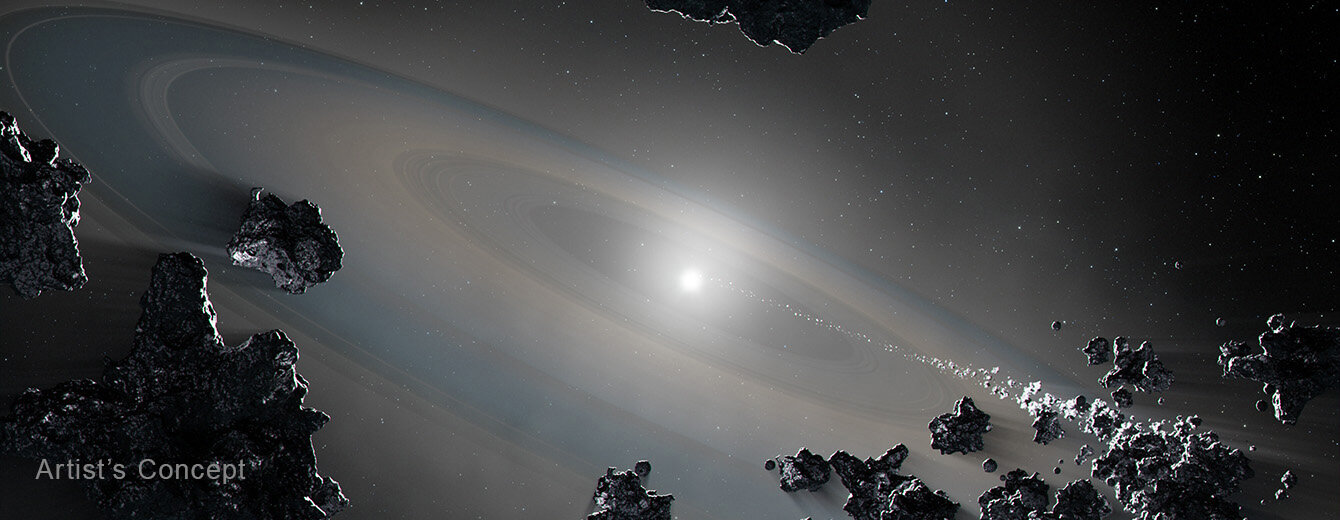
The white dwarf LSPM J0207+3331 is located 145 light-years away. It passed through the red giant stage 3 billion years ago. However, studies show that it is still absorbing material from its planetary system.
White dwarf that doesn’t fit the theory
The Universe never stands still. Everything is in a constant state of fluctuation. However, astronomers have been surprised by the discovery of a white dwarf that is around 3 billion years old but is still actively accumulating matter from its former planetary system — a discovery that casts doubt on assumptions about the late stages of stellar evolution.
Conclusive evidence was obtained from observations made by the W. M. Keck Observatory on Mauna Kea in Hawaii. Spectroscopic analysis of the dwarf’s light revealed 13 chemical elements that likely originate from a small rocky body—an asteroid or dwarf planet.
Like an apple falling from a tree, some unknown gravitational disturbance over the last few million years could have sent this object spiraling inward. It was then torn apart by tidal forces and swallowed up by the debris disk surrounding the white dwarf.
Absorption of the planetary system
Astronomers have discovered a rare ancient planetary system that is still actively being consumed by the white dwarf LSPM J0207+3331, located 145 light-years from Earth. This system contains the oldest and most metal-rich debris disk ever observed around a hydrogen-rich white dwarf, raising new questions about the long-term stability of planetary systems billions of years after a star’s death.
“This discovery challenges our understanding of planetary system evolution,” said lead author Érika Le Bourdais from the Trottier Institute for Research on Exoplanets at Université de Montréal. “Ongoing accretion at this stage suggests white dwarfs may also retain planetary remnants still undergoing dynamical changes.”
Spectroscopic data from the W. M. Keck Observatory on Mauna Kea in Hawaii showed that the atmosphere of the white dwarf was contaminated with 13 chemical elements, indicating the presence of a rocky body at least 120 miles (200 kilometers) wide that had been torn apart by the stars’ gravity.
The hydrogen-rich atmosphere around white dwarfs usually masks such traces of elements, making this discovery particularly significant. “Something clearly disturbed this system long after the star’s death,” said study co-author John Debes of the Space Telescope Science Institute in Baltimore, Maryland. “There’s still a reservoir of material capable of polluting the white dwarf, even after billions of years.”
Planetary instability system
Almost half of all polluted white dwarfs show signs of heavy element accumulation, indicating dynamic disturbances in their planetary systems. In the case of LSPM J0207+3331, a recent disruption—within the last few million years—likely resulted in the spiral destruction of a rocky planet. This indicates that the mechanisms of inflow destruction and accretion remain active long after the completion of the main sequence phase of a star’s life. Mass loss during stellar evolution can destabilize orbits, affecting planets, comets, and asteroids.
This system may be an example of delayed instability, where the interaction of several planets gradually destabilizes orbits over billions of years. “This could point to long-term dynamical processes we don’t yet fully understand,” Debes added.
Search for exoplanets
Astronomers are now investigating what could have caused this destruction. The cause could be planets the size of Jupiter, but they are difficult to detect due to their distance from the white dwarf and low temperatures. Data from the European Space Agency’s (ESA) Gaia space telescope may be sensitive enough to detect such planets by their gravitational influence on the white dwarf.
NASA’s James Webb Space Telescope may also provide information by conducting infrared observations of the system for signs of outer planets. “Future observations may help distinguish between a planetary shakeup or the gravitational effect of a stellar close encounter with the white dwarf,” Debes said.
According to phys.org

