

Astronomers from the University of Warwick have discovered the chemical fingerprint of a water-rich fragment of a dead planet. Directly at this moment, it is being absorbed by a white dwarf.
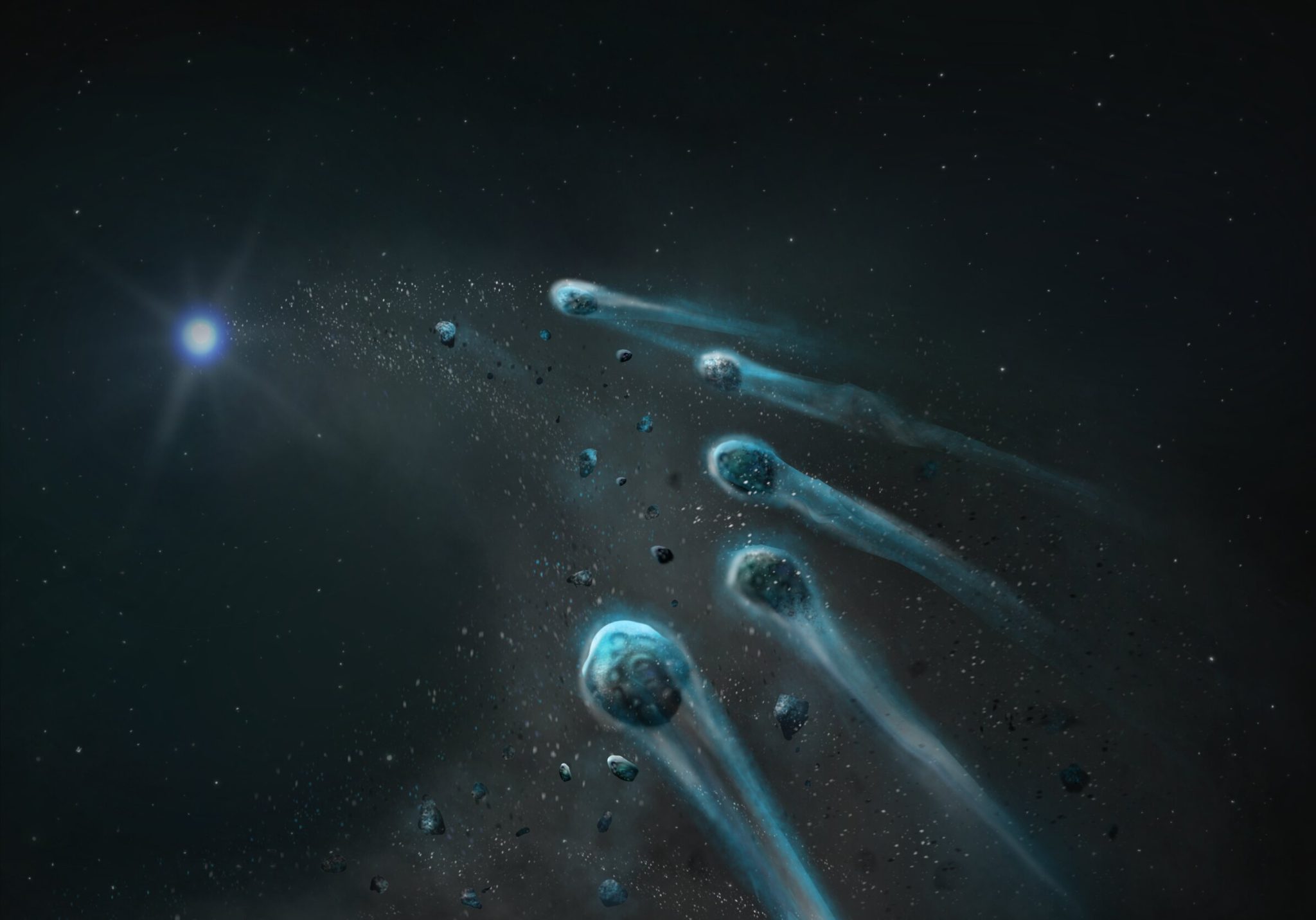
It is believed that comets and icy planetesimals were responsible for delivering water to Earth. The existence of these icy objects is a necessary condition for the development of life, but they are incredibly difficult to identify outside our Solar System because they are small, faint, and require chemical analysis.
But recently, astronomers have found compelling evidence that icy bodies rich in volatile substances capable of delivering water and the ingredients for life exist in planetary systems beyond our own. The discovery was made using the Hubble Space Telescope. During the observations of the white dwarf WD 1647+37, it managed to discover something curious. As a rule, the atmospheres of such bodies contain hydrogen and helium. However, elements such as carbon, nitrogen, sulfur, and oxygen were found in the spectrum of WD 1647+375.
Previously, scientists had already found white dwarfs with spectra that contained elements such as calcium and iron in addition to hydrogen and oxygen. It is a kind of evidence of a cosmic crime. When a planet fragment or asteroid comes too close to a white dwarf, it is torn apart and its material falls onto the surface, leaving chemical traces in the atmosphere. Astronomers can then use them to reconstruct the identity of the “victim.”
The peculiarity of the current discovery lies in the fact that, prior to this, astronomers had almost never found traces of the absorption of debris rich in volatile substances. However, in this case, ultraviolet spectroscopy showed that the material absorbed by WD 1647+375 contained a high percentage of nitrogen (~5%) by mass. This is the highest nitrogen content ever detected in the spectrum of a white dwarf. The atmosphere of WD 1647+375 also received much more oxygen than would be expected if the absorbed object were rocky — 84% more, indicating that it was an icy object.
Astronomers have also determined the minimum possible sizes of objects. Its debris has been feeding the dwarf for at least the last 13 years at a rate of 200 tons per second. This means a diameter of at least 3 km, which is about the size of a comet.
However, this is a minimum estimate based on observational data. In reality, accretion can take hundreds of thousands of years. This means that the object could have had a diameter of about 50 km and a mass of a quadrillion tons. All this paints a picture of an icy/water-rich planetesimal (64% water) being swallowed up by a white dwarf. According to astronomers, it is most likely a fragment of a dwarf planet similar to Pluto.
Earlier, we reported on a rare system discovered by the Hubble Telescope, consisting of a white dwarf and a blue straggler.
According to Phys.org

