

Capricornus is a zodiac constellation that the Sun enters on January 19. The most interesting thing about it is that it depicts a mythical creature with the head of a goat and the tail of a fish, but no one knows what kind of creature it is. However, there are also many interesting things about it from a purely astronomical point of view.
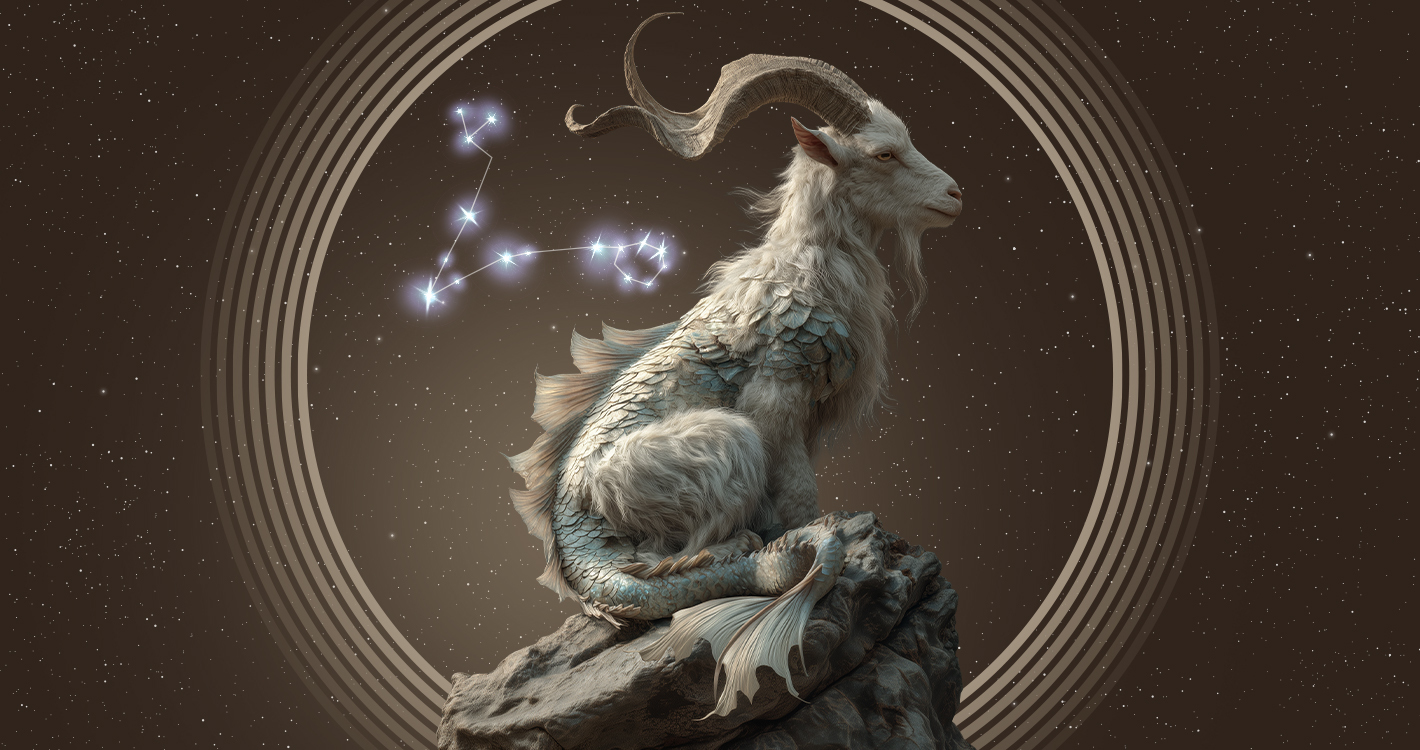
Capricornus
According to astrologers, January 19 is the last day when the Sun is in the zodiac constellation of Capricornus. Astronomers partially agree with them. Our star will indeed be in it on this day, but this will not be the end of its journey through it, but only the beginning.
As with other zodiac constellations, this is due to the shift in the vernal equinox and the revision of constellation boundaries, which you can read about in detail here. In short, astrologers use astronomical data from 2,000 years ago instead of looking at the sky.
Interestingly, in those days when astronomy and astrology were still the same, Capricornus was the point of the winter solstice, which is still marked by its symbol. The southern tropic of our planet – the latitude at which the Sun is directly overhead during the winter solstice – is also called the Tropic of Capricorn.

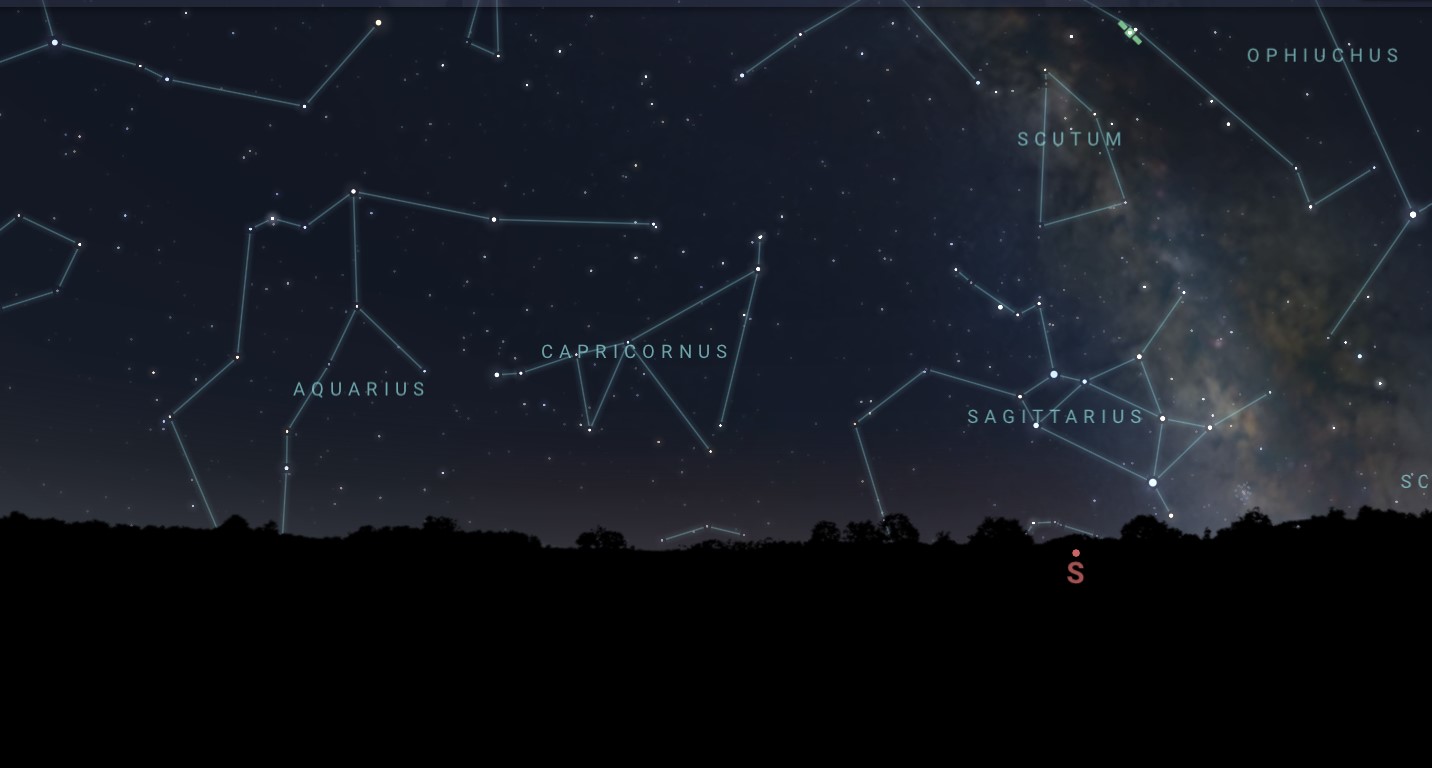
The constellation itself cannot be observed in January. It rises with the Sun and sets with it. Therefore, to admire it, it is better to wait until summer. At this time, the constellation Capricornus is high above the horizon in the middle of the night. To find it, you need to start by looking for the “summer triangle.” This is the name given to the bright stars Vega, Altair, and Deneb. We are interested in the last of these, which is located in the middle of a cross-like figure. This is the constellation Cygnus. Next, look southwest of it for a group of not very bright stars that form something like a boomerang or the letter “V.” This is the constellation Capricorn.
The mysterious history of the constellation
Capricornus is a mythical creature with the front half of a goat and the rear half of a fish. However, it is difficult to say for certain why this image exists and what it was meant to symbolize. The constellation Capricornus has been known since ancient times, but both the Greeks and Romans inherited it from the Babylonians. In their texts, images of Capricornus appear many centuries before our era, so this image is perhaps the oldest of all the constellations.
However, even clay tablets cannot fully explain why the goat was combined with the fish. The only thing that can be said for certain is that in those days, Capricornus symbolized the god of the underworld, Enki, or Ea, who was also a water god, because the people of Mesopotamia believed that deep beneath their feet there were dark waters where the Sun hid at night.
Despite his subterranean nature, Ea was not an evil god; he created humans from clay, and before the beginning of the universal flood, it was he who suggested that they build an ark. The “fish” part of Capricornus is easily associated with him, but the goat raises questions.
When the ancient Greeks inherited Capricornus, they tried to adapt its image to their myths, but they did not quite succeed. One of them tells that Capricornus is the same goat Amalthea, who nursed Zeus with her milk in a cave.
In the second myth, Capricornus is Pan, the god of nature, who was frightened by the monster Typhon and jumped into a river, where he turned into a fish. This transformation seems to fit well with the appearance of the mythical beast, but in reality, there is also a big problem with it. Pan’s lower body was that of a goat, while the mythical Capricorn had only the head and front hooves of a goat.

The bright stars of Capricornus
Capricornus is a constellation with no bright or easily visible stars. The brightest of them has a magnitude of 2.85 and is called Delta Capricorni, Deneb Algedi (“goat’s tail”). It is 49 light-years away and is actually a double star system.
Its main component is a hot white star, whose mass is twice that of the Sun and whose radius is 91% larger. A yellow or orange dwarf star, with 90% of the Sun’s mass and 71% of its radius, orbits around it with a period slightly longer than one Earth day. It causes short-term fluctuations in the star’s apparent brightness.
If you look at Delta Capricorni through binoculars or a telescope, you can see two more stars nearby. However, they have nothing to do with its system. Both are located far behind it at a distance of at least 1,000 light-years.
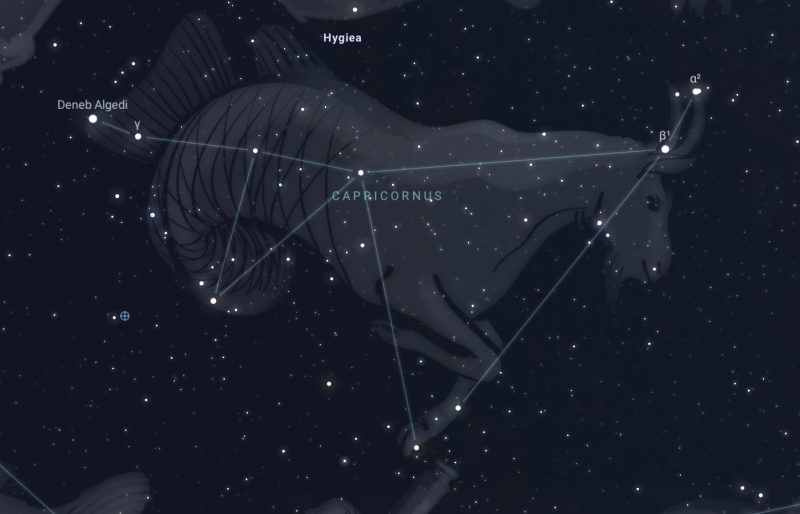
The second brightest star in the constellation is Beta Capricorni. It has a magnitude of 3 in our sky and has some interesting features. If you look at it through binoculars, you can see two points at once. In fact, these are not physically related objects: one of them, β¹ Capricorn, is 390 light-years away from us, and the other, β² Capricorn, is 360 light-years away.
At the same time, each of the components is a multiple system in itself. In the case of β1 Capricornus, the system is a triple system. Its main component is an orange giant, which is 35 times larger than the Sun in radius and 600 times larger in luminosity.
Another pair of stars revolves around it at a distance of approximately 5 AU. The larger of the two is a blue star four times more massive and 112 times brighter than the Sun. Its companion, located at a distance of only 0.1 AU, has not yet been properly observed, but it is known that its mass is 94% of the Sun’s.
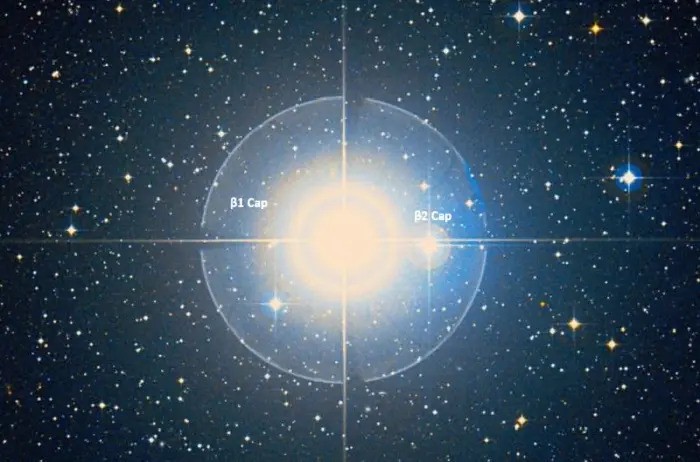
In the case of β² Capricorni, we are dealing with a double system consisting of two white stars, one larger and one smaller. The distance between them is several dozen astronomical units, and they orbit each other approximately once every 400 Earth years.
The third brightest star is Alpha Capricorni, or Algedi (“kid”). Incidentally, it was from this star that Frank Herbert’s novel took its name for the home planet of the Harkonnen family, Giedi Prime. Alpha Capricorni has the same history as Beta. There are two optically close stars, but one (Alpha¹ Capricorni) is located 690 light-years away from us, and the other (Alpha² Capricorni) is 109 light-years away.
How many components Alpha¹ Capricorni has remains a matter of debate. The only thing that can be said with certainty is that the main component is a rare giant yellow star with a mass 5.3 times greater than the Sun’s and a radius 36.3 times greater.
The number of companions to this star remains unclear. At least one of them is recognized as real, and there are three more stars that are visually located nearby, but whether they are actually gravitationally bound to the main star is unknown.
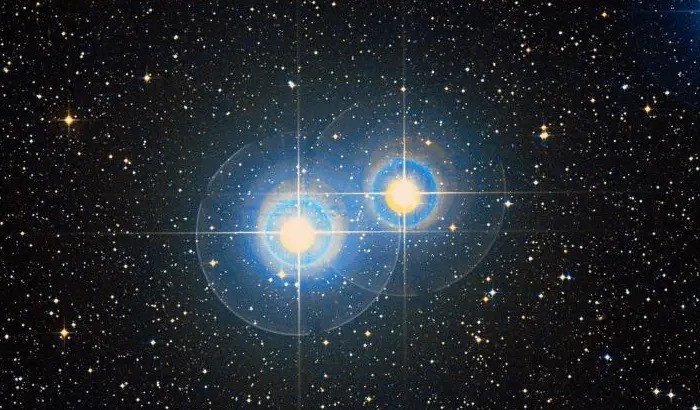
Alpha² Capricorni is a triple system. The main star is also a yellow giant, with a mass 2.05 times greater than the Sun’s and a radius 8.38 times greater than our star. With a period of approximately 1,500 years, it revolves around a common center of mass with a pair of satellites. Each of them has a mass comparable to that of the Sun. The period of rotation of this pair of stars around each other is 244 Earth years.
The nearest stars
The unusual nature of the Capricornus constellation is evident in the fact that it does not contain any stars that we can say are particularly close. The closest one is Gliese 785, also known as HD 192310. It is an orange dwarf with a mass and radius of 83% of the Sun’s. In 2010, a planet was discovered in the system, and in 2014, another one. However, some studies confirm their existence, while others refute it.
The second closest star to us is Delta Capricorni, mentioned above. The third closest star, Psi Capricorni, is located 47.9 light-years away from us. It is a single yellowish-white star of spectral class F. It is 35% more massive and 49% larger than the Sun. No planets have been discovered around it.
The fourth closest star to Earth in the constellation Capricornus is HD 196761. It is quite similar to the Sun, but has only 81% of its mass. No planets have been discovered around it either.
Deep space objects
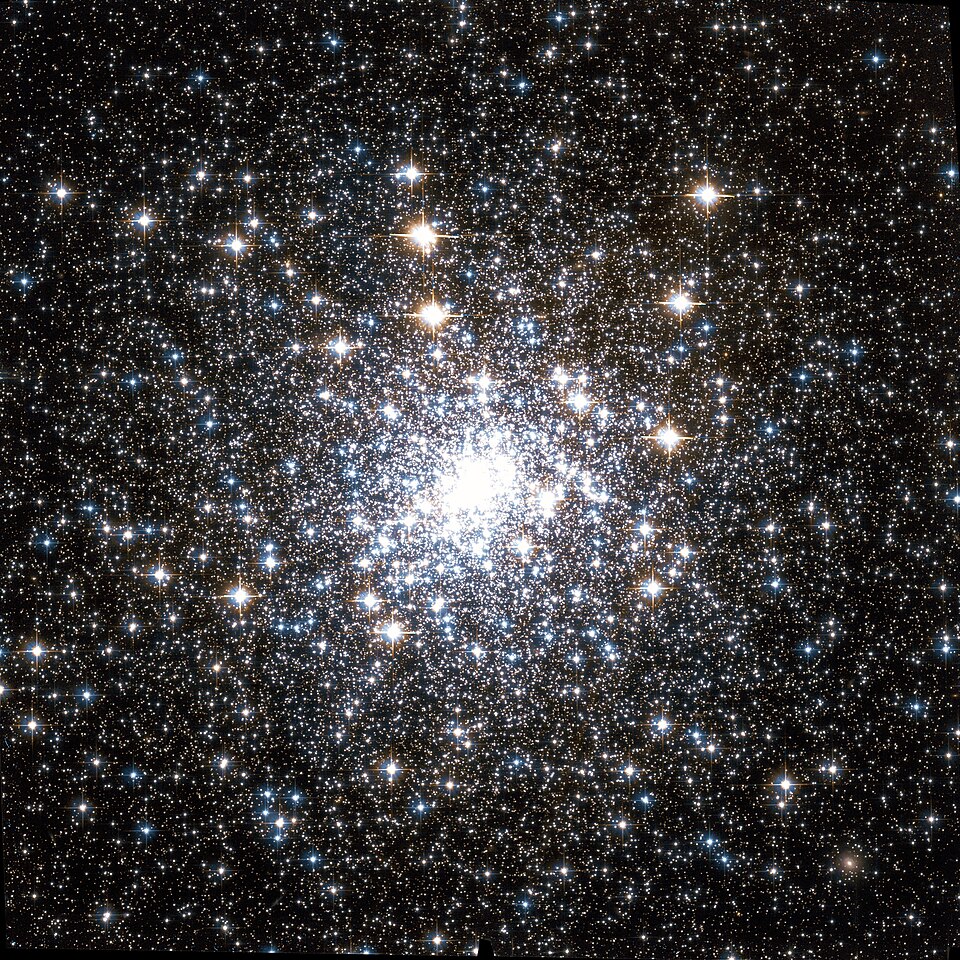
The constellation Capricornus is not particularly rich in deep-space objects, but they are still worth mentioning. First of all, there is the globular cluster Messier 30. Its apparent magnitude is 7.1. In reality, it is 26,000 light-years away from us and consists of hundreds of thousands of stars.
Next, we should mention NGC 6907. It is a spiral galaxy located 120 million light-years away from us. It is interesting because between 1984 and 2014, supernovae exploded in it four times, although such events usually occur once every few centuries.
The constellation Capricornus also contains an interesting group of galaxies called HCG 87. It consists of at least three star systems: a large elliptical one, a spiral one visible from the edge, and a spiral one facing us with its plane. The latter is experiencing a powerful burst of star formation, which may be explained by the proximity of the other two.
The elliptical galaxy and the one we see from the edge have active cores. This means that supermassive black holes at their centers are intensely absorbing matter. In addition, these two star systems are connected by a kind of bridge of stars. Scientists believe that in the next few hundred million years, HCG 87 will merge into one giant galaxy.

