

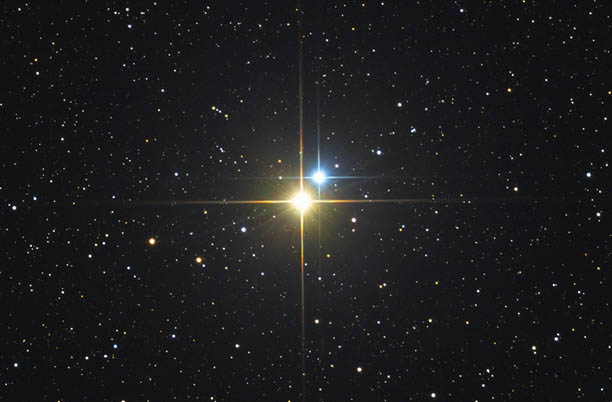
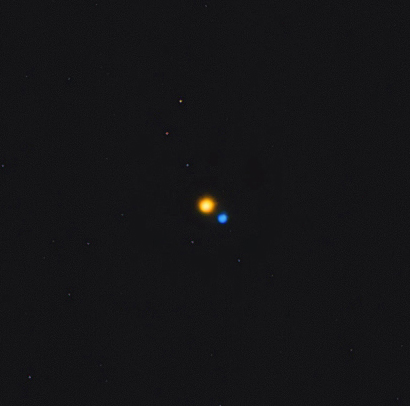
Albireo, or β Cygni, is the fifth brightest star in the constellation Cygnus. Even with a small telescope, you can see that it is actually a pair of stars, one of which is blue and the other yellow, almost orange. Together, they resemble the flag of Ukraine.

Albireo
On August 23, Ukraine celebrates National Flag Day. The streets of our cities and news feeds are filled with blue and yellow colors. In fact, this combination can be seen in many places, including the sky.
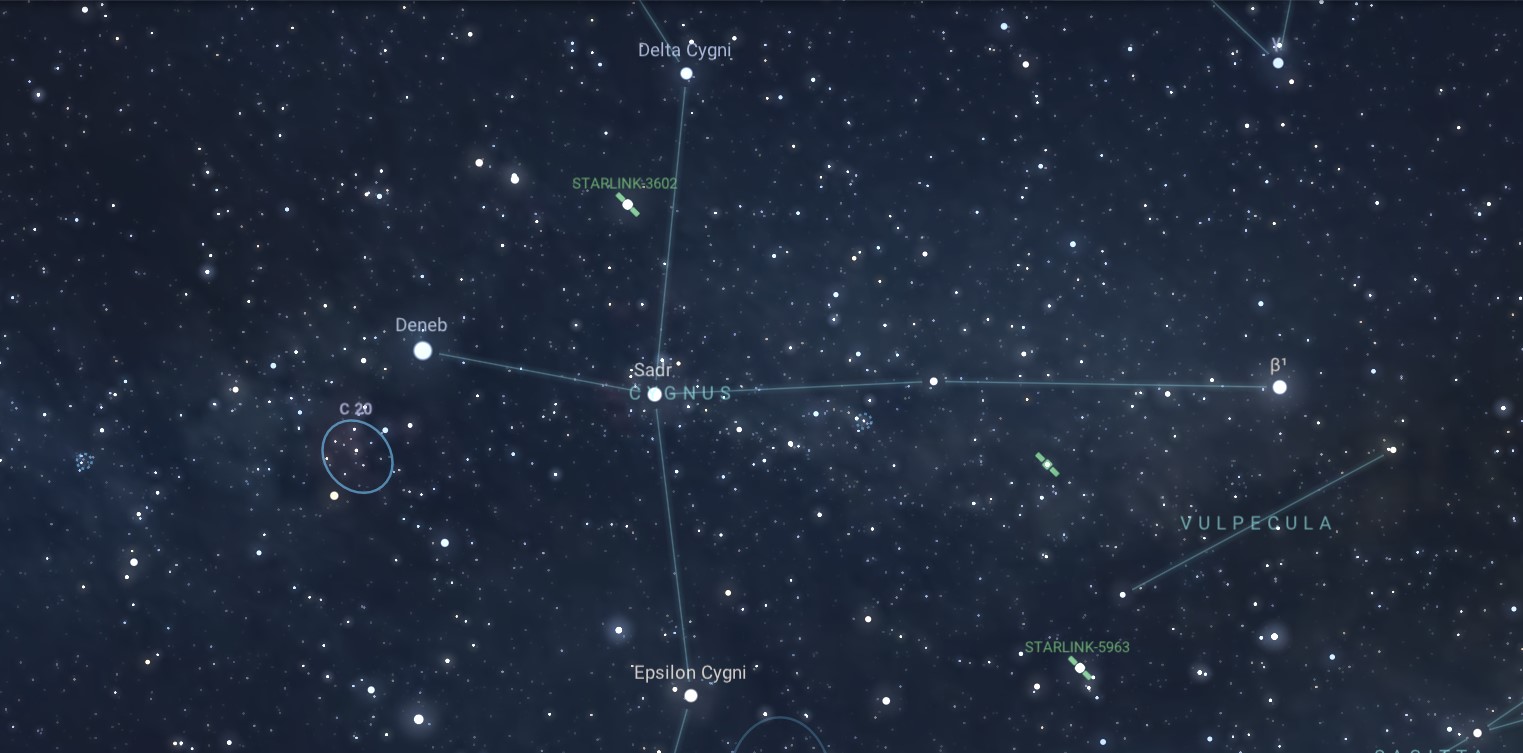
For example, the star Albireo, or β Cygni, is blue and yellow. It has been known to people since ancient times, as it, along with Deneb (α Cygni), Aljanah (ε Cygni), Sadr (γ Cygni), and δ Cygni, which has no name of its own, forms the asterism known as the Northern Cross. It is the most prominent component of the constellation Cygnus. On the evening of August 23, it will be located almost directly overhead, making it hard to miss.
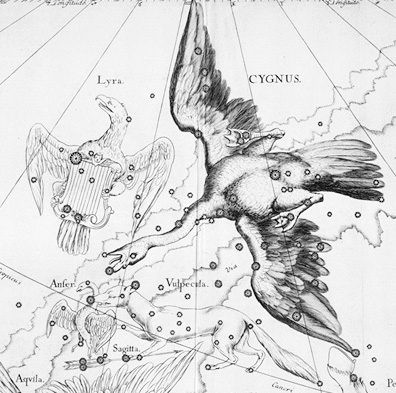
It will be very easy to find Albireo among the stars. Of all the stars in the Cross, Deneb is the brightest, forming its shortest side. The opposite segment is the longest. Albireo is located at its end. If you imagine that the cross is a swan with outstretched wings, then Albireo will be its head.
Confusion with the name
The modern name of the star Albireo is the result of a series of mistakes. At first glance, it may seem like some kind of Arabic name. However, on medieval Eastern star charts, it is called al-Minhar al-Dajajah, meaning “chicken’s beak.” So where did the modern name come from?
It all began with the ancient Greeks, who called the constellation Cygnus ὄρνις (Ornis), meaning “bird”. Later, this name was borrowed by the Arabs, and it was transformed into “Urnis”. Then the works of Arab scientists were translated back into European languages, and in the process, scientists decided that it referred to a plant called “ireo” in Latin.
The Latin article “ab” was added to the word, forming the name “Ab Ireo”. It was under this designation that the star began to be mentioned in scientific works. Later, other researchers decided that the translators had made a mistake and considered the name to be an original Arabic word, which was supposed to sound like “al-Bireo”. By the time the confusion was finally cleared up, everyone had already gotten used to the “Albireo” version, so it was too late to correct it.
Multiple-component system
Of course, no star can be both yellow and blue at the same time. However, even with a small telescope, it was clear that this was actually a pair of stars: one yellow-orange and the other blue-white. The distance between them is 35 arc seconds, which is why astronomers long believed that this was an optically double system, i.e., its components only appear to be close, but in reality they are separated by light-years.
However, the nature of these two stars remains controversial. The fact is that in the 1990s, the Hipparcos astrometric satellite showed that the distance to the main component (orange) is 434 light-years, and to the smaller one (blue) – 401 light-years. That is, in reality, there are more than 30 light-years between them. At the same time, the age of both stars is estimated at approximately 100 million years.
However, more recent studies conducted by the Gaia space telescope show that the distance to the stars is 330-390 light-years and that they are located close to each other. However, the measurement itself has a large margin of error. Be that as it may, even if the stars form a gravitationally bound system, their period of rotation around a common center of mass exceeds 100,000 years.
At the same time, the larger of the two stars is itself a multiple system with a complicated history of research. The main component of the system, called Albireo Aa, is more or less understood. The mass of this star is 5.2 times greater than that of the Sun. Due to its large mass, it has already evolved to the red giant stage and now has a spectral class of K2II. At the same time, its diameter has increased to 58 solar diameters, and its luminosity is 1,259 times greater than that of the Sun.
The existence of a close companion to Albireo A was first suspected in the 19th century, but it was not until the second half of the 20th century that the satellite’s existence was finally confirmed. Two different groups of astronomers confirmed the presence of an additional object in 1976 and 1982, but the parameters they obtained did not match. Scientists concluded they were dealing with two separate stars, named Albireo Ab and Albireo Ac. However, over time, only the existence of the second star was confirmed.
In the 1990s, another component was discovered, which was named Albireo Ad. As for Albireo Ab, its existence has never been confirmed. It is now believed that two satellites orbit around Albireo Aa. At a distance of 1.9 AU from it, the red dwarf Albireo Ad revolves. Its mass is 8.5% of the Sun’s, and it takes a little more than one Earth year to complete one revolution around the star.
Together, this pair revolves around a common center of mass with Albireo A in 121 Earth years. The mass of the latter star is 2.7 solar masses. It is a hot white-blue star with a surface temperature of 10,000 K.
As mentioned above, there is no certainty as to whether Albireo B is connected to all this. If so, it must have a common center of mass with the entire system described above. In any case, it is a so-called Be star with a surface temperature of 13,000 K, a mass of 3.7 solar masses, and a luminosity 230 times greater than that of our own star.
Albireo still holds many secrets, but astronomers hope to unravel them all in the future.

