

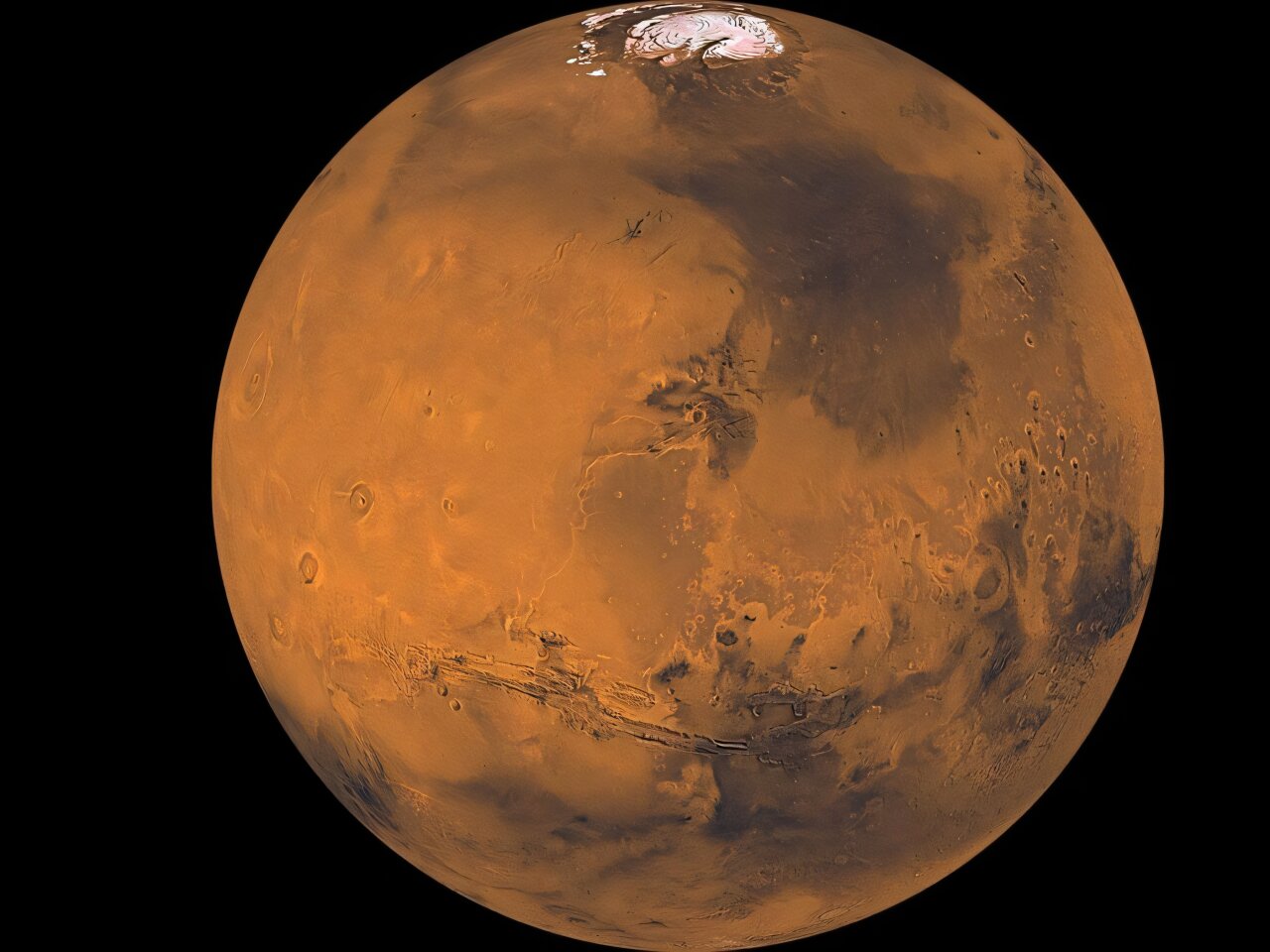
If people ever settle on Mars, they will need tools and parts to build structures on the planet. Transporting heavy, bulky supplies 34 million miles from Earth would be impractical.
Life-saving 3D printing technology
The best plan, according to Zane Mebruer, a recent graduate of the University of Arizona, would be to print objects on Mars using 3D printing. His new research, conducted while he was studying mechanical engineering at the University of Arizona and graduating with honors, suggests that this may be possible.
The study, which Mebruer conducted under the supervision of Wan Shou, an associate professor in the Department of Mechanical Engineering, was published in the Journal of Manufacturing and Materials Processing.
Metal 3D printing is typically performed in a chamber filled with argon, a non-toxic gas that prevents oxidation. Mebruer wanted to find out whether it was possible to successfully 3D-print metal in a carbon dioxide atmosphere, which makes up 95% of Mars’ atmosphere. If this were possible, there would be no need to transport or produce argon on Mars.
Laser printing process
Mebruer’s study utilized powder bed fusion, often abbreviated as PBF-LB. In this metal 3D printing method, metal powder is evenly distributed in a single layer on a build plate. A laser fuses the powder into a layer. The plate is lowered, another layer of powder is applied, and the laser fuses it into the next layer of the object.
The process is efficient. Unused metal from each layer can be collected and reused. However, the metal can oxidize quickly during the manufacturing process. Unlike rust on the outer surface of a metal object, the oxidation that occurs during additive manufacturing can weaken the internal structure of the part.
Results and significance of Mebruer’s experiment
In the experiment, simple single-layer metal lines were printed in atmospheres of argon, carbon dioxide, and ordinary air. The results were examined at the microscopic level to assess defects and determine the extent to which the single-layer sections achieved a smooth, flat surface. Although printing in argon gave the best results, the parts printed in CO₂ showed promising results and were better than those produced in a normal atmosphere.
This work represents a small step toward human exploration of Mars. For Mebruer, the work he did as a student at the University of Arizona—and the publication of his findings in a peer-reviewed journal—was a giant leap forward in his career. Mebruer is a graduate student in mechanical engineering at the Georgia Institute of Technology.
According to phys.org

