

Data obtained during the Juno mission has provided scientists with new information about the structure and subsurface composition of the icy shell covering Europa. Analysis has shown that its average thickness is 29 km.
Europa’s ice armor
Europa is Jupiter’s fourth largest moon, only slightly smaller than the Moon. Its surface is completely covered by an icy shell. Available data suggests that beneath this shell lies a salty ocean that may contain all the compounds necessary for life. It is not surprising that it has attracted increased attention from scientists. Determining the characteristics of the ice shell, including its thickness, is important for understanding the internal structure of the moon and its habitability.
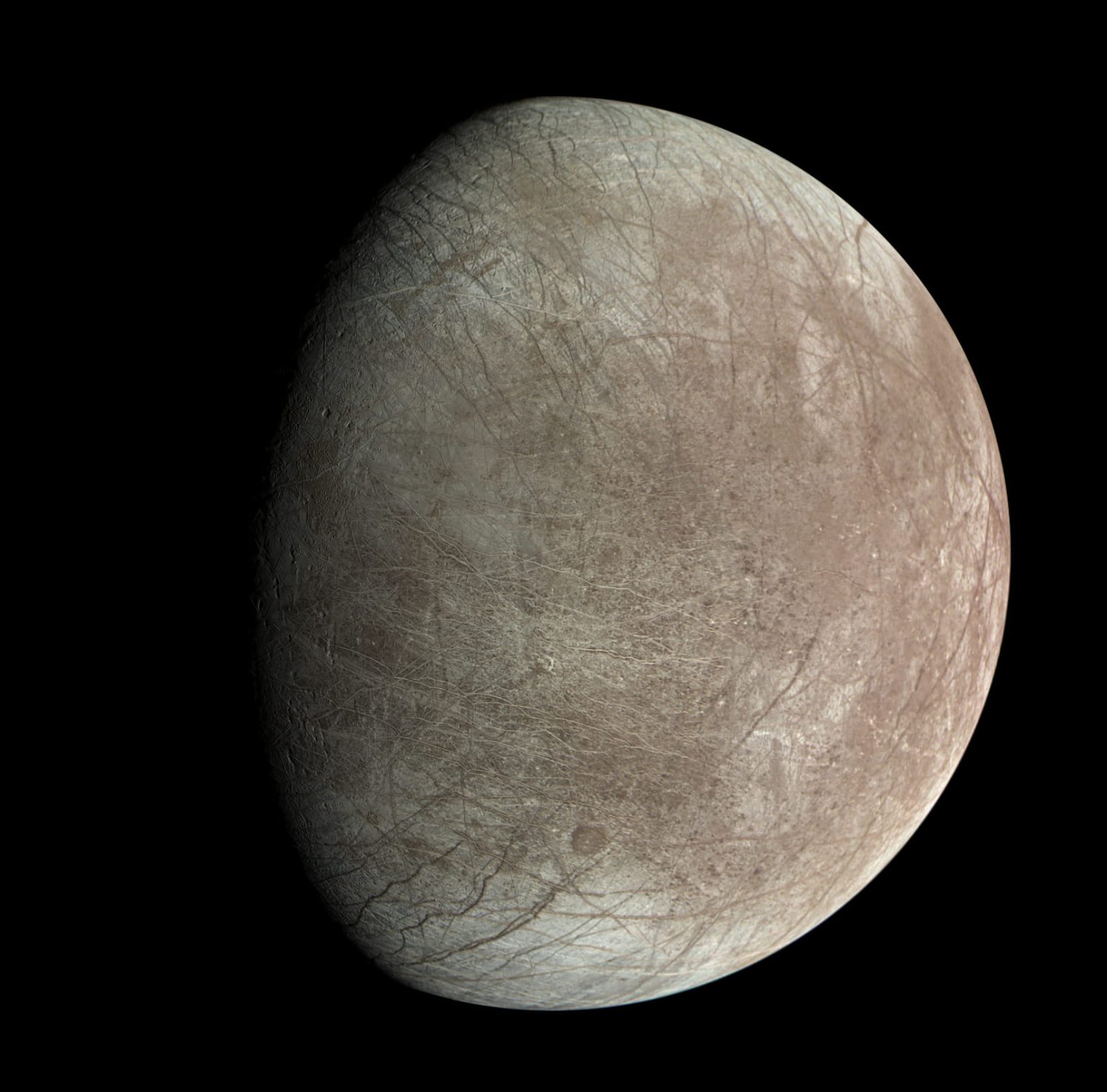
On September 29, 2022, the Juno spacecraft flew past Europa, passing about 360 km from it. During the visit, it used the Microwave Radiometer (MWR). Although this instrument was primarily designed to study Jupiter’s atmosphere, it proved to be very valuable for studying its moons as well. During the flyby of Europa, the MWR collected data on about half of its surface, looking beneath the ice and measuring its temperature at various depths.
After studying the data collected by MWR, scientists concluded that the average thickness of Europa’s ice shell is 29 km. This figure refers to the cold, hard outer layer consisting of pure water ice. If Europa has an internal, slightly warmer convective layer, it is quite possible that the total thickness of the shell is greater. If it contains a small amount of dissolved salt, as some models suggest, then its estimated thickness is reduced by about 5 km.
A thick shell, as shown by MWR data, means that oxygen and nutrients from the surface have to travel a longer distance. Understanding this process is important for future research into the habitability of Europa.
Cracks and pores
The MWR data also provide new insights into the composition of the ice immediately beneath Europa’s surface. The device detected the presence of “scatterers” — irregularities in the surface ice, such as cracks, pores, and voids, which scatter the device’s microwaves reflected from the ice (similar to how visible light is scattered in ice cubes). These diffusers are estimated to be no more than a few centimeters in diameter and appear to extend tens of meters below the surface of Europa.
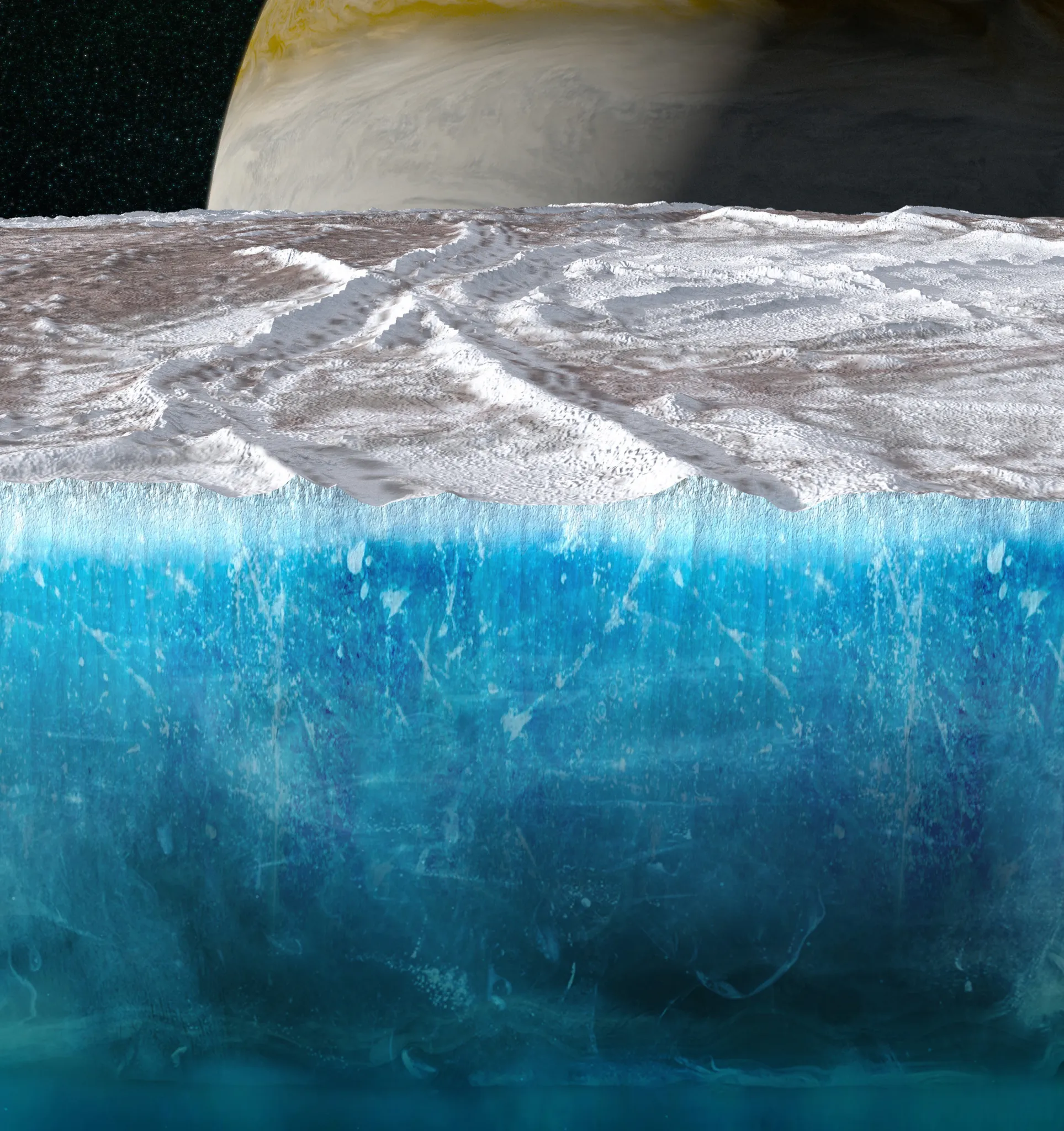
As models created by scientists show, the small size and depth of these formations indicate that they are unlikely to be a significant pathway for oxygen and nutrients to penetrate from the surface of Europa into its salty ocean.
“How thick the ice shell is and the existence of cracks or pores within the ice shell are part of the complex puzzle for understanding Europa’s potential habitability,” said Scott Bolton, principal investigator for the Juno project at the Southwest Research Institute in San Antonio. They will also be useful for the Europa Clipper and JUICE missions, which are currently on their way to Jupiter. Europa Clipper will arrive there in 2030, and JUICE a year later.
Earlier, we discussed how radioactive elements can support life in the ocean of Europa.
According to NASA

