

The Hubble Telescope has discovered the largest known protoplanetary disk. Its diameter is 40 times greater than that of the Solar System.
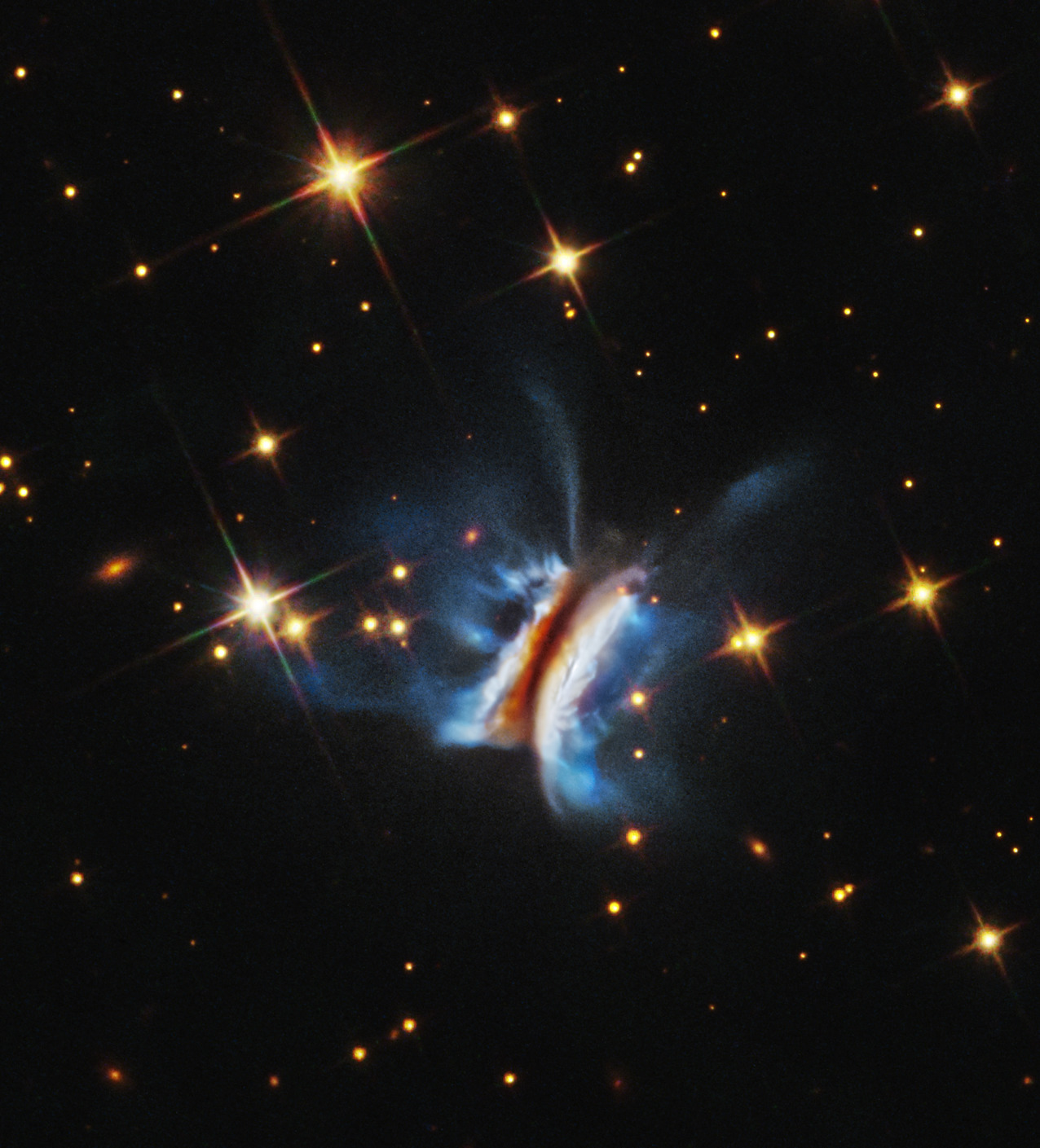
300 years ago, Immanuel Kant hypothesized that the planets in our solar system formed from a compacted disc of gas and dust. In our time, astronomers have discovered many “planetary nurseries” scattered throughout our galaxy. However, Hubble’s discovery stands out from the rest. The telescope managed to photograph the largest protoplanetary disk in the history of astronomy.
The protoplanetary disk IRAS 23077+6707 is located approximately 1,000 light-years from Earth. Its diameter is 640 billion kilometers. This is 40 times greater than the distance between the Sun and the Kuiper belt. The disk hides a young star, which, according to scientists, could be either a hot massive star or a pair of smaller stars.
The discovery has been jokingly nicknamed “Dracula’s Chivito,” reflecting the origins of the researchers – one is from Transylvania and the other from Uruguay, where the national dish is a sandwich called a chivito. The disc is turned edge-on to us and resembles a hamburger with a dark central band surrounded by glowing upper and lower layers of dust and gas.
The mysterious asymmetry
IRAS 23077+6707 is not only the largest protoplanetary disk known to us, but also one of the most unusual. Thanks to its orientation, we can see its structure in detail. The disk is unusually chaotic, with bright patches of material extending far above and below it.
The impressive size of these objects was not the only thing that caught the attention of scientists. New images showed that vertical thread-like objects appear only on one side of the disk, while the other side has a sharp edge and no visible threads. This strange, asymmetrical structure suggests that the disk is being shaped by dynamic processes such as recent dust and gas fallback or interaction with the surrounding environment.
All planetary systems form from discs of gas and dust surrounding young stars. Over time, the gas accretes onto the star, and the remaining material forms planets. IRAS 23077+6707 may be an enlarged version of our early solar system, with a disk mass estimated to be 10-30 times that of Jupiter – enough material to form several gas giants.
“In theory, IRAS 23077+6707 could host a vast planetary system,” said lead author Kristina Monsch. “While planet formation may differ in such massive environments, the underlying processes are likely similar. Right now, we have more questions than answers, but these new images are a starting point for understanding how planets form over time and in different environments.”
Provided by NASA

