

In 2024, an incredible event occurred. A star that scientists had previously considered stable suddenly dimmed almost completely for a period of time. Now astronomers believe that a brown dwarf or a planet with rings could have caused this event.
Mysterious eclipse of a star
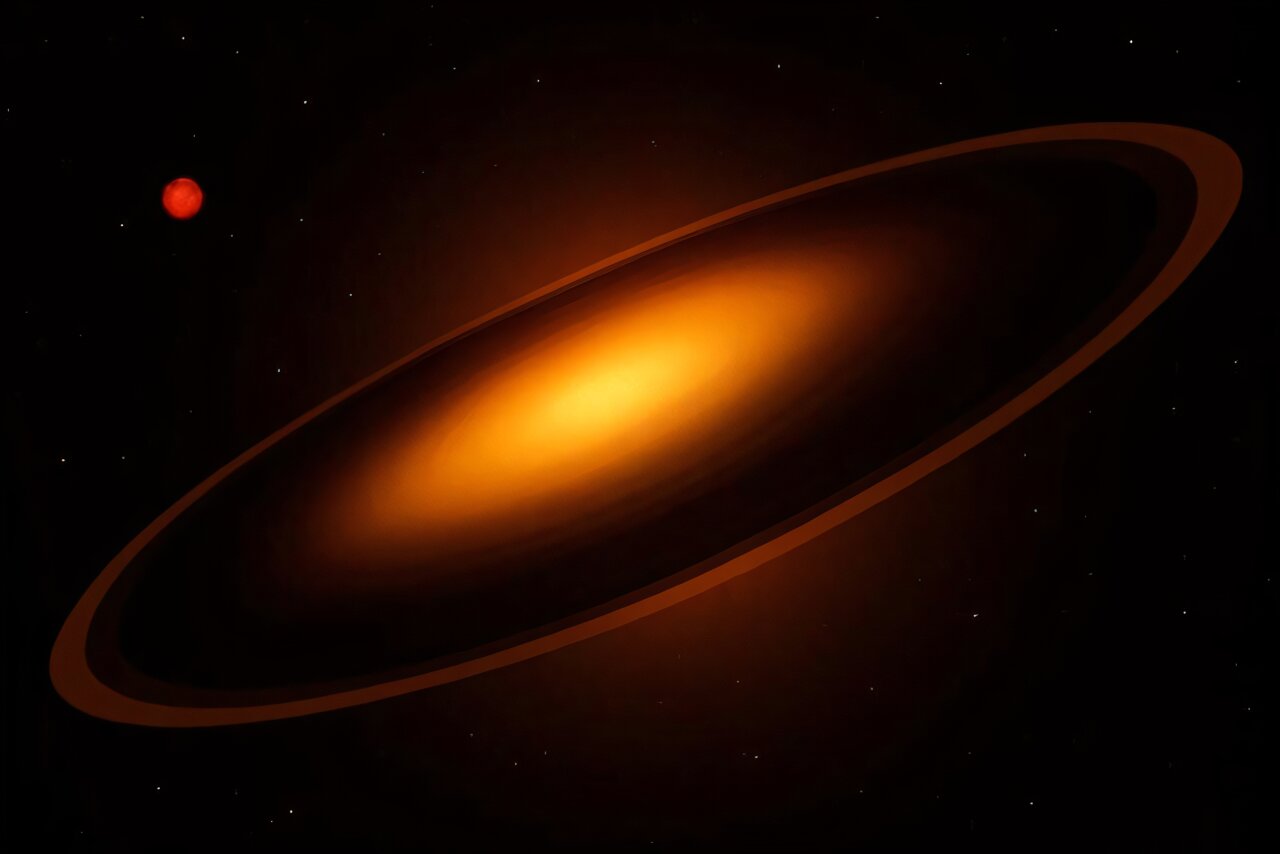
One of the longest stellar eclipses ever recorded was probably caused by huge saucer-like rings, either an invisible brown dwarf or a super-Jupiter, blocking the light. For decades, this star, located 3,200 light-years from Earth and about twice the size of our Sun, was considered stable, but at the end of 2024, it suddenly dimmed.
After that, the star remained dim for more than nine months — significantly longer than events of this type usually last. This surprised researchers and prompted them to seek an explanation for this “extremely rare” phenomenon.
Scientists believe that it was most likely a brown dwarf with rings similar to Saturn’s rings, which caused the ASASSN-24fw eclipse by approximately 97%. This ring system is so large that it extends approximately 0.17 astronomical units; this is comparable to half the distance between our Sun and Mercury.
Candidates for the role of dimming the star
Brown dwarfs are mysterious objects that are too large to be considered planets, but too small to be stars, as they lack the mass to continue fusing atoms and blossom into full-fledged suns.
Another object that could have caused the star to dim was a super-Jupiter — a massive gas giant exoplanet that exceeds Jupiter’s mass and fills the gap between brown dwarfs and planets.
Their discoveries provide insight into complex planetary structures beyond our Solar System, paving the way for new research into how planets and their rings may form and evolve around other stars.
Exceptionally long and rare event
Unlike typical eclipses, which usually last for days or weeks, this eclipse lasted for nearly 200 days, making it one of the longest ever recorded.
“Various models made by our group show that the most likely explanation for the dimming is a brown dwarf—an object heavier than a planet but lighter than a star—surrounded by a vast and dense ring system. It is orbiting the star at a farther distance with the ring,” said lead author Dr. Sarang Shah, a postdoctoral researcher at the Inter-University Centre for Astronomy and Astrophysics in Pune, India.
Long-lasting occultation events such as this are extremely rare because they require very precise positioning. The eclipse began gradually because the outer parts of the rings are thin, and only became noticeable when the denser parts passed in front of the star.
Tips from the star environment
Analysis of photometric and spectroscopic studies of the event indicates that the companion object has a mass more than three times greater than that of Jupiter.
ASASSN-24fw has a circumstellar environment (probably remnants of past or current planetary collisions) very close to it, which is unusual for a star of this age (probably more than 1 billion years old).
“Large ring systems are expected around massive objects, but they are very difficult to observe directly to determine their characteristics,” said Dr. Jonathan Marshall, an independent postdoctoral researcher at Academia Sinica, Taiwan. “This rare event allows us to study such a complex system in remarkable detail. In fact, while studying this dimming, we also serendipitously discovered that ASASSN-24fw also has a red dwarf star in its vicinity.”
Astronomers’ future plans
The research team now wants to measure the temperature, evolutionary state, chemical composition, and age of the dimmed star.
They hope to obtain more data using the European Southern Observatory’s Very Large Telescope in Chile and the James Webb Space Telescope to better understand the evolution of such systems and correlate it with theories of planet formation.
Researchers expect the star to dim again in about 42 or 43 years, at which time further analysis can be conducted to learn more about this fascinating system.
According to phys.org

