

Jupiter is the largest planet in our Solar System and has a vast number of moons orbiting it. Among this diverse family of celestial bodies, Ganymede stands out in particular. This moon is not only the largest one in our planetary system—surpassing even Mercury in size—but also a unique geophysical phenomenon. To date, it is the only moon known to science that is capable of generating its own magnetic field.
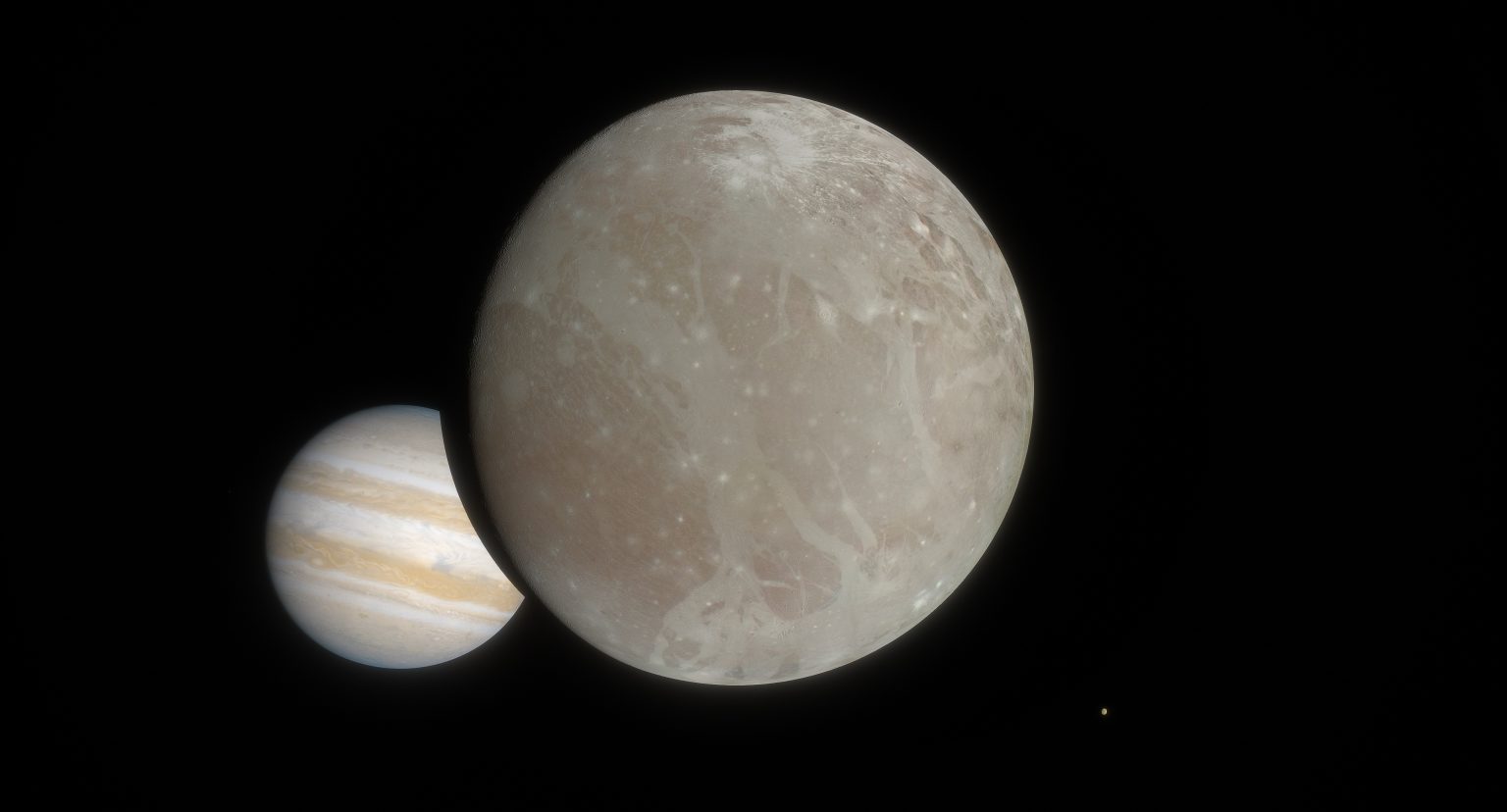
For decades, astrophysicists and planetary scientists have been groping in the dark, trying to explain the fundamental nature of this phenomenon. However, a team of researchers recently announced that they may have finally found the key to solving this problem. According to the findings of a new large-scale study published in the prestigious scientific journal Science Advances, the answer lies deep within the moon: Ganymede’s liquid metallic core is still actively forming right now. This continuous geological process is the primary source of energy for its magnetic field.
Magnetosphere under an impenetrable icy shell
In addition to its enormous size, Ganymede belongs to an extremely interesting category known as the “ice moons.” These celestial bodies are the focus of intense scientific interest due to the high probability that liquid oceans of water exist deep beneath their massive frozen crusts. However, when compared to other well-known ocean moons, such as Europa or Enceladus, Ganymede has one fundamental difference—it possesses a fully developed magnetosphere. This region of space, where the moon’s magnetic field is completely dominant, was first detected by the Galileo spacecraft back in 1996.
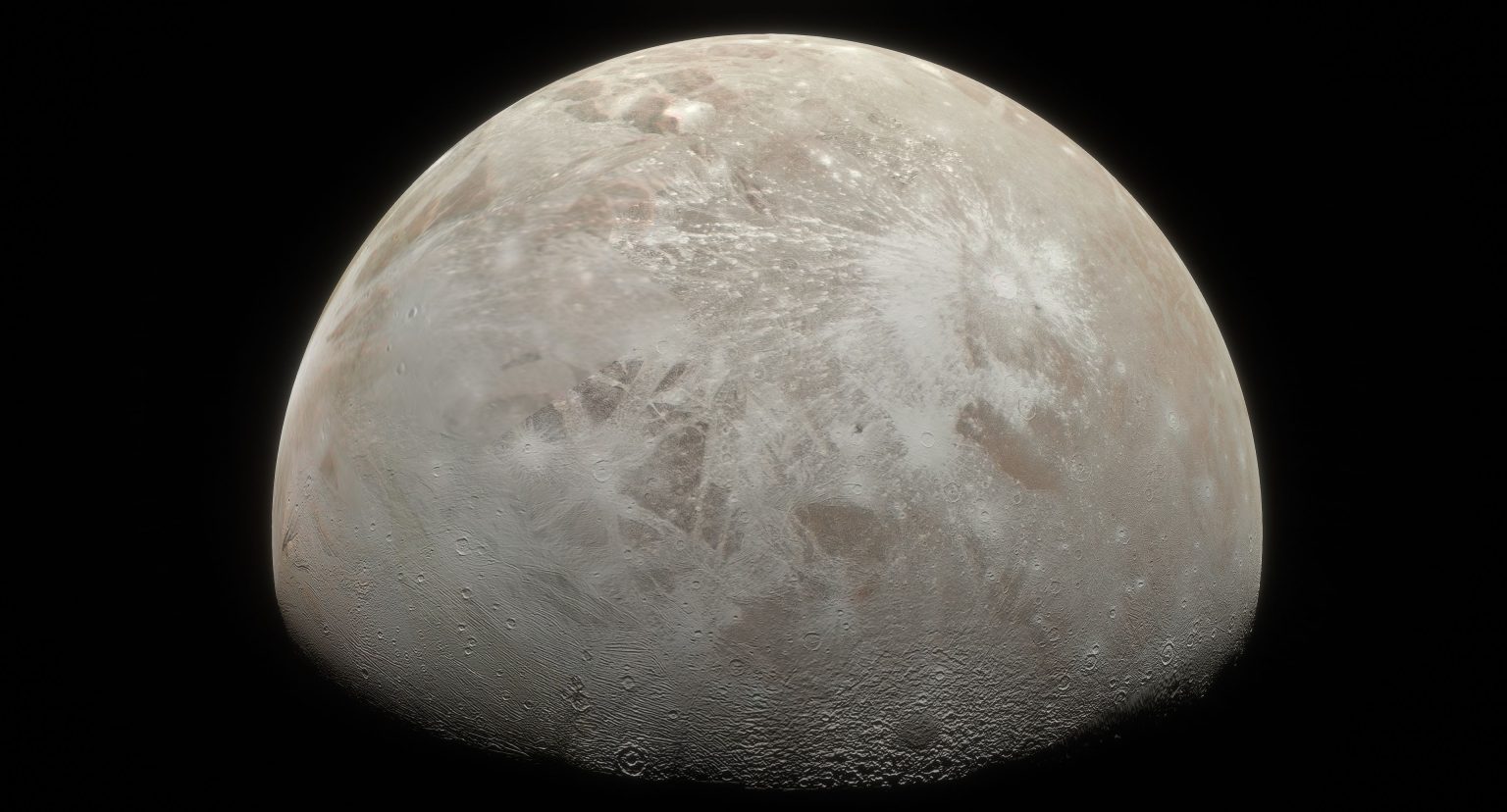
Since that historic moment, scientists have proposed numerous theoretical models in an attempt to explain in detail the nature of Ganymede’s dynamo—the internal geophysical mechanism responsible for generating the magnetic field. Most of these hypotheses, in one way or another, boiled down to complex turbulent motions within the metal core. However, as the authors of the new study point out, all of these classical theories were based on assumptions about Ganymede’s initial state that were too contradictory.
Cold Start Paradox
Kevin Trinh, the study’s lead author and a planetary scientist at the California Institute of Technology (Caltech), notes: “The internal dynamo mechanism is one of the few unique tools that allow us to, as it were, ‘peek’ into the dark depths of a celestial body simply by analyzing remote data from spacecraft.” “Take Callisto, for example. In terms of size and average density, this moon is extremely similar to Ganymede. However, it shows no obvious signs of an active magnetic dynamo. Why are these two worlds so different?”
The traditional view was that Ganymede’s core formed about 4.5 billion years ago, almost simultaneously with the moon’s formation—much as it did on Earth. But Trinh, who began this work while at Arizona State University (ASU), points out a logical inconsistency: most of the data suggests that Ganymede formed in an environment that was too cold for it to have had a molten metallic core from the very beginning. These two theories simply cannot coexist.
Resolving the contradiction
To resolve this paradox, Trinh’s team decided to model Ganymede’s geological evolution based on the “cold start” concept, rather than inputting a pre-existing, 4.5-billion-year-old hot core into the program. If the classical models were correct, this would mean that Ganymede’s core is simply cooling down gradually today. Consequently, once it finally freezes and turns into a solid monolith, the cosmic dynamo will shut down for good.
Instead, the latest computer simulations have revealed a completely different, previously unknown scenario. It turns out that the generation of a magnetic field is not necessarily a consequence of the operation of a continuously cooling reservoir. According to a new theory, a slow and large-scale geological process is still underway inside Ganymede: molten iron is gradually migrating toward the moon’s core. It is precisely this dynamic process of heavy-metal sinking that stirs up the interior and generates powerful convective currents that power the electromagnetic field. This discovery is perfectly consistent with the hypothesis of a cold start to Ganymede’s existence.
New challenges and missions for the future
The researchers emphasize that their work does not definitively refute previous models. Since we cannot physically turn back the cosmic clock by billions of years, the possibility remains that the moon was born with a metallic core. Nevertheless, the new modeling offers a much more comprehensive and logical interpretation of current lunar observations.
Moreover, this concept is prompting scientists to take a fresh look at other large icy moons, such as Europa and Callisto. Why were they unable to generate their own internal dynamo? Did one exist in their distant past? The answers to these questions are key to understanding the evolutionary trajectories of the worlds in our solar system.
Fortunately, humanity won’t have to wait too long. If all goes according to plan, NASA’s Europa Clipper and ESA’s Juice probe will deliver an unprecedented amount of new data on the Jovian system in the coming years, which will help confirm or refute these fascinating hypotheses.
We previously reported on how auroras were detected on Jupiter’s Galilean moons.
According to caltech.edu

