

The Subaru telescope has discovered a previously unknown object beyond Pluto’s orbit. Its existence may challenge the hypothesis of the existence of the Ninth Planet.
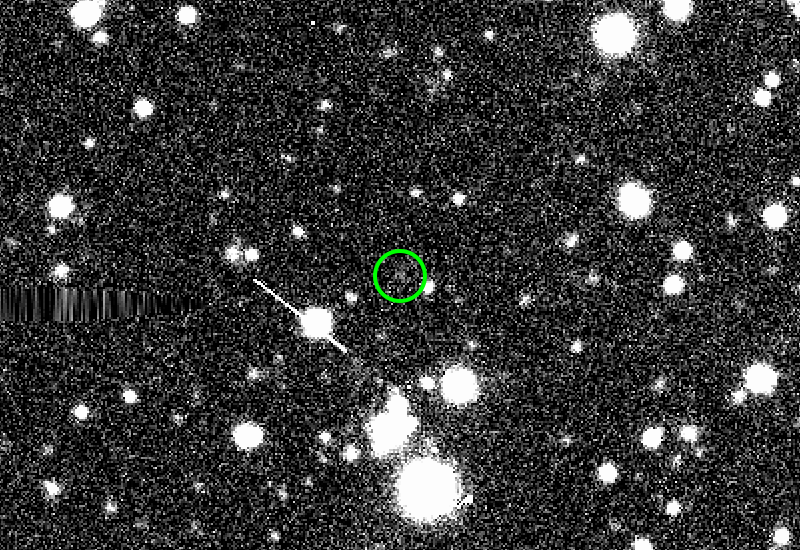
The discovery was made as part of the FOSSIL research project during observations conducted by the Subaru telescope in March, May, and August 2023. Follow-up observations in July 2024 using the Canada-France-Hawaii Telescope and analysis of old archival data allowed astronomers to track the orbit of the celestial body over a period of 19 years.
The object has been given the provisional designation 2023 KQ14 and the unofficial nickname “Ammonite.” Its diameter is estimated at 220–380 km, and its orbital period is 3,998 years. 2023 KQ14 moves in a highly elongated orbit, approaching the Sun at perihelion at 66 AU (more than twice as far as Neptune) and moving away from it at aphelion at 438 AU. Due to the peculiarities of its orbit, it was classified as a “sednoid,” making it only the fourth known example of this very rare type of celestial body. They were named after the trans-Neptunian object Sedna, which has very unusual orbital characteristics.
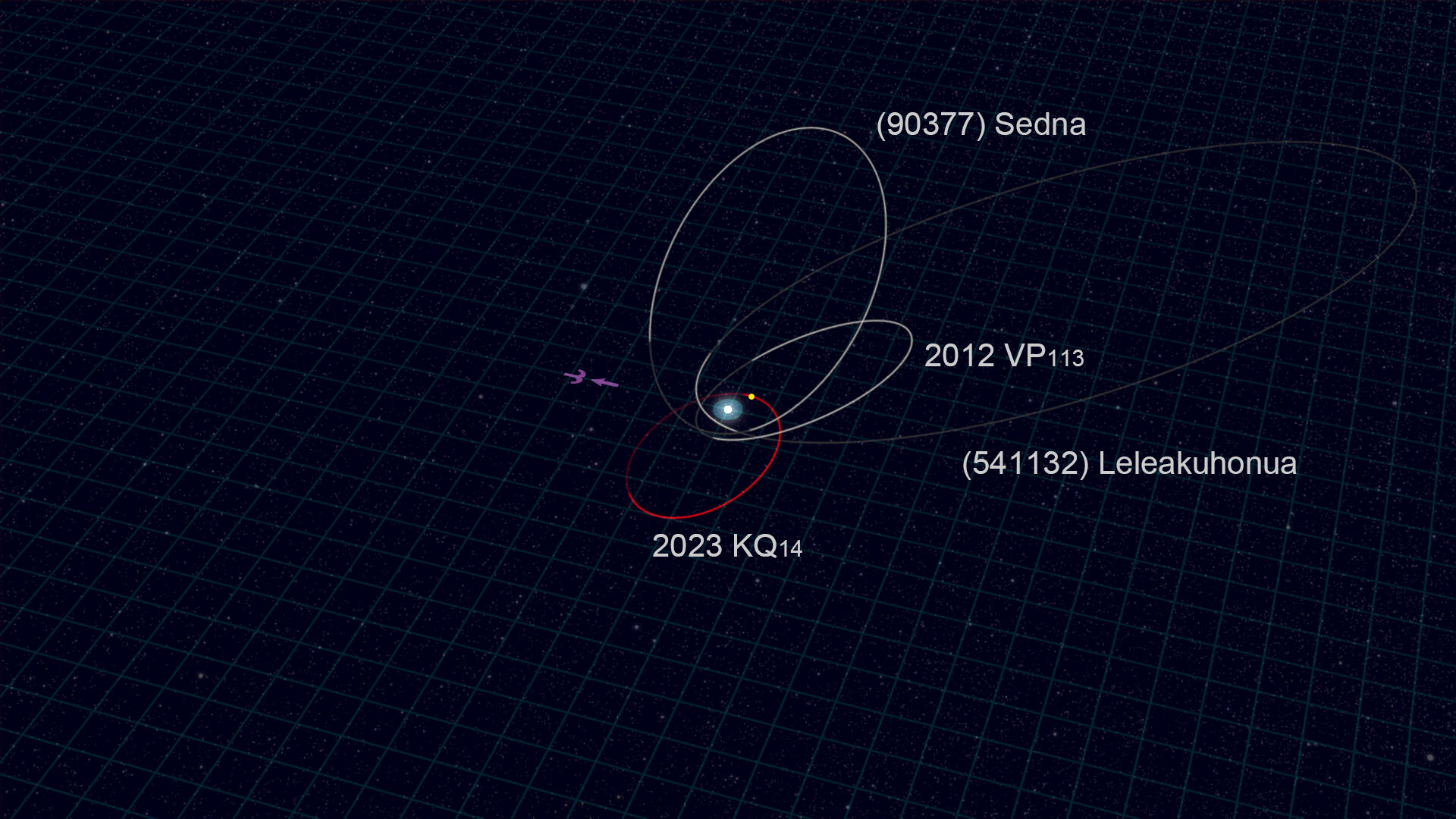
The discovery plays an important role in our understanding of the past of the Solar System. Although the current orbit of 2023 KQ14 differs from the orbits of other sednoids, simulations show that about 4.2 billion years ago, their orbits were remarkably similar. It then moved to its current orbit, where it remains to this day. This indicates that the outer part of the Solar System is more diverse and complex than previously thought. The discovery of 2023 KQ14 also imposes new constraints on the hypothetical Ninth Planet. If it exists, its orbit must lie farther out than is typically predicted.
According to Dr. Yukun Huang of the National Astronomical Observatory of Japan, the fact that the current orbit of 2023 KQ14 does not coincide with the orbits of the other three known sednoids reduces the likelihood of the Ninth Planet hypothesis. Perhaps there was once another planet in the Solar System, but it was later ejected, leading to the unusual orbits we see today.
Another participant in the study, Dr. Fumi Yoshida, stated the following: “2023 KQ14 was found in a region far away where Neptune’s gravity has little influence. The presence of objects with elongated orbits and large perihelion distances in this area implies that something extraordinary occurred during the ancient era when 2023 KQ14 formed”.
Scientists hope that in the future they will be able to find other sednoids. Studying the evolution of the orbits and physical properties of these distant objects is crucial to understanding the entire history of the Solar System.
According to Phys.org

