

The Hubble Space Telescope has recorded a collision between two objects, which may be planetesimals, in the Fomalhaut star system. This is a star that is relatively close to us, surrounded by an extremely powerful debris disk. Planets have been found there before, but they later disappeared.
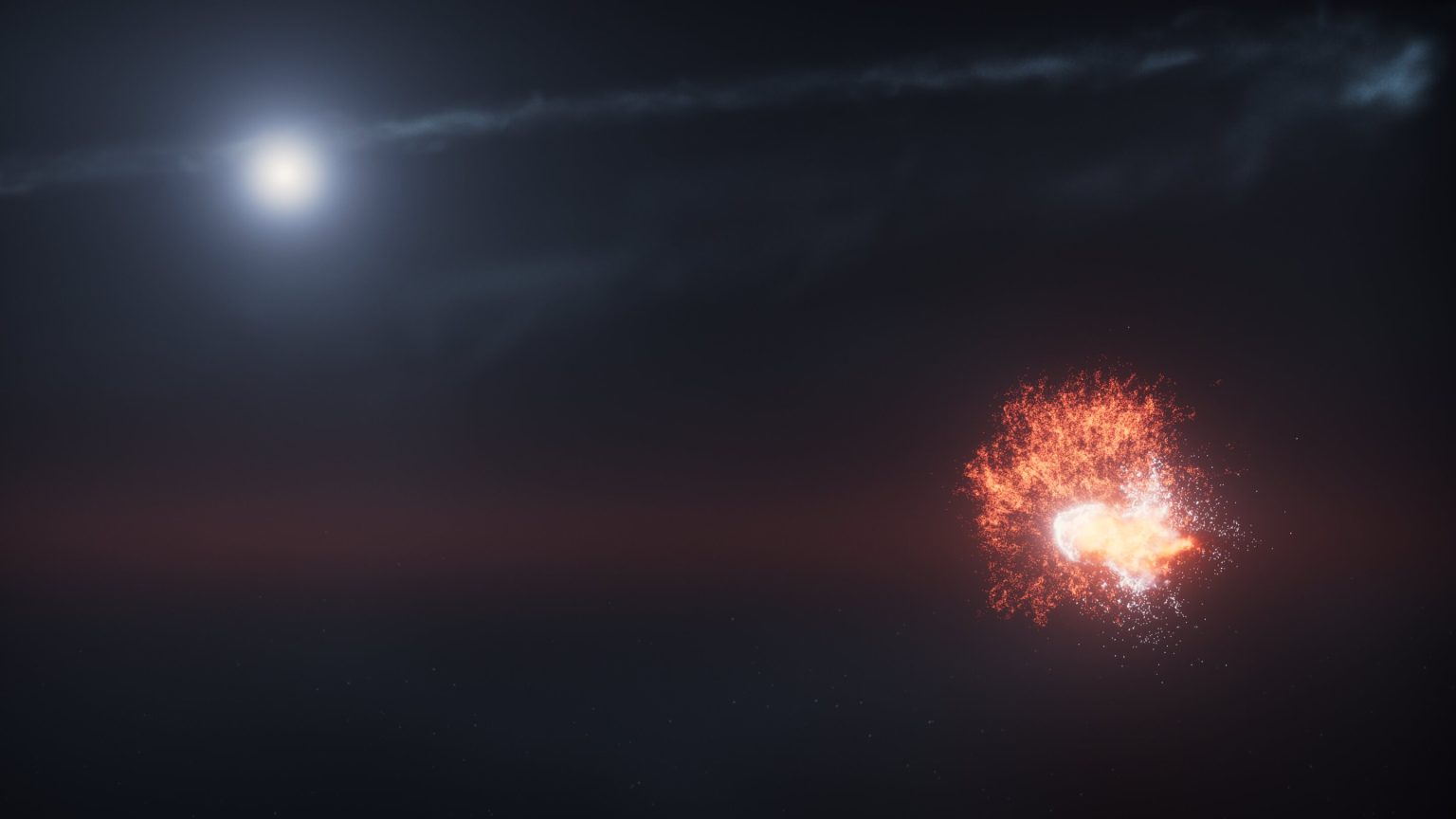
Collision in the Fomalhaut system
Fomalhaut is not only a bright star in the Earth’s sky, but also a system close enough to us that the Hubble Space Telescope recently made an interesting discovery there. An article published in the journal Science states that two space objects collided there.
When researchers first saw a bright spot near the star, they initially thought it was an exoplanet, or that a supernova had exploded somewhere far behind it. But then they saw the object grow larger, yet dimmer, and realized they were dealing with a cloud of debris formed by the collision of two celestial bodies.
Fomalhaut is surrounded by one of the most powerful debris disks known to scientists. It can be said that star formation is still ongoing there. It is not surprising that when a point appeared in the middle of this disk that had not been there before, everyone thought of a collision of planetesimals. This is the name given to the primary rocky bodies from which planets are then formed. Their collisions should play an important role in the birth of new worlds.
Fomalhaut
This whole story about collisions is very important for understanding what is happening in the Fomalhaut system. There is an old mystery called “Fomalhaut b.” This is the name given to the planet found in images taken in 2008. And then it looked as if a newborn gas giant was making its way through the protoplanetary disk.
But later, the planet disappeared, and scientists suggested that the spot was actually just a cloud of dust. Then Fomalhaut b was discovered, but in a different location, and everything became completely confusing. Now it is becoming clear that these were all traces of collisions between planetesimals.
And it seems like the mystery is disappearing, but new questions arise. According to scientists’ calculations, collisions should occur once every several tens of thousands of years. But in the Fomalhaut system, they occur once every decade.
The reason for this is unclear. But scientists believe that future research, including with the help of NIRCam, the main infrared camera of the James Webb Telescope, may help to shed light on this.
According to phys.org

