

The European Space Agency (ESA) has published an interesting image taken by the Mars Express spacecraft. It shows a very unusual crater, whose structure resembles a butterfly.

Usually, in a collision that causes a crater to form, material will be ejected in all directions. However, this is not always the case. In the case of the butterfly crater, the space rock fell at a low, shallow angle, resulting in the interesting and unusual shapes that can be seen in the Mars Express image.
As a result of the collision, two separate sections of material were ejected north and south of the crater, creating two elongated “wings” of raised ground. The “wings” of this unique butterfly crater are rather vague and irregular, but they can be seen in the lower left and upper right parts of the main crater, which resembles a walnut. It has an atypical oval shape and measures 15 by 20 km.
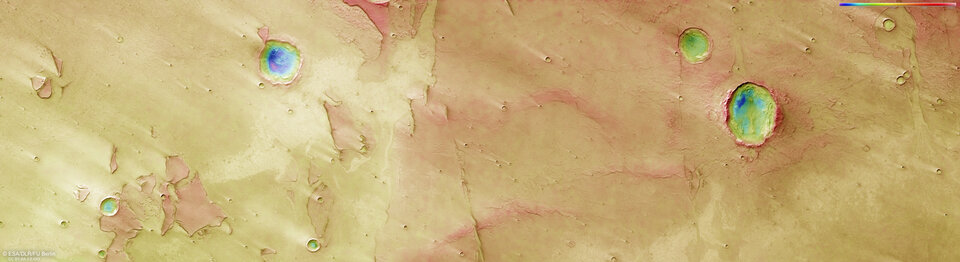
Some of the debris forming the wings (mainly visible just above the crater) also appears smoother and more rounded, almost resembling a mudflow. This indicates that it mixed with water or ice from beneath the surface of Mars, which melted during the impact.
The butterfly crater is far from the only interesting feature of this place. The rest of the frame is mostly flat, drawing attention to a group of steep, flat-topped rock formations known as mesas. The higher areas of land here have been gradually eroded away, and the remaining hills are those that have managed to withstand erosion over time.
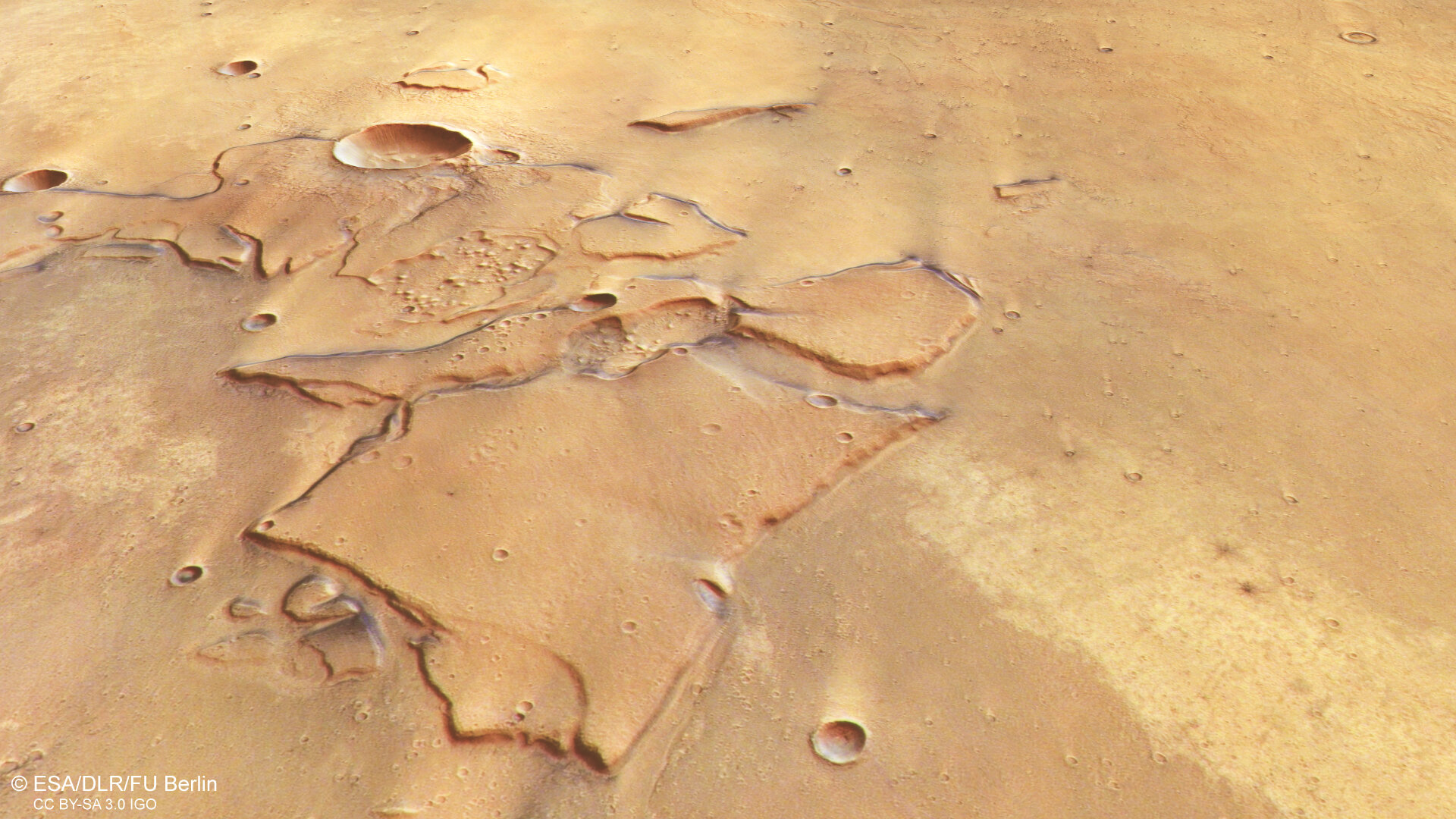
The mesas stand out sharply against the brownish surroundings thanks to layers of exposed dark material at their edges. As on Earth, it is probably rich in magnesium and iron and was formed by eruptions. In the past, this region experienced fairly powerful volcanic activity, resulting in the accumulation of lava and ash deposits over time, which were buried by other materials.
Signs of lava can be seen in the form of “wrinkled ridges”: folded patterns that formed when lava flows cooled and contracted, causing the surface to crumple.
Earlier, we reported on how mysterious rocks revealed the history of Mars’ tropical climate.
According to ESA

