

Recently, scientists used the Atacama Millimeter Array to obtain the most detailed images ever taken of the center of the Milky Way. It demonstrates how chaotic and dusty this region is.
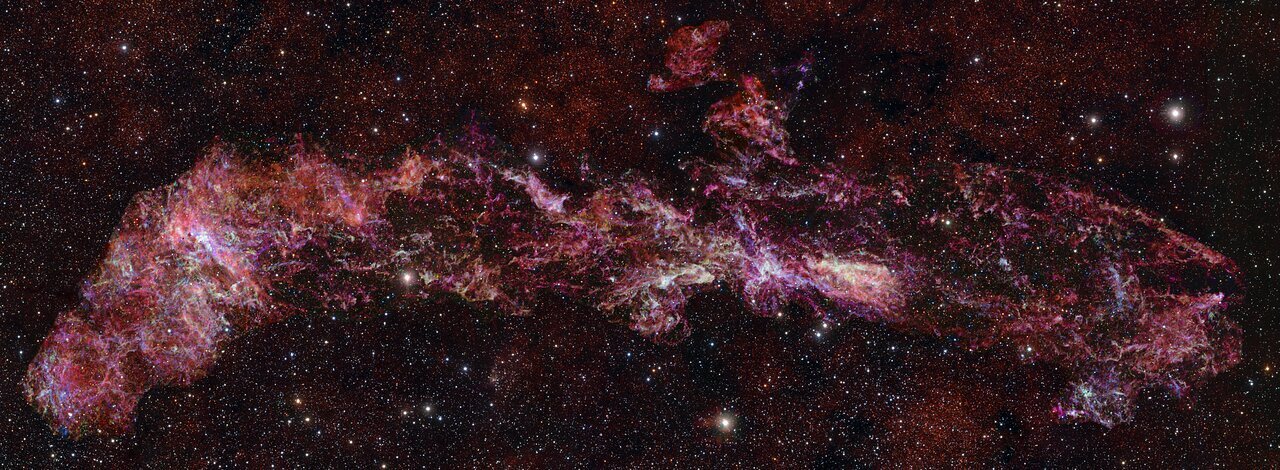
The central part of the Milky Way
Astronomers have captured the central part of our Milky Way galaxy in a stunning new image that reveals a complex network of cosmic gas filaments in unprecedented detail. Obtained using the Atacama Large Millimeter/submillimeter Array (ALMA), this rich dataset — the largest ALMA image to date — will allow astronomers to explore the lives of stars in the most extreme region of our galaxy, near the supermassive black hole at its center.
This region was hidden from our eyes for a long time, but now it has been revealed in extraordinary detail.
The observations provide unique insights into cold gas — the raw material from which stars form — in the so-called Central Molecular Zone (CMZ) of our galaxy. For the first time, cold gas throughout this region is being studied in such detail.
Study of molecular gas in the galactic core
The region depicted in the new image spans more than 650 light-years. It contains dense clouds of gas and dust surrounding a supermassive black hole at the center of our galaxy.
“It’s a place of extremes, invisible to our eyes, but now revealed in extraordinary detail,” says Ashley Barnes, an astronomer at the European Southern Observatory (ESO) in Germany. The dataset reveals the CMZ like never before, from gas structures spanning tens of light-years to small gas clouds around individual stars.
The gas specifically studied by ACES (ALMA CMZ Exploration Survey) is cold molecular gas. The study reveals the complex chemistry of the Central Molecular Zone, detecting dozens of different molecules, from simple ones such as silicon monoxide to more complex organic ones such as methanol, acetone, or ethanol.
Cold molecular gas flows along filaments that feed clumps of matter from which stars can form. In the vicinity of the Milky Way, we know how this process occurs, but in the central region, events are much more extreme.
How are stars born in the center of the Milky Way?
As scientists note, CMZ contains some of the most massive stars known in our galaxy, many of which live fast and die young, ending their lives with powerful supernova and even hypernova explosions. With the help of ACES, astronomers hope to better understand how these phenomena affect star formation and whether our theories about star formation in extreme conditions are correct.
“By studying how stars are born in the CMZ, we can also gain a clearer picture of how galaxies grew and evolved,” says ACES leader Steve Longmore, professor of astrophysics at Liverpool John Moores University in the UK. “We believe the region shares many features with galaxies in the early universe, where stars were forming in chaotic, extreme environments.”
Space puzzle
To collect the new data set, astronomers used ALMA, which is operated by ESO and partners in Chile’s Atacama Desert. In fact, this is the first time that such a large area has been scanned using this setup, making this image the largest ALMA image in history.
The mosaic in the sky, created by combining many individual observations, like putting together a puzzle, has a length equal to three full moons placed side by side.
“We anticipated a high level of detail when designing the survey, but we were genuinely surprised by the complexity and richness revealed in the final mosaic,” says Katharina Immer, an ALMA astronomer at ESO who is also involved in the project.
“The upcoming ALMA Wideband Sensitivity Upgrade, along with ESO’s Extremely Large Telescope, will soon allow us to push even deeper into this region—resolving finer structures, tracing more complex chemistry, and exploring the interplay between stars, gas and black holes with unprecedented clarity,” says Barnes.
According to phys.org

