

On the night of February 24-25, US President Donald Trump made history by giving the longest speech on the state of the nation — it lasted 107 minutes. The main topics were economic successes, criticism of the Democrats, and the fight against illegal immigration. However, amid the political statements, an event worthy of special attention has been overlooked: the country is preparing to send a human into deep space for the first time since the legendary Apollo program.
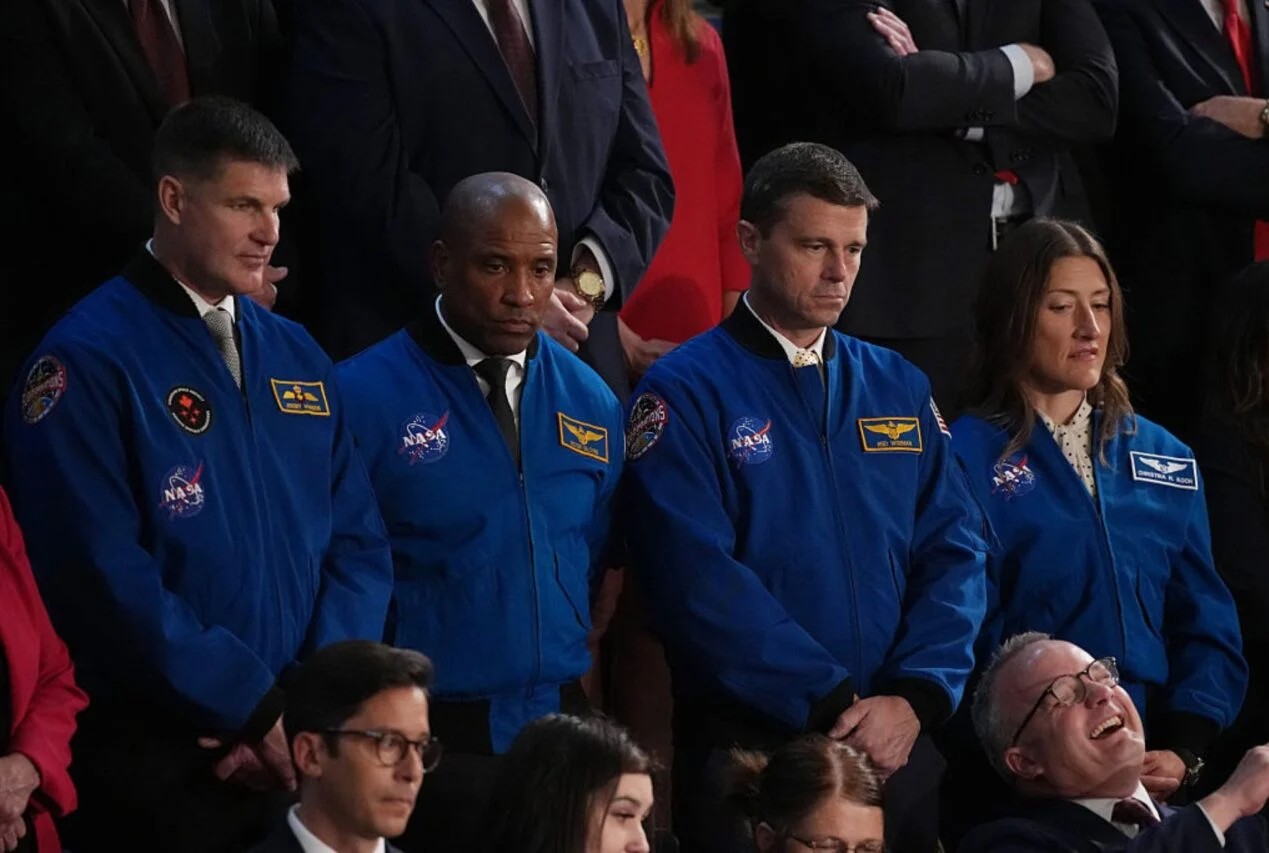
The most ironic thing is that the main characters of the upcoming space breakthrough went unnoticed, even though they were sitting in the front row. The astronauts of the Artemis II mission — Reid Wiseman, Victor Glover, Christina Koch from NASA, and Jeremy Hansen from the Canadian Space Agency — were guests of honor of the Speaker of the House of Representatives. These four brave souls are about to embark on a journey to the Moon that no human being has undertaken in more than fifty years.
Their 10-day flight will be more than just a symbolic gesture. This will be the farthest human expedition in the history of space exploration, taking the Orion spacecraft into orbit around our natural satellite.
The Trump administration’s vision
The Artemis II mission is intended to lay the foundation for a “golden age of American space leadership” — a phrase that the Trump administration uses quite often. However, the president limited himself to brief references to Apollo’s glorious past and boastful statements about the creation of the US Space Force, proudly calling it “his brainchild.”
However, the significance of Artemis II extends far beyond political ambitions. This is a critically important test phase: for the first time, the super-heavy Space Launch System (SLS) rocket and the Orion spacecraft will be tested with a crew on board. The success of the mission should confirm the US’s ability not only to return to the Moon, but also to make long-term plans for expeditions to Mars.
Space race gains momentum
The importance of the program is reinforced by the international context. China is actively developing its own manned lunar program, adding an element of healthy competition and urgency to American efforts. Maintaining NASA’s technological supremacy is not only a matter of prestige, but also of national security and scientific leadership.
However, despite its historical context and geopolitical significance, the mission faces an unexpected enemy — public indifference. Even among space enthusiasts, interest is beginning to wane due to technical problems. It was recently announced that SLS and Orion are returning to the hangar, postponing the likely launch until at least April.
A missed opportunity to unite the nation
The problem of lack of attention is not just a matter of NASA’s “public relations.” Without broad public support, multi-billion-dollar space programs become vulnerable targets for budget cuts. Trump had a unique opportunity to draw the attention of a 300 million-strong audience to the titanic feat that his compatriots are preparing to accomplish for the first time in half a century. He could present the astronauts sitting in the hall and explain the significance of their mission for the future of humanity.
Instead, time was spent on political tirades. By failing to seize this opportunity, the president did more than simply ignore an important event — he dealt a blow to his own space policy, depriving it of potential public support at a time when it needs it most.
Earlier, we reported on whether Trump is hiding something about aliens.
According to Gizmodo

