

To date, humanity has discovered more than 6,000 planets outside our Solar System. Amid this incredible variety of giants and dwarfs, a group of astronomers decided to weed out the “unwanted” ones and compile a list of objects that have the best chance of becoming home to living organisms.
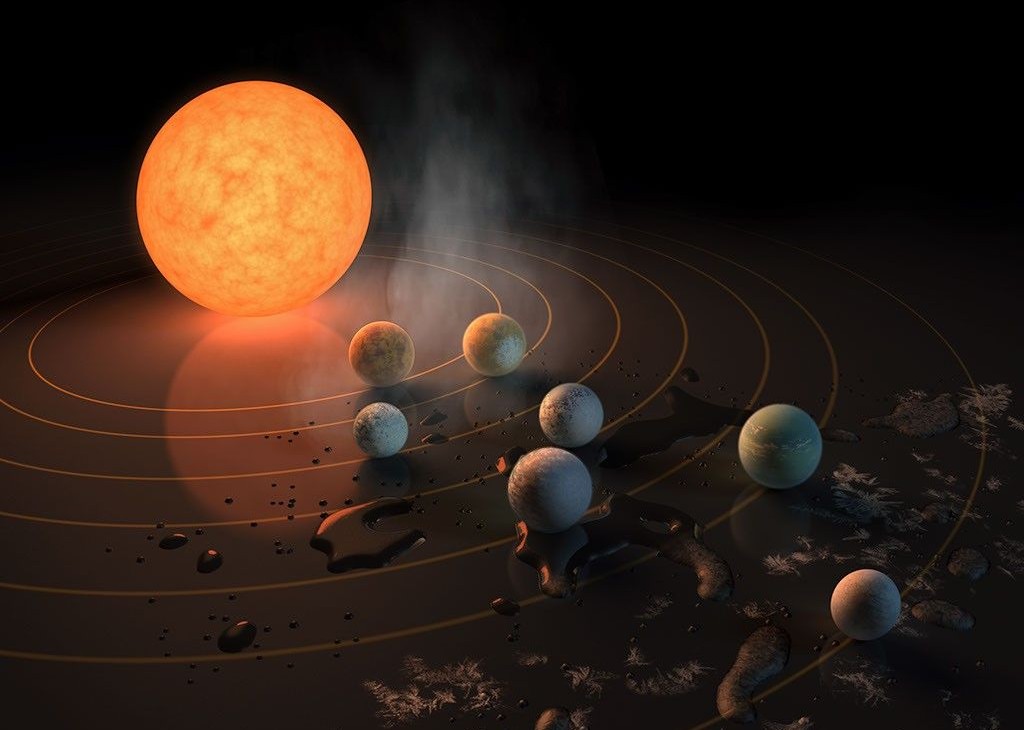
A new study published in the journal Monthly Notices of the Royal Astronomical Society identifies 45 rocky worlds. All of them are located within the so-called habitable zone, which makes the presence of liquid water on their surfaces a distinct possibility.
“Deciding exactly where to point our telescopes is the first and most important step. Our project tells astronomers, ‘Here are the best objects to observe,’” explains Gillis Lowry, a co-author of the study from the University of San Francisco.
Secret of the “Goldilocks” zone
Since we know of only one planet that supports life—Earth—the search is based on Earth-like parameters. The main criterion is being within the “Goldilocks zone,” or “habitable zone.” It’s a region around a star where it’s not too hot for water to evaporate, and not too cold for it to turn into eternal ice.
To compile the list, the scientists analyzed data from the European Gaia telescope and NASA’s exoplanet archive. They searched for worlds not only rocky, but also ones that receive roughly the same amount of energy from their star as Earth does from the Sun.
Race favorites
The scientists paid particular attention to the TRAPPIST-1 system, located 40 light-years away from us. Seven planets orbit this red dwarf, and four of them have been officially included in the list of top candidates.
Another star on the list is LHS 1140 b. It is a “super-Earth” located 48 light-years away from us. The latest data from the James Webb Space Telescope suggest that this planet may be a true water world with a nitrogen atmosphere, making it arguably the most promising candidate for the search for biosignatures. The list also includes Earth’s well-known “twins”: Proxima Centauri b, Kepler 186f, and the recently discovered TOI-715 b.
A life we know nothing about
The researchers went beyond conventional wisdom and identified 24 candidates in the so-called “narrow 3D zone.” These are planets with unusual, highly elongated elliptical orbits. These worlds pose a real challenge to science. As they orbit the star, they move in and out of the habitable zone.
- Can a planet retain water if it periodically “heats up” or “freezes”?
- What degree of orbital curvature can life withstand?
The answers to these questions will help scientists understand the limits of nature’s resilience. “Observing these extreme planets will help us understand exactly when habitability is lost and what the critical energy threshold is,” notes Abigail Bohl of Cornell University.
Now, armed with this shortlist, astronomers around the world will be able to use humanity’s most powerful tools to finally find the answer to the question: Are we alone in the Universe?
Earlier, we reported on the most suitable exoplanet for human life.
According to Gizmodo

