

Carbon monoxide CO is an important element present on many celestial bodies. Until recently, it could not be detected, but now scientists have the ability to do so.
Molecular hydrogen clouds
An international team of astronomers has created the first-ever large-scale maps of a mysterious form of matter known as CO-dark molecular gas in one of the Milky Way’s most active star-forming regions, Cygnus X. Their findings were obtained using the Green Bank Telescope (GBT) in the Milky Way.
For decades, scientists have known that most new stars are born inside clouds of cold molecular hydrogen. Most of this molecular hydrogen is invisible to most telescopes — it does not emit light that can be easily detected.
Traditionally, astronomers have searched for these clouds by looking for carbon monoxide (CO), a molecule that acts as a flashing sign for regions where stars are forming. However, it turns out that there is a lot of gas from which non-luminous stars form in CO. This dark, hidden material (called CO-dark molecular gas) was one of the most blind spots in astronomy.
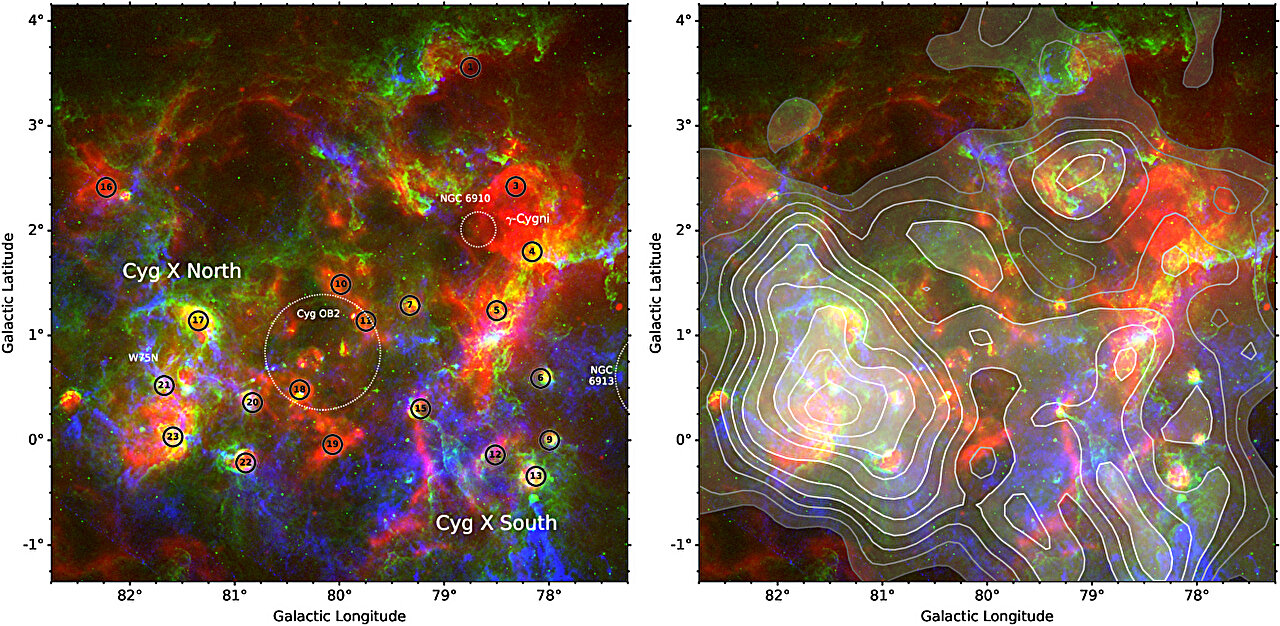
Map of Cygnus X region with hidden interstellar gas
Now, for the first time, astronomers have mapped this hidden gas across a vast area of sky—more than 100 times the area covered by a full moon—by observing radio spectral lines from atomic recombination, known as Carbon Radio Recombination Lines (CRRL). The team’s map covers the bustling region of Cygnus X, a cosmic metropolis located about 5,000 light-years away and teeming with newborn stars.
The new map reveals a vast network of arcs, ridges, and a web of dark gas permeating Cygnus X. These shapes indicate where material for star formation collects and grows before it becomes visible as CO in molecular clouds. Research shows that these weak carbon signals, detected at very low radio frequencies, are a very powerful tool for detecting hidden gas that directly links ordinary matter to the formation of new stars.
Movement of matter in our galaxy
Researchers have discovered that this dark gas is not simply stationary; it flows and shifts, moving at speeds much higher than previously thought. These turbulent flows may influence the rate of star formation. The team also found that the brightness of these carbon lines is directly related to the intense starlight illuminating the region, highlighting the important role of radiation in the galactic recycling cycle.
“By making the invisible visible, we can finally track how raw materials in our galaxy transform from simple atoms into complex molecular structures that will one day become stars, planets, and perhaps life,” explains Kimberly Emig, a research scientist at the National Radio Astronomy Observatory (NRAO).
The GBT has become the world’s leading instrument for this type of research, and even larger CRRL studies (such as the GBT Diffuse Ionized Gas Survey at Low Frequencies) are already underway to study other star-forming regions of the Milky Way. The data obtained will help astronomers around the world model how our galaxy, and possibly others, form massive clouds in which stars are born.
According to phys.org

