

A team of European astronomers has confirmed a long-standing hypothesis that massive “runaway stars” were once part of binary systems and were ejected as a result of their companion’s explosion. They managed to link such a star with the remnant of a supernova.
While most stars, including our Sun, move relative to their neighbors at low speeds, “runaway stars” race through interstellar space at speeds ranging from tens to hundreds of kilometers per second. Astronomers know that a lot of these objects were part of dense clusters in the past and then got kicked out by the gravity of their neighbors. However, this mechanism has difficulty explaining the origin of the most massive runaway stars, which are difficult to accelerate to high speeds in this way.
In 1961, Dutch astronomer Adriaan Blaauw proposed an alternative idea: massive runaway stars were once part of a binary system and were ejected when their companion collapsed, accompanied by a supernova explosion.
Decades later, support for Blaauw’s theory emerged in the form of the star HD 37424. With a mass between 12 and 13 times that of the Sun, it is located within the Jellyfish Nebula, which is the remnant of a supernova.
The discovery was made while studying data collected by the Gaia mission, which accurately measured the position and direction of movement of a huge number of stars in the Milky Way. In addition, astronomers analyzed spectroscopic data on runaway stars, which reveal information about their temperature, composition, and evolutionary state.
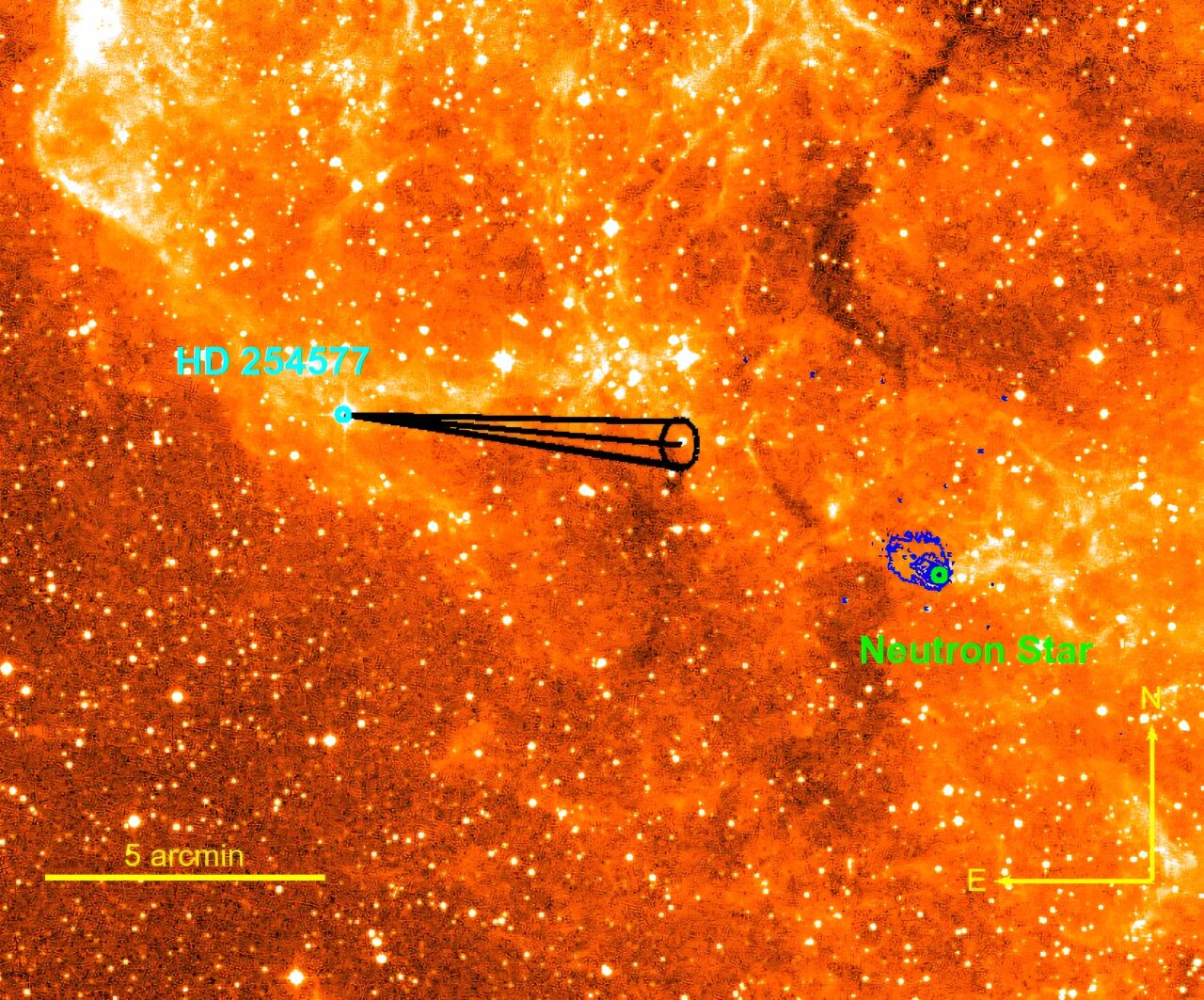
One candidate stood out in particular: HD 254577. Combined observations showed that it is a massive, highly evolved star that is no longer part of a binary pair, consistent with the assumption that it once coexisted with a similar companion, meeting the criteria for a progenitor star of a supernova.
The team then used modeling techniques to reconstruct the flight path of HD 254577. They confirmed its connection to the IC 443 nebula, also known as the Jellyfish Nebula, which is the remnant of a supernova. According to the scientists’ calculations, HD 254577 was ejected into space between 10,000 and 30,000 years ago.
The results of the study show that the true center of the supernova remnant explosion may be far from its geometric center, as IC 443 expands asymmetrically through dense molecular clouds. They also indicate that the exploded star had a very large mass, exceeding the mass of the Sun by 30 times. This discovery may help in the search for other massive runaway stars and allow astronomers to trace their origins back to the remnants of their former companions.
Earlier, we reported on how the star concealed its true age from astronomers.
According to Phys.org

