

The National Optical Astronomy Observatory (NOIRLab) has reported on the results of its study of the longest gamma-ray burst in history. Thanks to observations from several telescopes, astronomers were able to obtain important information about its origin.
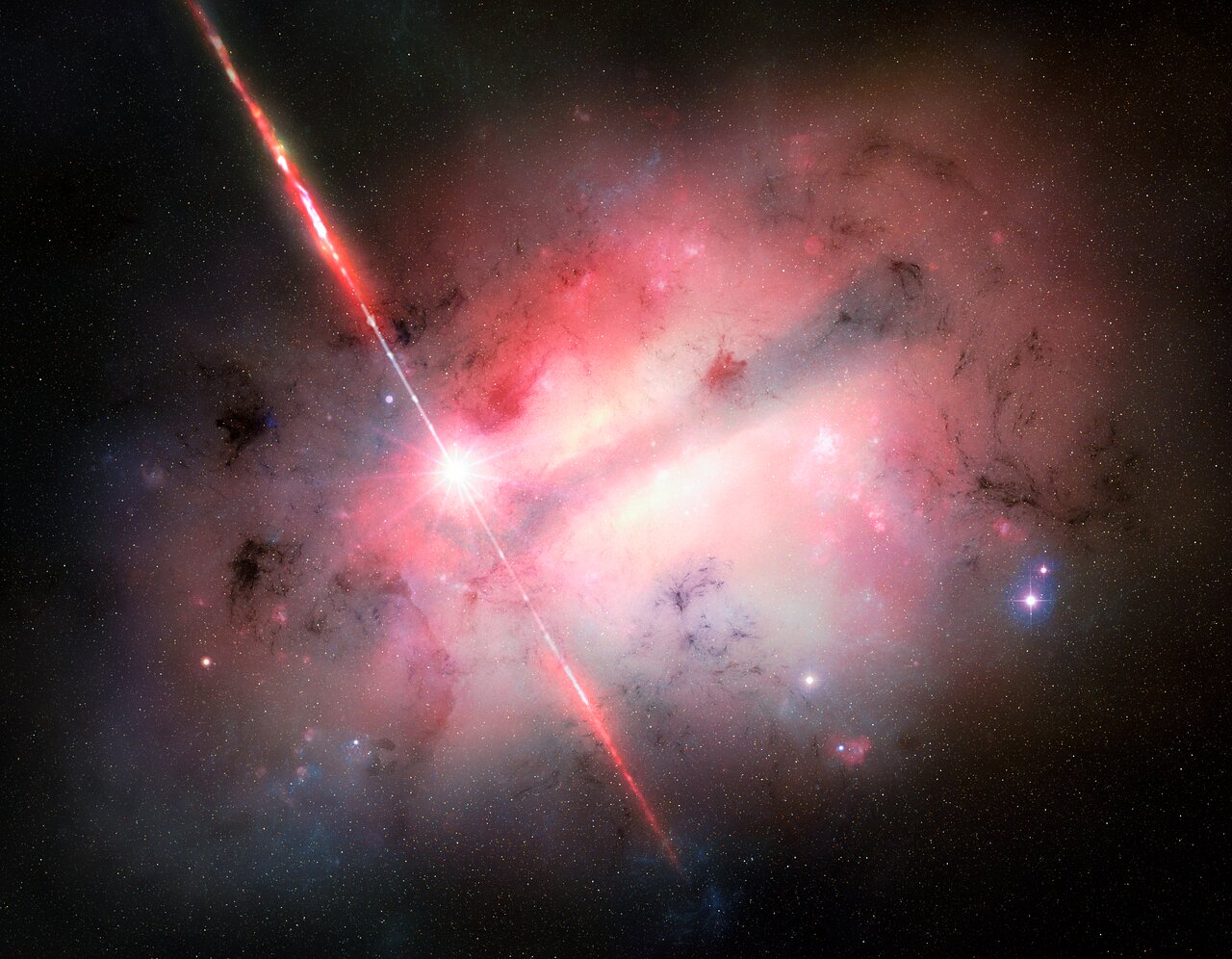
Gamma-ray bursts are among the most powerful events in the Universe, second only to the Big Bang in terms of energy. Most of them are observed as flashes that fade away within a few seconds or minutes. But on July 2, 2025, astronomers recorded a very unusual gamma-ray burst, designated GRB 250702B. It lasted seven hours, which is currently a record for the entire history of observations.
GRB 250702B was first detected by the Fermi space telescope. Other observatories then joined in the observations. Data collected by ESO’s Very Large Telescope showed that its source was located outside the Milky Way.
Dusty galaxy
After that, astronomers began observing the afterglow that follows the initial extremely bright gamma-ray burst. They used three powerful ground-based telescopes for this: Victor Blanco’s 4-meter telescope and two 8.1-meter telescopes at the Gemini International Observatory.
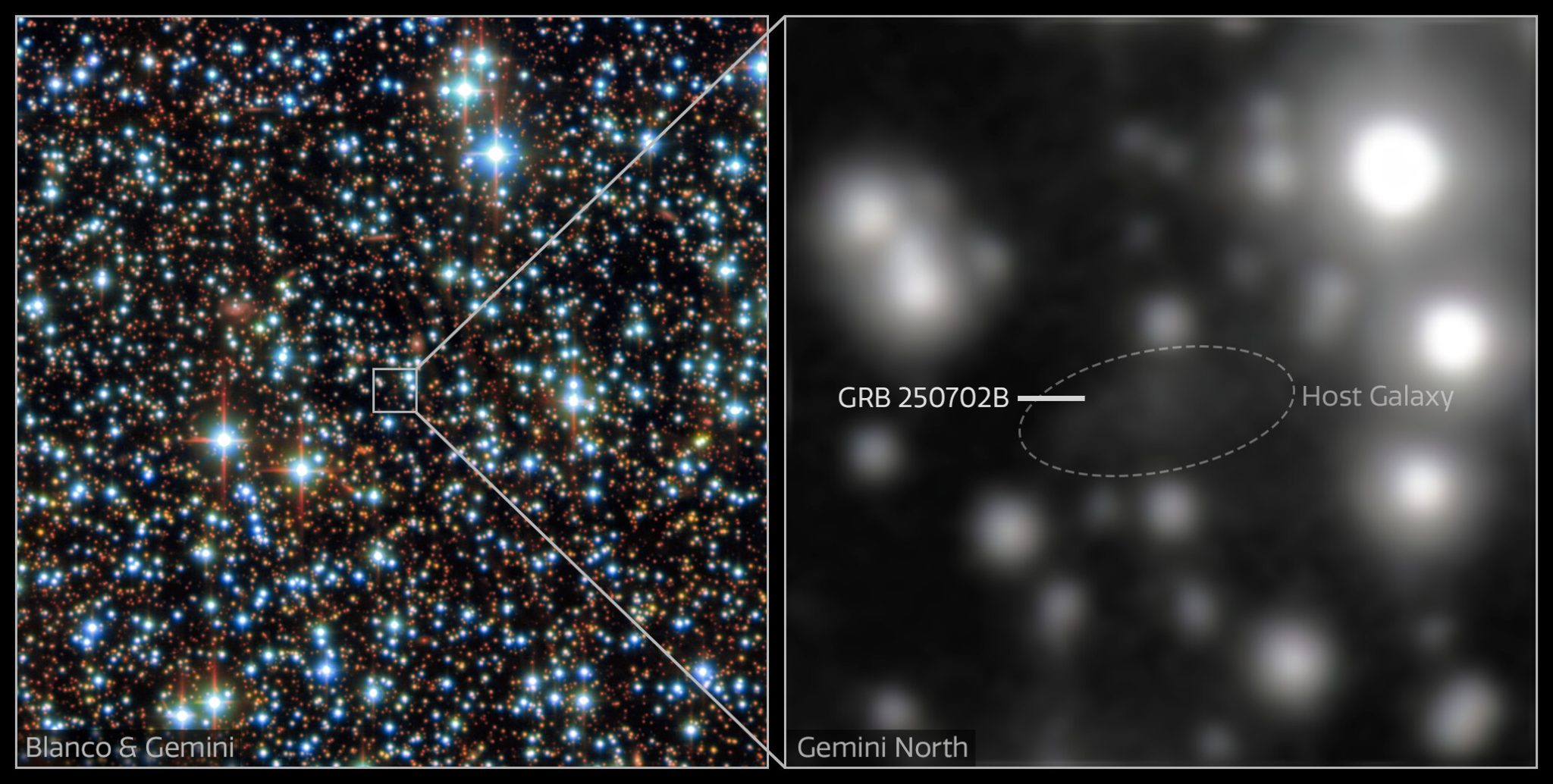
Analysis of the data they collected showed that GRB 250702B was not detectable in visible light, partly due to interstellar dust scattered across the Milky Way, but more significantly due to dust within the galaxy where the burst source was located.
The research team then combined this data with observations obtained by other telescopes and compared the resulting set with theoretical models. As a result, they concluded that the initial gamma-ray signal originated from a narrow, high-speed jet of matter (a relativistic jet) colliding with the surrounding matter.
The analysis also helped characterize the environment around the burst and the host galaxy as a whole. They found that there is a large amount of dust around the explosion site, and that the galaxy is extremely massive compared to most typical gamma-ray burst host galaxies. These details about the environment surrounding GRB 250702B provide important constraints on the system that produced the initial gamma-ray burst.
Source of record gamma-ray burst
Of the approximately 15,000 gamma-ray bursts observed since the phenomenon was first detected in 1973, only half a dozen come close to GRB 250702B in duration. Their presumed sources range from the collapse of a blue supergiant star, tidal disruption of a star, or a newborn magnetar.
However, GRB 250702B does not fit into any of the known categories. Based on the data obtained to date, scientists have put forward several hypotheses about possible scenarios for its origin:
- a black hole falling into a star that was deprived of hydrogen and now consists almost exclusively of helium;
- a star (or substellar object, such as a planet or brown dwarf) destroyed during a close collision with a compact stellar object, such as a stellar-mass black hole or neutron star;
- a star being torn apart by an intermediate-mass black hole. If this scenario is confirmed, it will be the first time in history that astronomers have been able to record such a phenomenon.
According to NOIRLab

