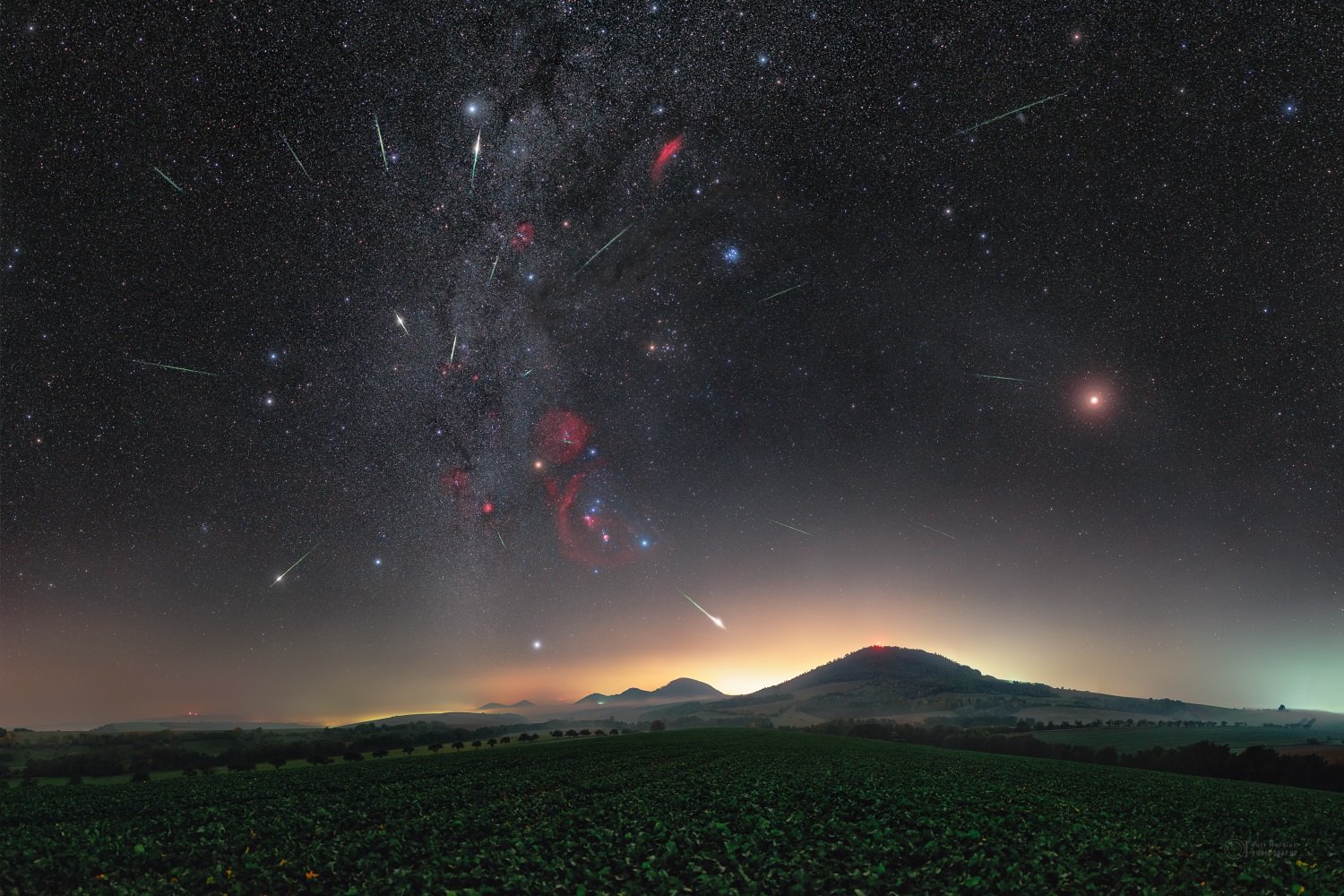
Since the beginning of October, the nighttime hours have been slightly longer than the daytime hours, opening up more opportunities to observe various astronomical phenomena. The pre-dawn sky is particularly spectacular, with Orion shining quite high. It is accompanied by such rich constellations as Gemini, Auriga, Perseus, and Cassiopeia. Here you can also see the brightest planets: Venus moves across the sky behind the Sun, passing from Leo to Virgo, while Jupiter remains in Gemini.
The main event of this month may be the bright appearance of comet C/2025 A6 (Lemmon), which will be at its closest distance to Earth on October 21. It is expected that around this date, the comet will be visible to the naked eye. At the end of the month, on October 29, the famous interstellar comet 3I/ATLAS will pass through perihelion. Unfortunately, at this moment, it will be in conjunction with the Sun: Earth and the comet will be on opposite sides of the morning star. Therefore, it will remain inaccessible to both ground-based and space observatories until at least the second decade of November. However, at the beginning of the month, when 3I/ATLAS passes at its closest distance to Mars, an attempt will be made to observe it using spacecraft orbiting the Red Planet.
This year, we are lucky with the Orionid meteor shower. Its peak, expected on October 21, coincides with the new moon, so the Moon will not interfere with observations. This shower is highly unpredictable and may well be a pleasant surprise.
In the last days of the month, Mercury will be at its greatest eastern elongation. But this time, it will be surprisingly unfortunate for us: in the evening, the planet will hide behind the horizon shortly after the Sun.
List of events
? ? ? October 6 – conjunction of the almost full Moon (98%) with Saturn (+0.6m) and Neptune (+7.7m). The Moon will be 2.9° from Saturn and 2° from Neptune. The first event will occur closer to morning, the second after dawn, when all three bodies will already be below the horizon. Therefore, the best time for observation is the night of October 5 to 6.
? ? ? October 7 – full moon, exact time of the full phase of the moon 06:47 a.m. Kyiv time (03:47 a.m. UTC).
? ? ? October 10 – conjunction of the Moon (87%) with the Pleiades cluster. In those parts of the globe where it will be night at this time, the occultation can be observed at approximately 06:40 a.m. UTC.
? ? ? October 13/14 – conjunction of the Moon (47%) with Jupiter (-2.2m): at 01:30 a.m. Kyiv time, the bodies will be at their closest distance of 4.3°. Throughout the night, you will be able to watch the old Moon, moving through Gemini, “slip” between Pollux and Jupiter.
? ? ? October 19 – the old Moon (5%) will be near Venus (-3.9m) in the predawn sky. The closest the bodies will be is at 6:26 p.m. UTC that day, when they will be below the horizon for observers in Ukraine.
? ? ? October 21 – new moon, exact time 3:25 p.m. Kyiv time (12:25 p.m. UTC).
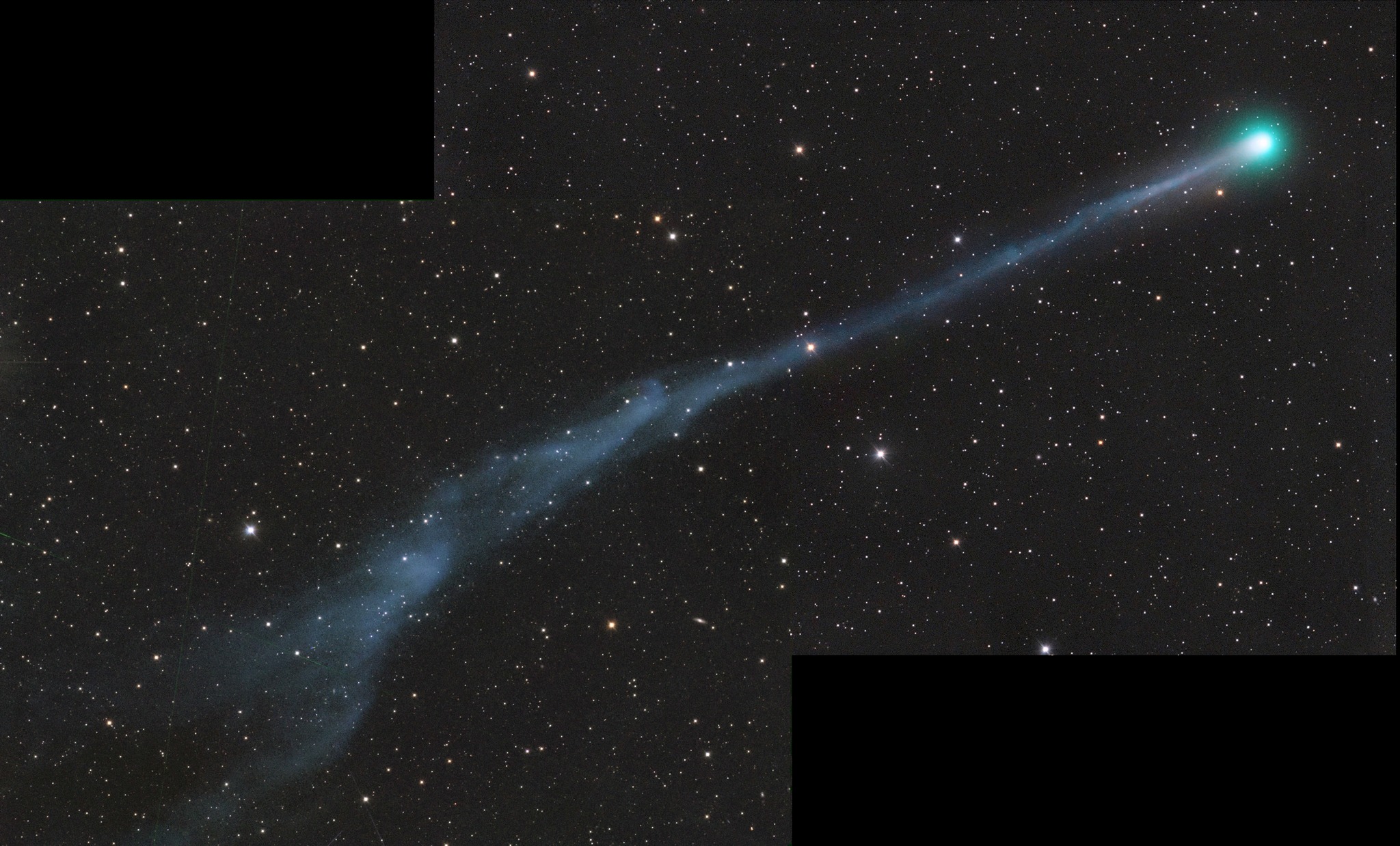
? ? ? October 21 – comet C/2025 A6 (Lemmon) will pass at its closest distance to Earth – 0.68 AU. It is currently predicted that around this time, it may become visible to the naked eye. Excellent conditions for observation in the Northern Hemisphere throughout October.
? ? ? October 21 – peak of the Orionid meteor shower, which is active from October 2 to November 7. At its peak, the ZHR is 20 or above.
? ? ? October 29 – Mercury will be at its greatest eastern elongation, with the angular distance between the planet and the Sun reaching 23.9°. However, despite this, observations will be almost impossible, since after sunset Mercury will be too low above the southwestern horizon. The Southern Hemisphere will have ideal conditions for observation. You can find out why this is the case in this article.
? ? ? October 29 – interstellar comet 3I/ATLAS will pass perihelion at a distance of 1.36 AU from the Sun, inside the orbit of Mars. Observation will not be possible, as at this moment the comet and Earth will be in almost opposite directions relative to the Sun. But this is an important stage for researchers – comets usually show the greatest activity after passing perihelion.
A detailed overview of the most interesting events
October 6: The Moon, Saturn, and Neptune
Just recently, in the last ten days of September, Saturn and Neptune were at opposition, and October continues to be a favorable period for observing these giant planets. On the night of October 5-6, the Moon will be near them – the trio will be located near the border of the constellations Aquarius and Pisces.
The celestial bodies will be visible throughout the night: as the Sun sets, they will just begin to peek out from behind the horizon. In the morning, they will disappear behind the horizon shortly before sunrise. Saturn will be the only bright object near the 97% illuminated Moon, so you cannot miss it. Their location will tell you where to look for Neptune, the most distant planet in the Solar System. You will definitely need binoculars or a telescope for this. At low magnification, Neptune is difficult to distinguish from a star, but at higher magnification (approximately x100 for telescopes with a diameter of 150-200 mm), you can see a tiny, faintly blue disk.
Due to the specific orientation of the orbits of Earth and Saturn, the planet’s rings will gradually close throughout October, and in November, they will be visible almost exactly from the edge. So, if you have a telescope, it will be interesting to follow this process throughout the current month.
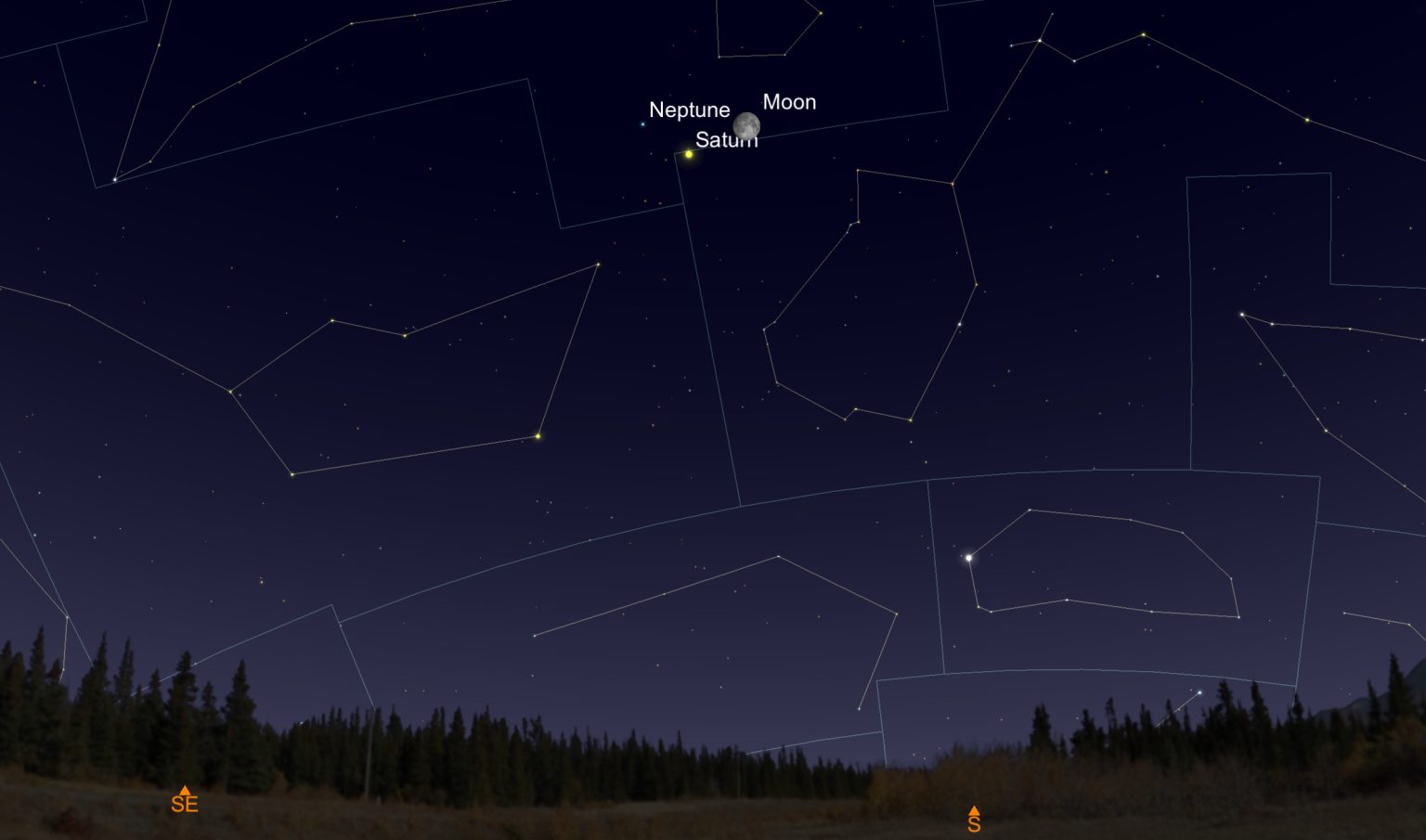
Source: SkySafari electronic planetarium
October 21: comet C/2025 A6 (Lemmon)
On this day, comet C/2025 A6 (Lemmon) will be at its closest distance to Earth – 0.68 astronomical units, or approximately 100 million kilometers. According to current forecasts, its brightness at that time will reach +3.1m, which means it will be clearly visible even to the naked eye. If you use binoculars, the comet will be even more visible. Ironically, viewing it through a telescope may be less interesting, although it will allow you to see the details of the coma’s structure. However, it is worth experimenting if you have the appropriate equipment.
Of course, the visibility of this comet is not limited to October 21. At the end of September, C/2025 A6 became visible with medium-powered binoculars, and it will gradually increase in brightness until early November. Therefore, it can be seen on any day in October. The main condition is weather – clear skies and a transparent atmosphere.
In early October, C/2025 A6 will leave the constellation Lynx, then pass through a small corner of Leo Minor, cross Ursa Major, move to Canes Venatici, and from there to Boötes, ending up in Serpens at the end of the month. This rapid movement is due to the comet approaching its perihelion and increasing its speed.
A particularly pleasant moment: around October 21, you can count on double visibility of the comet – it will be available for observation both in the evening in the northwest and before dawn in the northeast.
October 21: New Moon – time for galaxies, nebulae, and star clusters
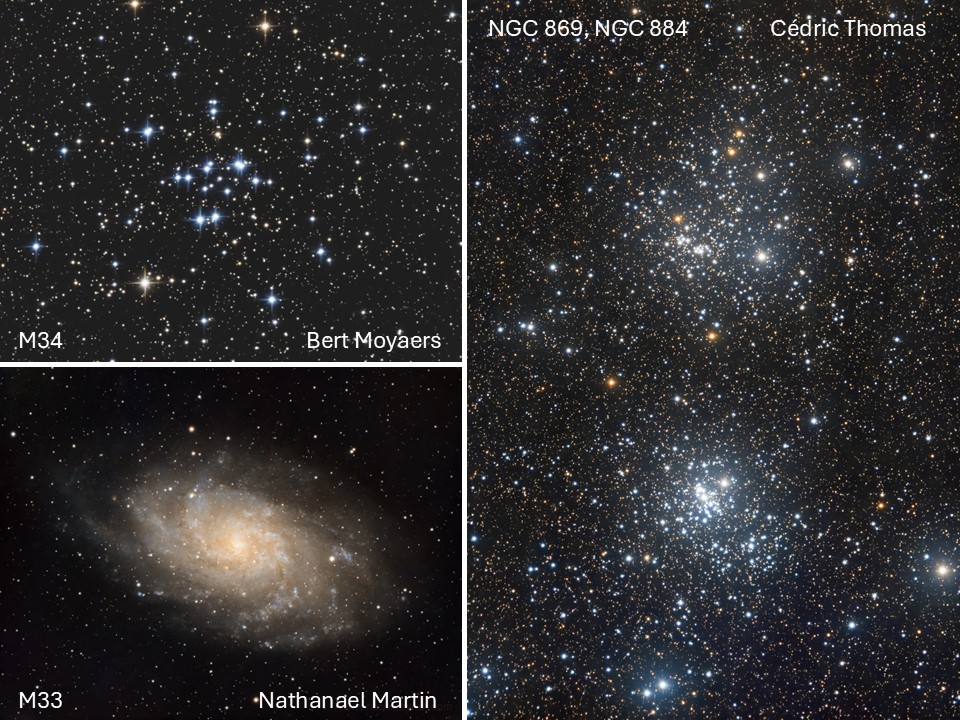
The nights of October 20/21 and 21/22 are a great opportunity to combine business with pleasure. In addition to the comet, which can be observed both in the morning and in the evening, and the meteor shower (more on that later), the autumn sky offers astronomy enthusiasts a multitude of magnificent deep-space objects. The simplest of these, which can be seen with the naked eye under dark skies, are the open cluster Pleiades (M45), the Andromeda Nebula (galaxy M31), and the pair of open clusters NGC 869 and NGC 884 in Perseus.
But no less worthy of your attention are the Triangulum Galaxy (M33), the α Persei (also known as Melotte 20 or Collinder 39), the M34 cluster, the compact Cat’s Eye Nebula (NGC 6543), and a bunch of other objects – both within the Milky Way and far beyond.
October 21-22: the perfect night for the Orionids
The radiant of the Orionid meteor shower is located near the northern border of the constellation Orion. This meteor shower is associated with one of the most famous comets – Halley’s Comet (1P/Halley).
Orionids are usually not very powerful, but they can bring surprises. The characteristic zenith hourly rate (ZHR) is 20 to 50, although in some years there are surges of up to 100. This means that in our latitudes, under perfectly dark skies, even with minimal activity, you can see at least 15-17 meteors per hour. The best time for observation is approximately from 3:00 to 5:30 a.m. local time. You do not have to look directly at the radiant, as the meteors will appear unpredictably across the sky.
Halley’s Comet moves in almost the opposite direction to Earth, and we “fly into” its particle stream at almost the maximum possible speed – 66-67 km/h. That is why meteor phenomena are extremely rapid.
Since this year’s predicted peak flow occurs on the night of the new moon, it is worth traveling outside the city to admire how tiny particles of Halley’s Comet burn up in the atmosphere against the backdrop of a velvety dark sky. In fact, the peak of the Orionids is quite broad, and between October 21 and 24, activity is often approximately the same.