

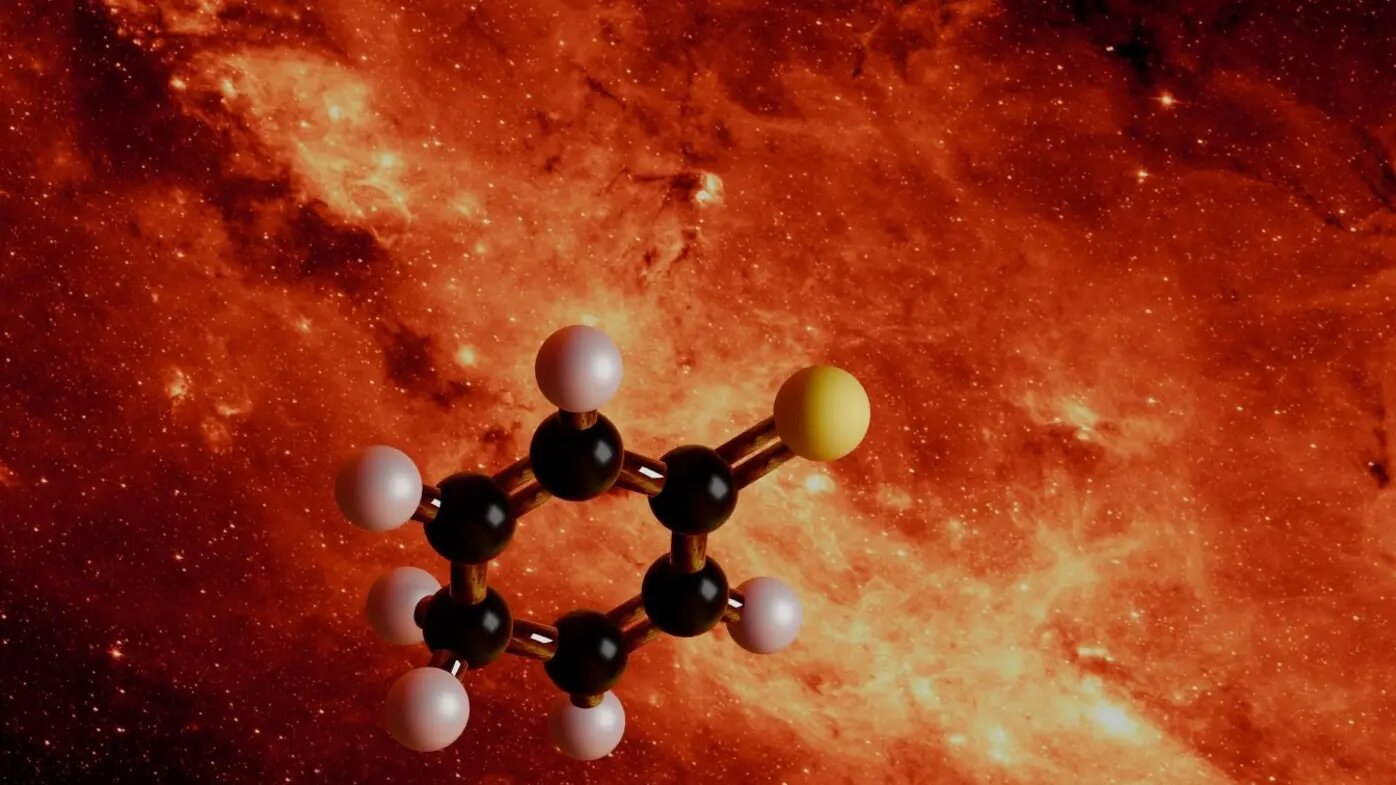
German astrophysicists have discovered 2,5-cyclohexadiene-1-thione (C₆H₆S) in space. This is the name of the substance contained in a molecular cloud located 27,000 light-years away from us. It is the whitest sulfur-containing molecule in terms of the number of atoms discovered outside Earth.
The largest sulfur-containing compound in space
Researchers from the Max Planck Institute for Extraterrestrial Physics (MPE), in collaboration with astrophysicists from the Center for Astrobiology (CAB), CSIC-INTA, have discovered the largest sulfur-containing molecule ever found in space: 2,5-cyclohexadiene-1-ion (C∆S). They achieved this breakthrough by combining laboratory experiments with astronomical observations. The compound is located in the molecular cloud G+0.693–0.027, approximately 27,000 light-years from Earth, near the center of the Milky Way.
With a stable six-membered ring and only 13 atoms, it significantly exceeds the size of all previously discovered sulfur-containing compounds in space. The study was published in the journal Nature Astronomy.
Why is this important?
“This is the first unambiguous detection of a complex, ring-shaped sulfur-containing molecule in interstellar space—and a crucial step toward understanding the chemical link between space and the building blocks of life,” says Mitsunori Araki, a scientist at MPE and lead author of the study.
Previously, astronomers had only detected small sulfur compounds in interstellar space, mostly with six or fewer atoms. Large, complex molecules containing sulfur were expected, especially given sulfur’s important role in proteins and enzymes, but these large molecules remained elusive. This discrepancy between interstellar chemistry and the organic composition of comets and meteorites was a major mystery in astrochemistry.
The recently discovered C₆H₆S is structurally similar to molecules found in extraterrestrial samples and is the first sample of its kind to be definitively detected in space. It creates a direct chemical “bridge” between the interstellar medium and our Solar System.
How was the molecule discovered?
The team synthesized the molecule in the laboratory by applying a 1,000-volt discharge to a liquid with an unpleasant thiophenol (C₆H₅SH) odor. Using a spectrometer they developed themselves, they accurately measured the radio frequencies of C₆H₆S, obtaining a unique “radio fingerprint” with more than seven significant digits. This imprint was then compared with astronomical data from an extensive observational study led by CAB, collected using the 30-meter IRAM radio telescope and the 40-meter Yebes radio telescope in Spain.
The scientists’ findings show that a molecule with 13 atoms, structurally similar to molecules in comets, already exists in a young molecular cloud without stars. This discovery proves that the chemical basis for life emerges long before stars form.
This discovery suggests that there are likely many more complex molecules containing previously undetected sulfur, and that the basic building blocks of life could have formed in the depths of interstellar space long before the Earth came into existence.
According to phys.org

