

Almost half a century ago, the Voyager 1 spacecraft left Earth on a journey originally intended to last just five years. Today, this space veteran has become the farthest object ever created by humankind. However, time is inexorable even for space heroes: this week, NASA officially announced the shutdown of one of the spacecraft’s last scientific instruments. This decision was made not because of a malfunction, but out of necessity—to keep the probe operational in the icy void of interstellar space.
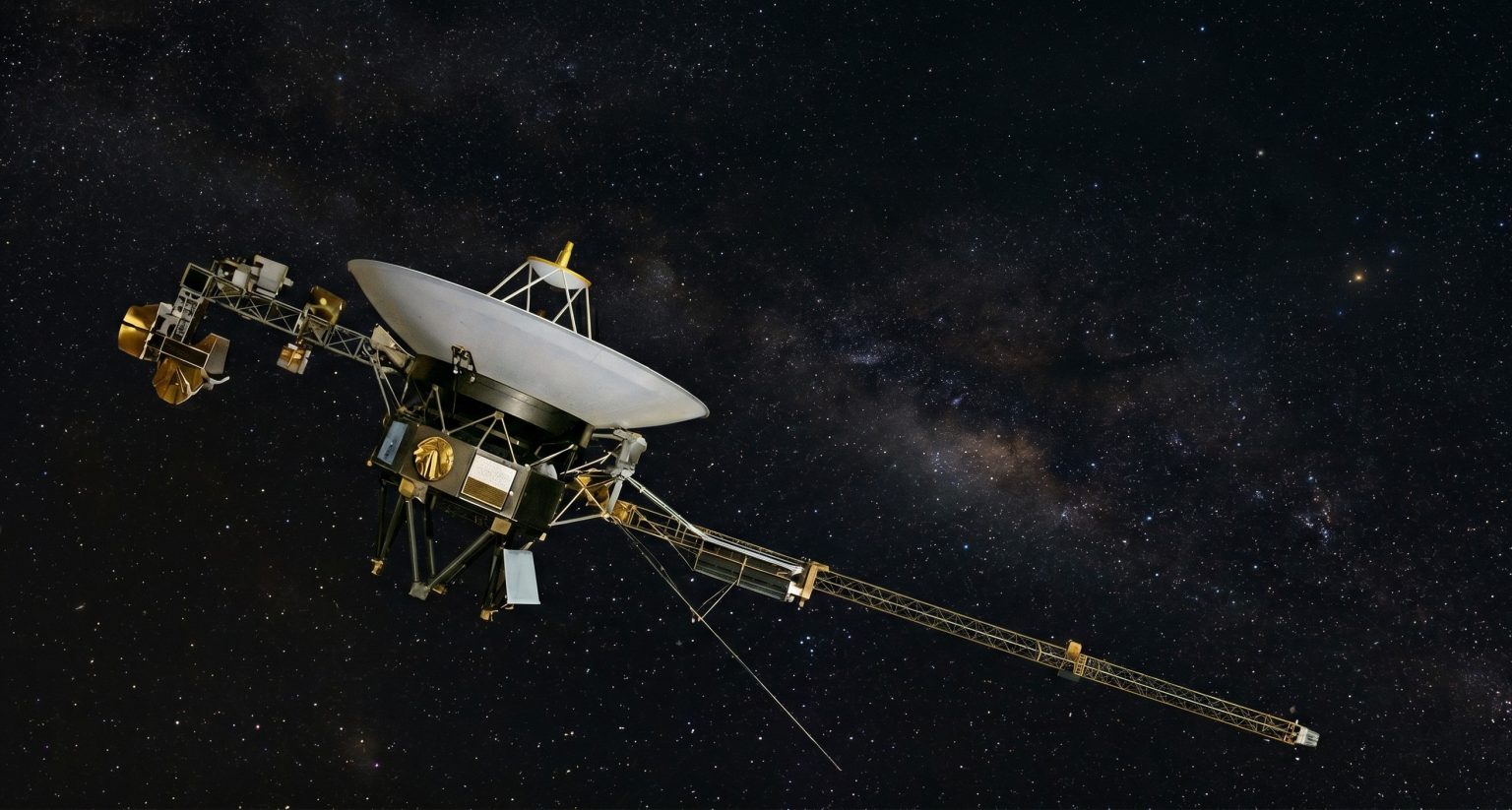
Engineers at the Jet Propulsion Laboratory (JPL) in Southern California are working with precision to try to delay the inevitable. The Voyager 1 space probe is gradually running out of power, and every watt of energy saved today means an extra month of communication with Earth tomorrow.
Five-year mission that has lasted 50 years
The story of Voyager 1 began on September 5, 1977, when a Titan-Centaur rocket launched it into orbit from Cape Canaveral. Weighing approximately 815 kg and equipped with a massive 3.7-meter antenna, the spacecraft was designed for an ambitious but short journey through the Solar System.
The launch was prompted by a unique astronomical opportunity that occurs only once every 175 years. In the late 1960s, scientists calculated that the giant planets—Jupiter, Saturn, Uranus, and Neptune—would align in a straight line. This allowed the spacecraft to use each planet’s gravity as a “slingshot,” accelerating and changing course without using any additional fuel. Although NASA scaled back its original plan due to budget constraints, Voyager 1 and its twin, Voyager 2, exceeded all expectations by operating 10 times longer than originally planned.
From Io’s volcanoes to the interstellar void
Voyager 1’s early missions transformed our understanding of space. In 1979, it flew past Jupiter, where it detected active volcanoes on the moon Io for the first time in history—a sensational discovery, since volcanism had previously been considered an exclusively terrestrial phenomenon. Subsequently, in 1980, the spacecraft reached Saturn, transmitting detailed images of its rings and its giant moon, Titan. It was the close approach to Titan that altered the probe’s trajectory, sending it upward from the plane of the ecliptic—forever away from the planets and toward distant stars.
In 1990, the mission was renamed the Interstellar Mission. On August 25, 2012, Voyager 1 officially became the first man-made object to cross the heliopause—the boundary where the solar wind meets the wind from other stars. Since then, the spacecraft has been traveling through interstellar space, collecting data on an environment that humanity has never encountered before.
24 billion kilometers and twenty-four hours of waiting
As of today, Voyager 1 is an astonishing 25 billion kilometers from Earth. A radio signal traveling at the speed of light takes 23 hours to cross this gap. This means that any command sent by the engineers receives a response only after a full day.
The device is powered by a radioisotope thermoelectric generator (RTG), which converts heat from the decay of plutonium into electricity. However, this “nuclear engine” is losing steam: its power decreases by about 4 watts every year. In February 2026, energy levels dropped to a critical point, nearly triggering an automatic shutdown of the safety systems. The NASA team had to take preemptive action.
Sacrifice for the sake of science
On April 17, 2026, engineers sent a team to decommission one of the key scientific instruments—the Low-Energy Charged Particle (LECP) detector. For decades, this instrument measured the fluxes of ions, electrons, and cosmic rays, helping scientists map the structure of space beyond our Solar System. A similar instrument on Voyager 2 was deactivated in March 2025.
“Shutting down the scientific instruments is always a painful decision for the team,” said Karim Badruddin, mission manager at JPL. “But it’s the only way to save the entire mission and maintain communication.”
Currently, only two active scientific instruments remain on board Voyager 1: one for studying plasma waves and the other for measuring magnetic fields.
Plans for the 2030s
Despite the difficult situation, NASA has a “trump card up its sleeve.” Engineers are preparing a radical energy-saving operation codenamed “Big Bang.” The plan provides for the coordinated replacement of outdated, energy-intensive components with more energy-efficient alternatives.
The first tests of this strategy will take place on Voyager 2 in May and June 2026. If the procedure is successful, a similar maneuver will be performed on Voyager 1 no earlier than July. Scientists are even hoping for a temporary return to service of the LECP instrument.
The team’s ultimate goal is to keep at least one scientific instrument operational on both spacecraft until the early 2030s. As long as the nuclear heat continues to smolder in the hearts of these steel travelers, they will keep sending back invaluable data from places where eternal night reigns and no human-made machine has ever reached.
We previously reported on how Voyager 1 lost the ability to transmit data back to Earth.
According to NASA JPL

