

Scientists are interested in the origin of a number of gullies on Mars. They believe that carbon dioxide may be responsible for their formation. More precisely, we are talking about its solid form, which is essentially ice.
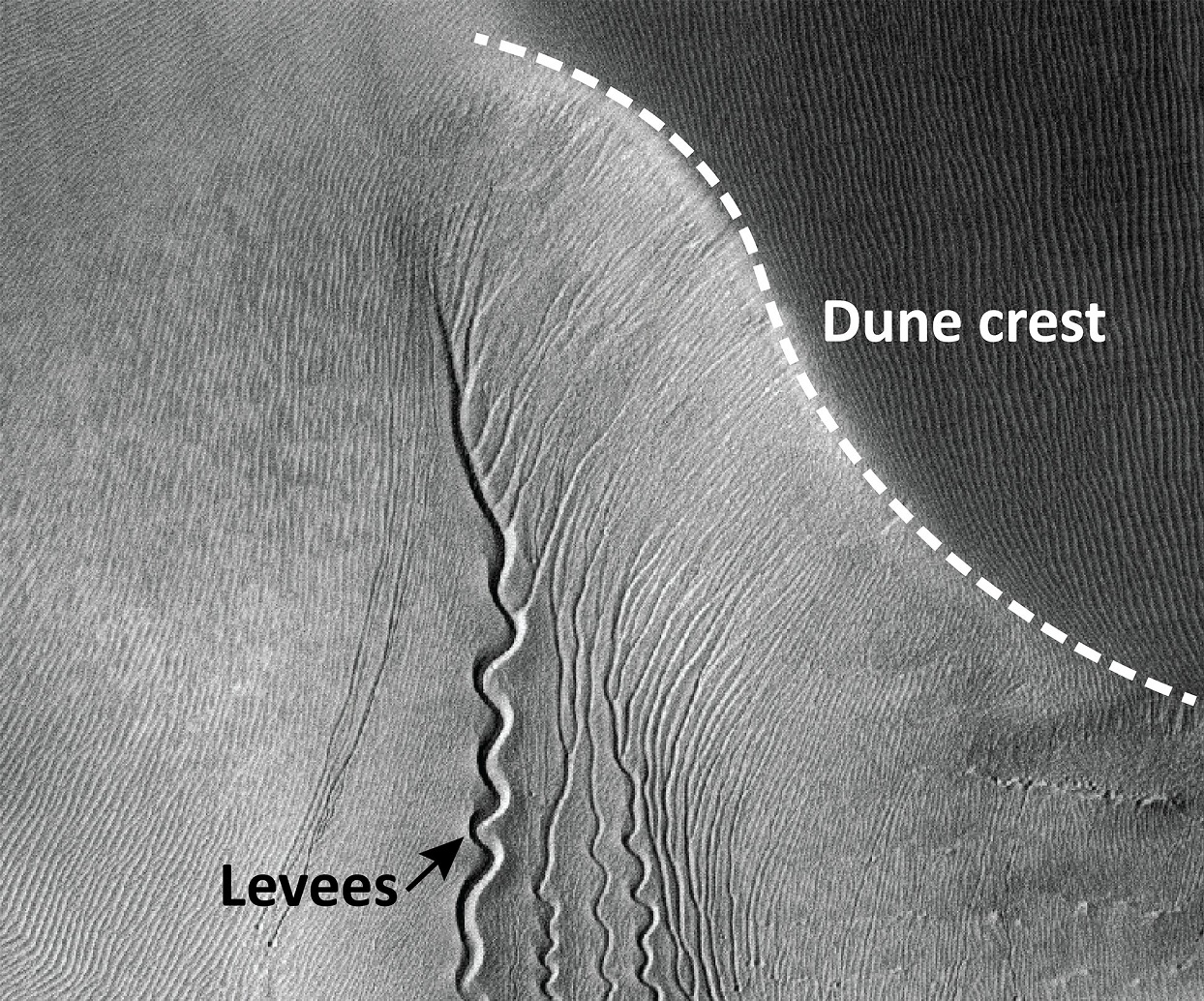
Martian gullies
Was there really life on Mars? Unfortunately, there is no convincing evidence of this yet. However, some form of life seems to have been the driving force behind the mysterious Martian gullies. Geologist Dr. Lonneke Roelofs from Utrecht University investigated how these gullies were formed. During her experiment, she observed that blocks of CO2 ice “dug” these gullies in a unique way.
Other researchers had previously suggested that these blocks might play a role in the formation of gullies. Roelofs proved this by conducting an experiment in which blocks of CO2 ice actually carved out these gullies — a phenomenon that is unknown on Earth and has never been observed before.
Sublimation process
Ice appears on the dunes during the Martian winter, when temperatures drop to minus 120 degrees Celsius. By the end of winter, the slopes of the dunes heat up and blocks of ice break off, some of which are up to a meter long. Due to the thin atmosphere and the large temperature difference between the warm sand of the dunes and the ice, the lower part of the ice immediately turns into gas — a process called sublimation. Since a kilogram of gas takes up much more space than the same weight of ice, the ice, so to speak, explodes.
As a result of this process, the block gradually moves downward, leaving behind a long, deep gully with small sandy ridges on both sides. Such gullies can also be found on the Red Planet.
Lonneke Roelofs investigates the processes that shape the landscape on Mars. For example, last year she published the results of her research on CO2 ice sublimation as a factor contributing to the formation of Martian debris flows. These flows cut deep gullies into the crater walls. But the gullies discovered during this study looked different. Consequently, there was another phenomenon behind this, but what exactly was it? The researcher decided to find out.
Tests in the Mars chamber
Together with master student Simone Visschers, she traveled to the English city of Milton Keynes to unravel the mystery of these unusual sandy gullies. The Open University has a Mars chamber: a facility for simulating Martian conditions.
“We tried out various things by simulating a dune slope at different angles of steepness. We let a block of CO2 ice fall from the top of the slope and observed what happened,” says the researcher. “After finding the right slope, we finally saw results. The CO2 ice block began to dig into the slope and move downwards just like a burrowing mole or the sandworms from Dune. It looked very strange.”
But how exactly are these ice blocks formed? CO2 ice blocks form on desert dunes halfway to the Southern Hemisphere of Mars. In winter, a layer of CO2 ice forms across the entire surface of the dune field, sometimes reaching a thickness of 70 cm. In spring, this ice begins to heat up and sublimate.
The last remnants of this ice are on the shaded side of the dune tops, and there, blocks break off when the temperature gets high enough. When the blocks reach the bottom of the slope and stop moving, the ice continues to sublimate until all the CO2 has evaporated. A cavity remains in the sand at the bottom of the dune.
Why Mars?
Mars is our closest neighbor. It is the only rocky planet located near the “green zone” of our Solar System. This zone is far enough from the Sun to make liquid water possible, which is a necessary condition for life to exist. Therefore, the question of the origin of life and possible extraterrestrial life can be resolved right here.
Roelofs says: “Also, conducting research into the formation of landscape structures of other planets is a way of stepping outside the frameworks used to think about Earth. This allows you to pose slightly different questions, which in turn can deliver new insights for processes here on our planet.”
According to phys.org

