

Red dwarfs are a type of star that, due to their prevalence, are perhaps the most important for understanding how often life occurs in space. However, a recent study has been published suggesting that complex life is unlikely to exist near them.
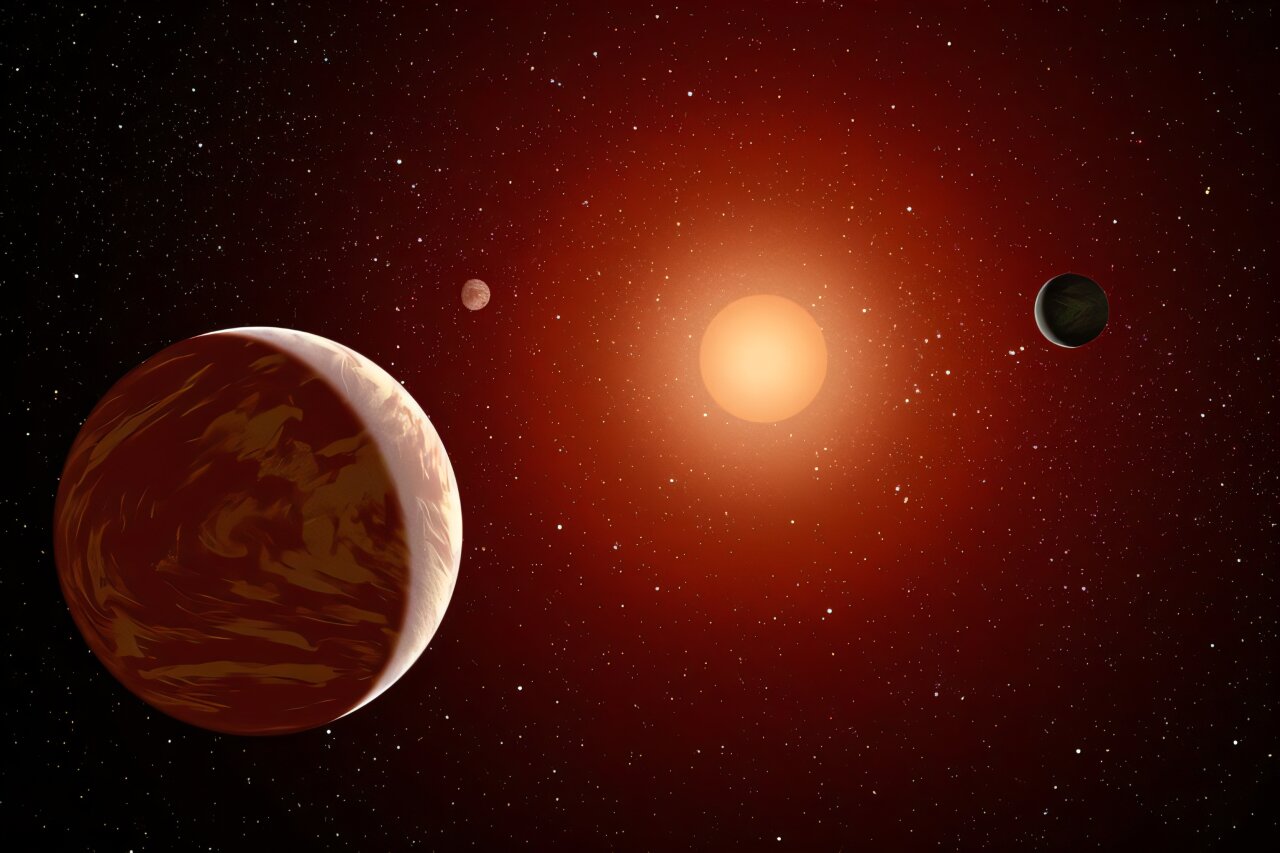
Red dwarfs
A study recently appeared on the arXiv preprint server, whose authors claim that complex life on planets orbiting red dwarfs is unlikely. It represents one more round of debate surrounding these small, cold stars.
Red dwarfs are slightly larger than Jupiter, and their mass is measured as a percentage of the Sun’s mass. However, 85% of the stars in the Milky Way are red dwarfs. In addition, they have an extremely long lifespan. All this means that statistically, they are the most likely place to find life outside the Solar System.
But this is only if life is actually possible there. And there have been many reasons cited in recent decades why this may not be the case: tidal capture of planets in the “habitable zone,” intense radiation that “blows away” the atmosphere and hydrosphere, and extremely powerful flares. This time, scientists have noted that the radiation from these stars is not very suitable for photosynthesis, which is common on Earth.
Star color and photosynthesis
In reality, red dwarfs are not entirely red. Like the Sun, they emit energy across the entire frequency range — from gamma rays to radio waves — and appear only slightly more yellow than our star. However, the peak of their radiation is indeed shifted toward the red end of the spectrum.
This is very crucial for the most important process in the biosphere — photosynthesis. It consists of plants storing radiation energy in nutrients as a result of a series of chemical reactions. However, this only occurs within a certain frequency range.
And for red dwarfs such as TRAPPIST-1 with its seven Earth-like planets, the maximum radiation does not come from them. This means that nothing like the Great Oxygenation Event, which 2.3 billion years ago made breathing possible and, therefore, complex multicellular life, could have occurred on them. Nothing more complex than bacteria could have remained there.
This conclusion implies that our chances of encountering complex multicellular life somewhere in the Universe are also reduced. However, this conclusion is based on studies of photosynthesis on Earth. Chlorophyll, the molecule that gives plants their green color, is not the only substance capable of converting stellar radiation into nutrients for the entire biosphere.
Even on Earth, we know about the possibility of other reactions, and they operate in slightly different frequency ranges. It is quite possible that chlorophyll dominates because of the distribution of maxima in the Sun’s radiation. And near other stars, some other reaction will simply dominate.
According to phys.org

