

Cosmologists have long been searching for answers to two major mysteries: why the Universe is expanding at an accelerating rate, and where the energy driving this acceleration comes from. A new theory has emerged that may explain both mysteries at once.
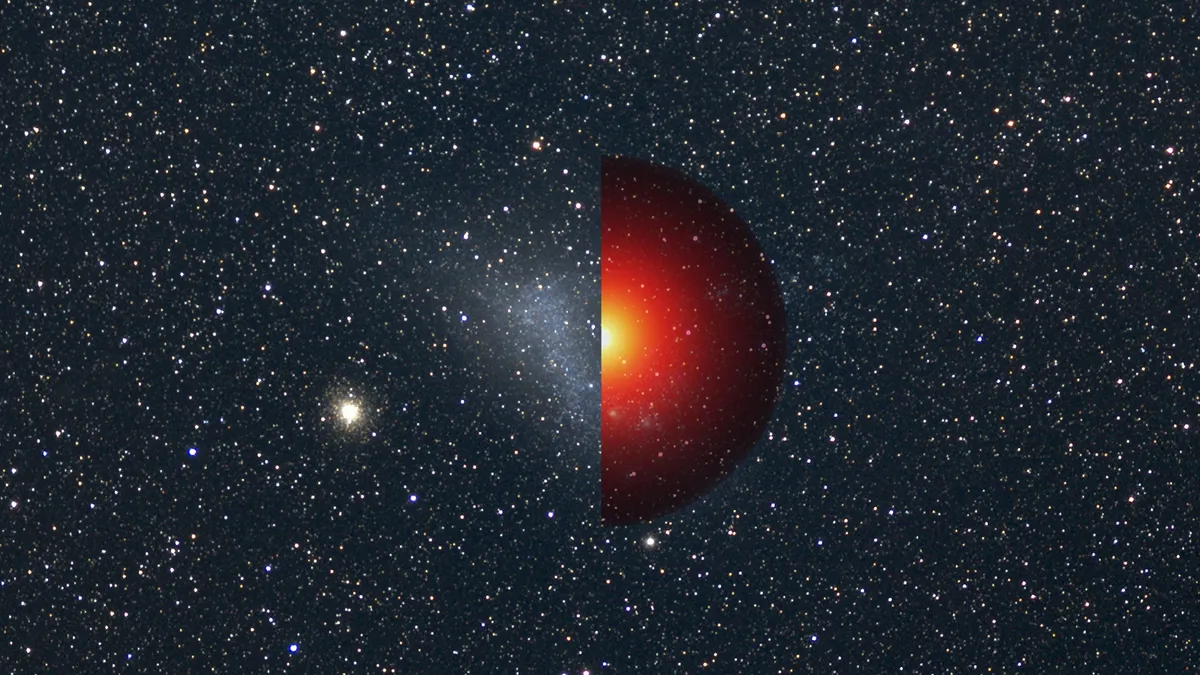
What’s wrong with our model?
The standard model of cosmology, Lambda-CDM, provides an excellent description of the structure of the Universe on a large scale. It accounts for the distribution of galaxies, the cosmic microwave background, and the abundance of light elements. But it has one weakness.
Lambda, or the cosmological constant, is responsible for the accelerating expansion of the Universe. Quantum field theory predicts a value for it that is approximately 10¹²² times larger than the measured value, and this is one of the largest discrepancies between theory and reality in all of physics.
The so-called Hubble tension remains a separate issue. The rate of the universe’s expansion, as measured locally, does not match the rate derived from data on the early Universe. This discrepancy persists despite decades of research.
Koushiappas’s idea
Savvas Koushiappas, a researcher at Brown University, has published a paper on the arXiv preprint server proposing an unconventional approach. He suggests that the size of the Universe and the rate of its expansion cannot be determined simultaneously with arbitrary precision. Just as in quantum mechanics, it is impossible to know both the position and momentum of a particle with precision at the same time.
This quantum uncertainty at the level of the entire universe distorts the Friedmann equations. These are the fundamental equations that describe how the universe expands. The modified version automatically reproduces the acceleration of expansion in the later stages and requires no dark energy. No new particles, no new fields—just its own quantum uncertainty.
What does the model entail?
The parameter of the dark energy equation of state for the true cosmological constant is exactly −1. In Koushiappas’s theory, it turns out to be slightly larger. The Dark Energy Spectroscopic Instrument (DESI) has already detected such deviations, and future surveys are expected to confirm them.
If the sign of the free parameter in the equation is changed, the model behaves quite differently. Instead of accelerating in the later stages, it replaces the Big Bang singularity with a minimal size from which the universe rebounds and begins to expand, without infinite density and without the breakdown of the laws of physics.
What’s next?
For now, this is a theoretical study by a single author that has not been verified by observations. The model hinges on whether future data will confirm deviations from −1 in the dark energy parameter. The Euclid mission, the Vera Rubin Observatory, and DESI are measuring precisely the quantities that the theory predicts will differ from those of the Standard Model.
If these discrepancies persist, Koushiappas’s idea will become increasingly appealing to the cosmological community.
According to space.com

