

Astrophysicists have discovered a slight discrepancy between two sets of cosmological data, and it turned out to be enough to cast doubt on conclusions about the nature of dark energy. When investigating the driving force behind the universe’s accelerated expansion, even a minor error in the input data can significantly skew the picture. Scientists in Mumbai say it is too early to draw definitive conclusions.
Constant or variable
Dark energy remains one of the greatest unsolved mysteries in cosmology. Its existence was proposed to explain why the universe is expanding at an accelerating rate, but it is still unclear whether its influence remains constant or evolves over time.
The key to the answer may lie in the equation of state for dark energy, which describes the relationship between its pressure and density. This parameter reveals how dark energy behaves at different stages of the universe’s history and may indicate whether it has changed over billions of years.
What was checked
Researchers Samsuzzaman Afroz and Suvodip Mukherjee from the Tata Institute of Fundamental Research (TIFR) in Mumbai decided to test the reliability of two widely used datasets.
For this purpose, they investigated whether one of the basic rules of cosmology—the fundamental relationship between two methods of measuring distances in the universe—holds true across these datasets. If the datasets yield results that are inconsistent with one another, this is a sign of a possible systematic error.
Insignificant, but important
The researchers analyzed two types of observations: data on supernovae and baryonic acoustic oscillations—that is, fluctuations in the density of matter in the early universe caused by acoustic waves that propagated through the primordial plasma following the Big Bang. The imprint left by these waves serves as a kind of cosmic ruler for measuring distances.
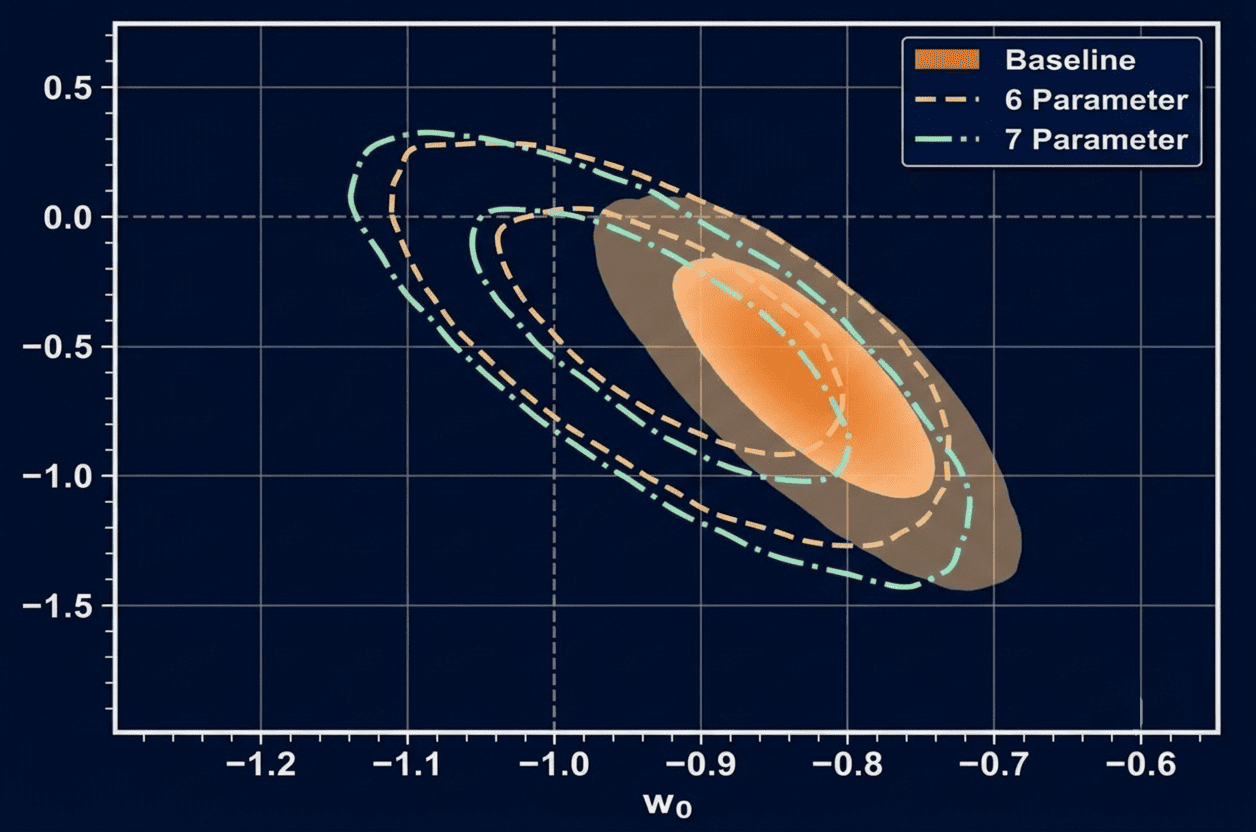
Both datasets generally satisfied the relationship—but with a slight deviation. This deviation correlated with a shift in the parameters of the dark energy equation of state away from the values expected for a simple cosmological constant. In other words, a slight discrepancy in the input data can mimic a signal of dark energy evolution where one may not actually exist.
What does this change?
The DESI spectroscopic survey of the sky recently reported evidence that the equation of state of dark energy may change over time. This would mark a turning point for cosmology.
A new analysis published in Physical Review D does not refute these results, but cautions that the methodological framework has not yet been sufficiently validated to constitute reliable confirmation. The proposed technique will make it possible in the future to better reconcile different datasets and filter out systematic errors before drawing far-reaching conclusions.
According to phys.org

