

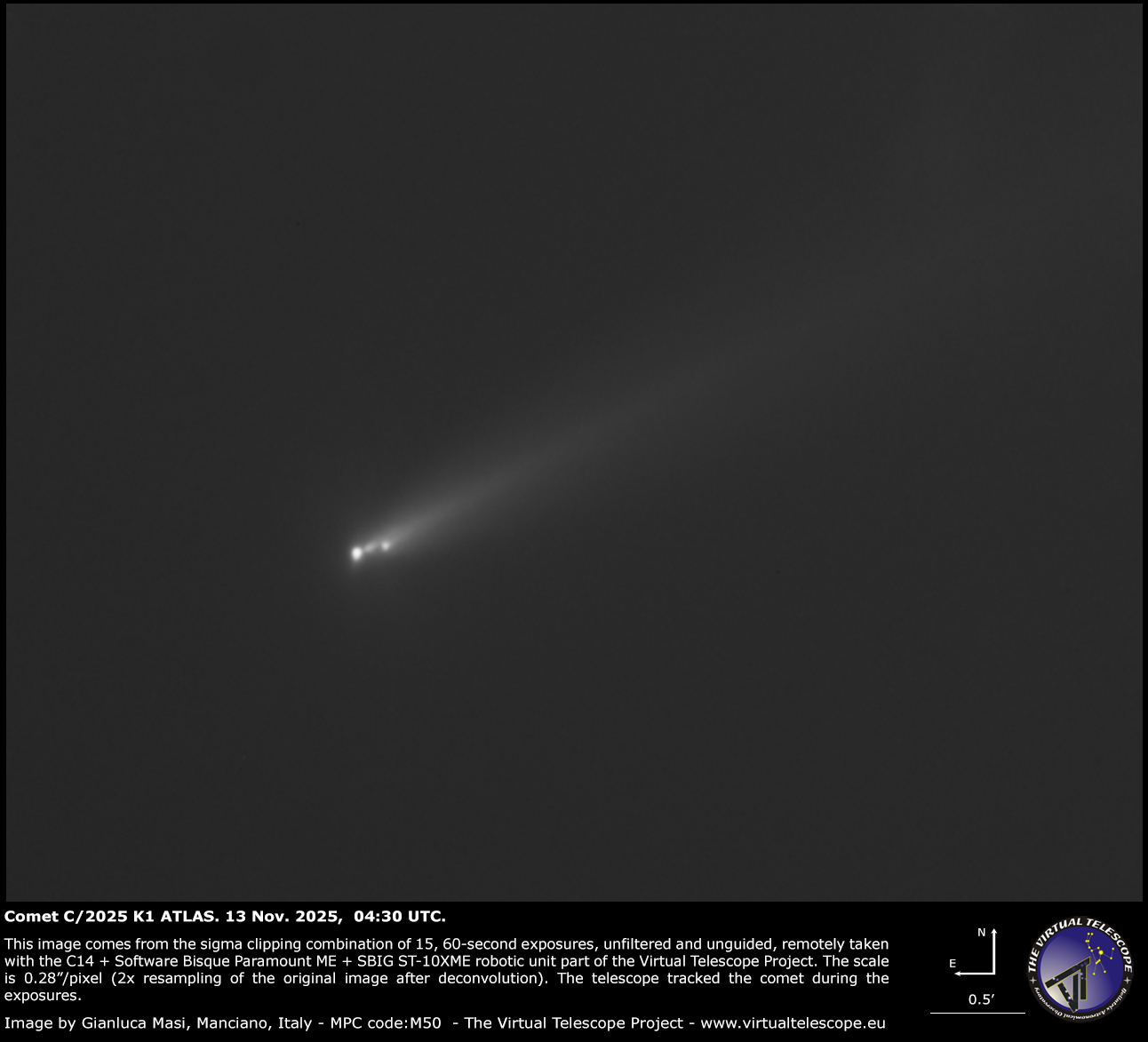
Comet C/2025 K1 ATLAS has broken up. Its nucleus has split into several fragments, as shown in recent images taken on November 13.
Not that comet ATLAS
C/2025 K1 ATLAS should not be confused with the much more famous interstellar comet 3I/ATLAS, which is currently the focus of global attention. Both were discovered in 2025 by the ATLAS system, a network of robotic telescopes designed to search for small near-Earth objects and warn of possible collisions with Earth. This is why the word ATLAS appears in the designation of both comets.
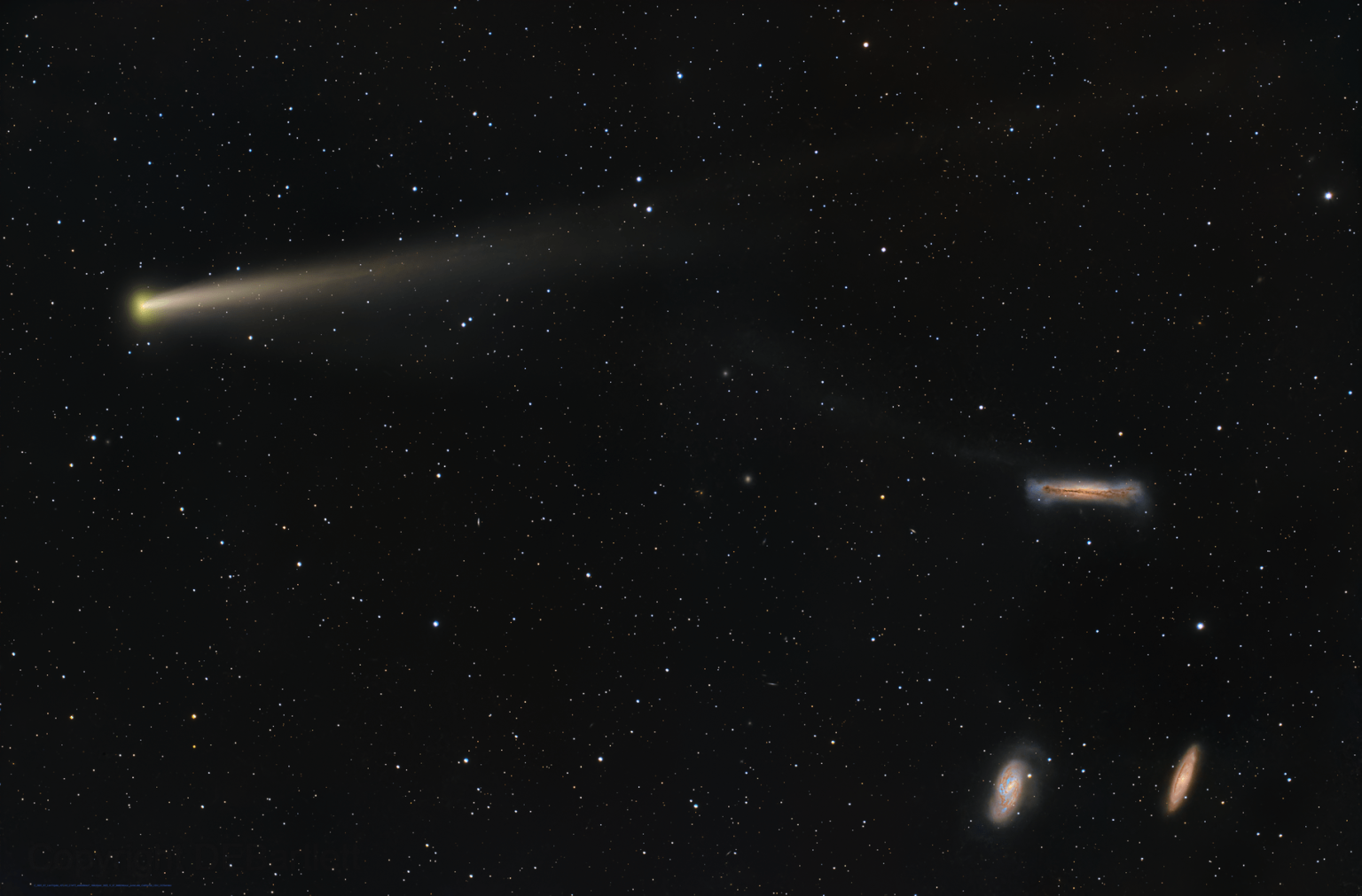
As for the alphanumeric designations, they are deciphered as follows. In the case of C/2025 K1/ATLAS, the letter “C” means that the comet is long-period (its orbital period around the Sun exceeds 200 years), 2025 is the year of its discovery, the letter “K” is the half-month of discovery (the second half of May), and the number 1 indicates that it is the first comet discovered during that half-month.
In turn, in the case of comet 3I/ATLAS, the letter “I” means that it is an interstellar object, and the number 3 means that it is the third such object found. In the future, as the number of interstellar objects found increases, changes may be made to their designation system.
Golden Comet
Although C/2025 K1 ATLAS is not an interstellar visitor, it is still a rather curious object. The comet arrived from the Oort Cloud, a cluster of icy bodies located at the far reaches of the Solar System. This means that its material has never been exposed to solar radiation.
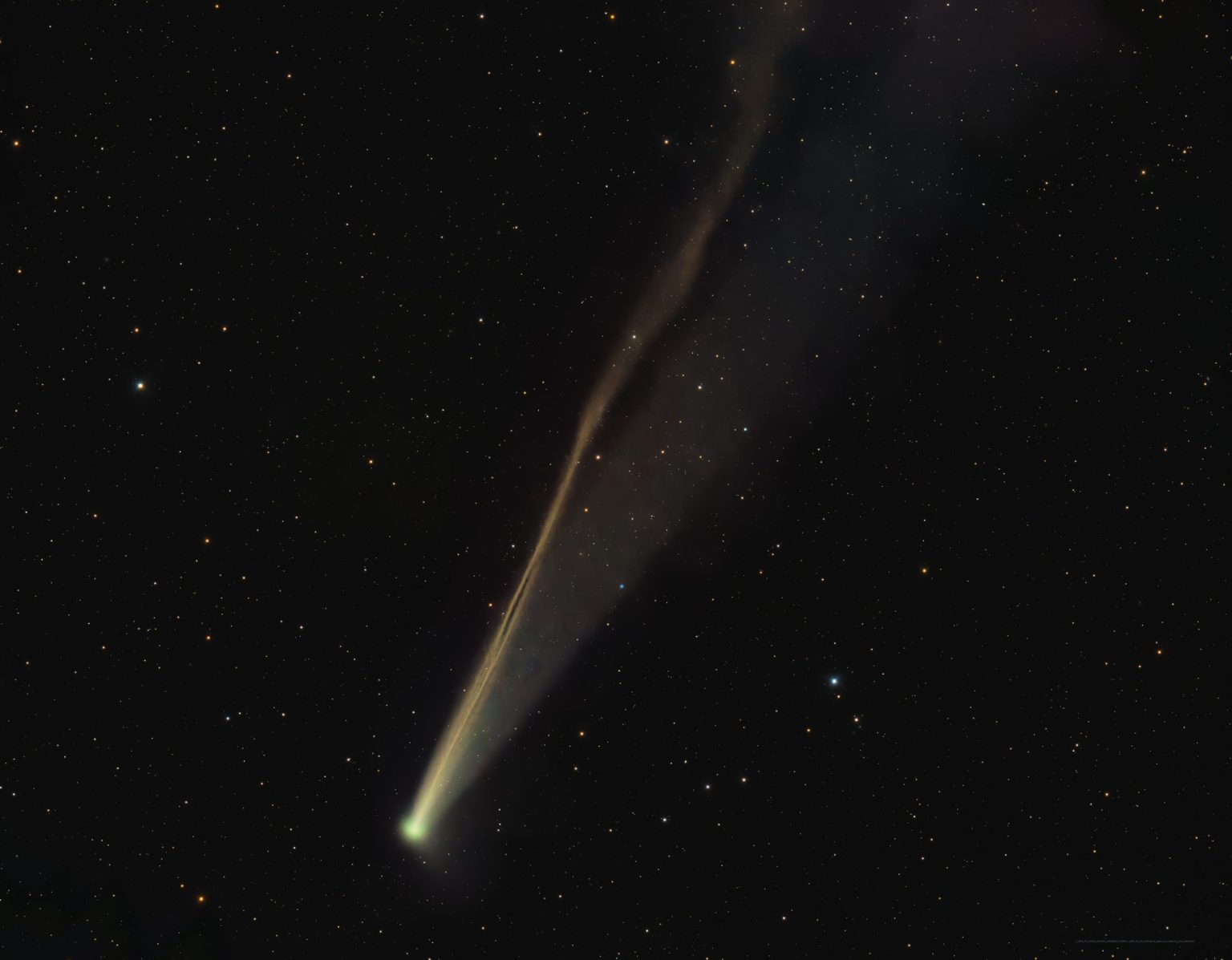
On October 8, C/2025 K1 ATLAS passed the perihelion of its orbit at a distance of 0.33 AU (50 million km) from the Sun. The comet surprised scientists by acquiring a very rare golden color. Subsequent studies revealed that C/2025 K1 ATLAS contained very few carbon-containing molecules, such as dicarbon, carbon monoxide, and cyanide. In the absence of these compounds, light is reflected differently, creating a golden glow effect. This peculiarity in the chemical composition is probably due to the fact that the comet originated in the Oort cloud.
Initially, astronomers believed that due to its fragility and small size, C/2025 K1 ATLAS would not survive perihelion. However, to the surprise of many, the comet passed through it intact. Nevertheless, the encounter with the Sun did not remain without consequences. Images taken on November 10 showed that the comet’s nucleus had begun to fragment. Three days later, astronomers confirmed the fragmentation of C/2025 K1 ATLAS. Its nucleus broke up into at least three fragments.
Before its demise, comet C/2025 K1 ATLAS was moving along a hyperbolic trajectory. This means that if any of its fragments manage to survive, they will be ejected from the Solar System forever, after which they will continue their journey through interstellar space.

