

Scientists have investigated whether all seven planets in the TRAPPIST-1 system could have their own moons. The short answer is yes. However, for this to be possible, they would need to be small and very close to the planet.
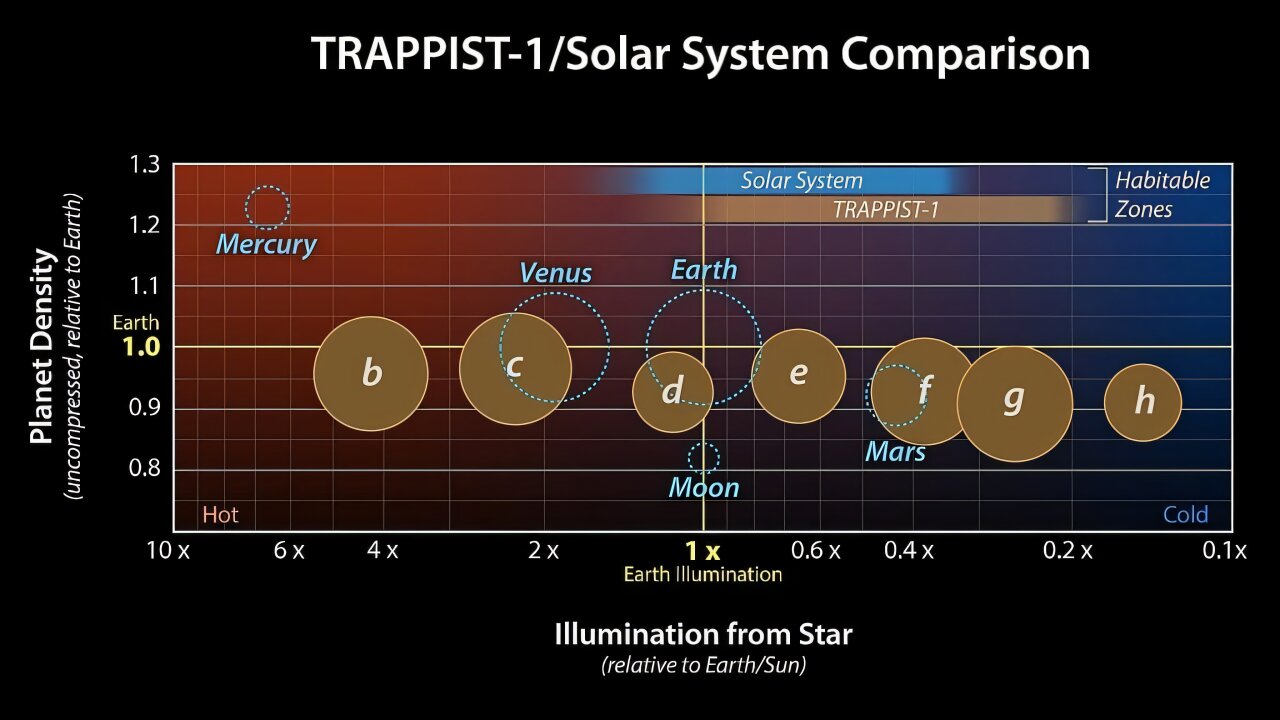
TRAPPIST-1 system
TRAPPIST-1 is a planetary system located 40 light-years away from us. It is known for having seven Earth-like planets orbiting a red dwarf star. Their orbits are so close to each other that three of them are in the “habitable zone.” They may have liquid water.
But what remains a mystery is the possibility that any of them could have their own satellites despite such dense packing. This is the subject of an article by Shubham Dey and Sean Raymond, published on the arXiv preprint server.
They began by examining each planet separately. The minimum radius at which a satellite can be located is called the Roche limit. Closer than that, the Moon would be torn apart by tidal forces. The maximum distance is the Hill radius. Beyond that, gravity simply cannot hold another celestial body.
Scientists calculated these limits for each planet in the TRAPPIST-1 system and placed 100 satellites of various sizes between them. Calculations showed that such satellites could indeed exist.
The system as a whole
However, all this takes into account only individual planets, without considering that they constantly influence each other. It is these interactions that are the main reason for doubts about the possibility of satellites existing in the TRAPPIST-1 system.
Scientists modeled the entire system and concluded that at least some of the satellites that were supposed to be farther from the planets would not remain in their places. They are still possible, but they must be relatively small and located closer to the Roche limit.
This is especially noticeable for planet b, located closest to the star, and planet e, located in the middle of the “habitable zone.” That is, we cannot completely rule out the existence of satellites for these planets. However, we will not be able to find out whether they really exist for some time yet, as modern astronomical instruments do not yet have sufficient resolution.
Provided by: phys.org

