

Observations of the hot Jupiter WASP-94A b revealed that dust clouds moving through the upper layers of its atmosphere disappear at some point. This allowed them to plan the James Webb Space Telescope’s observations effectively. They learned new details about the planet.
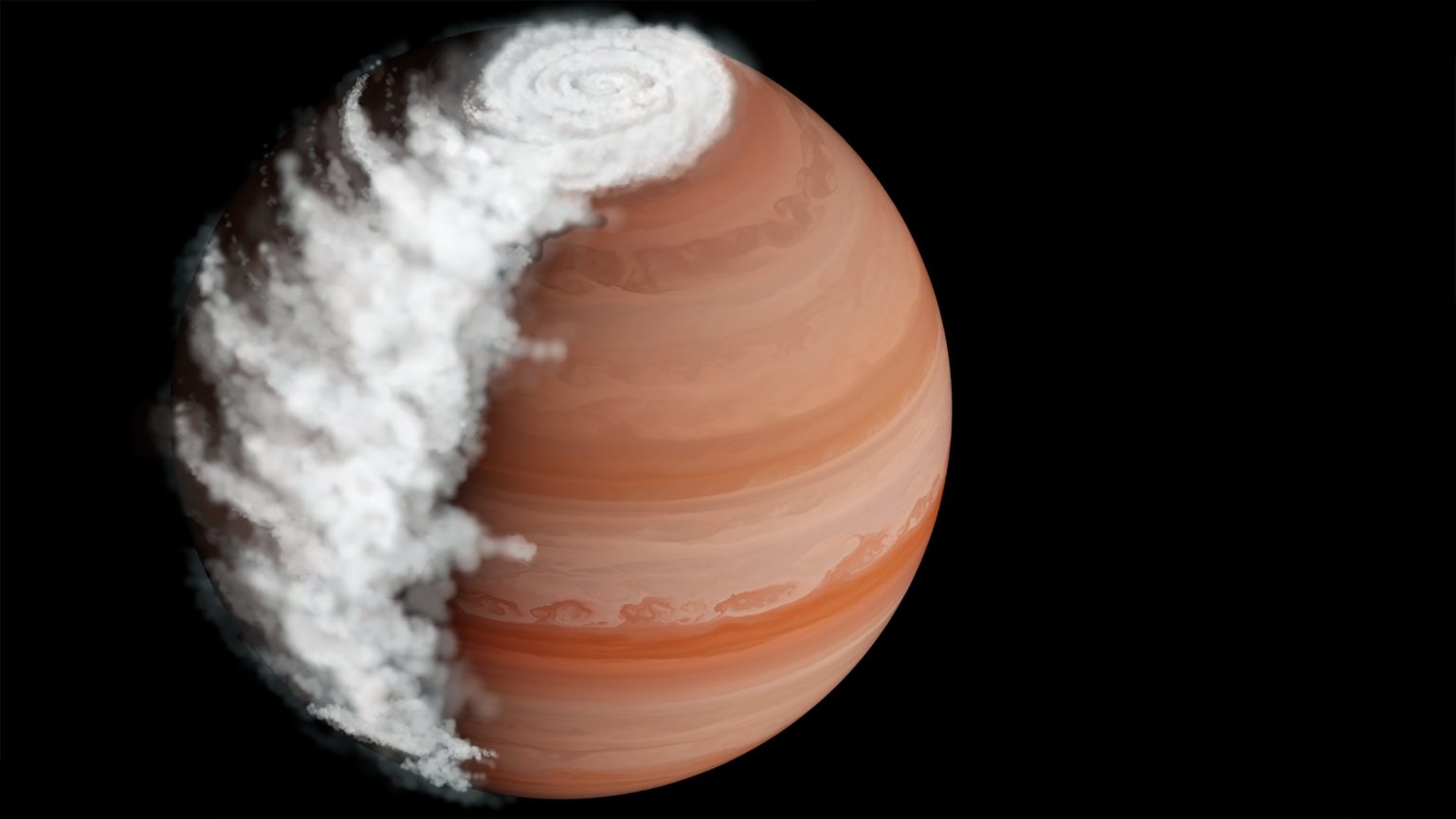
Clouds on the planet
A team of astronomers working with the James Webb Space Telescope recently presented the results of their study of the planet WASP-94A b. This is a “hot Jupiter” that has already been well studied and is located very close to its star.
It orbits one of a pair of stars located 700 light-years away from us. A distinctive feature of this planet, described in an article in the journal Science, is that, like many other “hot Jupiters,” it forms clouds of silicates and metals, but something strange happens to them here.
Dust clouds form high above the shadowed hemisphere. But then, as they drift away from the sunlit “morning” side, they begin to gradually descend until they dissipate almost completely near the “evening” side. This allows us to see deeper layers of the planet’s atmosphere.
What did the researchers find?
The fact that there is a region on WASP-94A b where clouds are virtually never present has come as a big surprise to researchers. After all, they know that this poses a major problem when studying the planet. Because of this, they can only study the composition of the outermost layers.
And in the case of WASP-94A b, this approach proved effective. The researchers adjusted the James Webb Space Telescope so that its spectrograph could focus on a specific section of the “evening” zone of the illuminated hemisphere.
This has yielded results. Previously, it was believed that WASP-94A b contained hundreds of times more oxygen and carbon than Jupiter. Now, researchers have determined that all of that was actually part of the cloud composition. In reality, the planet contains only five times more of these elements, meaning it is indeed very similar to the giant of our Solar System.
Now researchers want to apply the same method to other “hot Jupiters.” It is quite possible that a similar effect exists on them as well. This means that astronomers will be able to gain a much better understanding of what they are made of.
According to phys.org

