

A decade ago, scientists hypothesized that complex cyanide-based membranes might form on Saturn’s moon Titan. They could serve as a good foundation for life. However, a new study has shown that this conclusion may be incorrect.
Membranes on Titan
For a long time, scientists believed that Titan, a moon of Saturn known for its high hydrocarbon content, might have conditions conducive to the emergence and development of life. However, a new study recently published in the journal Science Advances casts doubt on these assumptions.
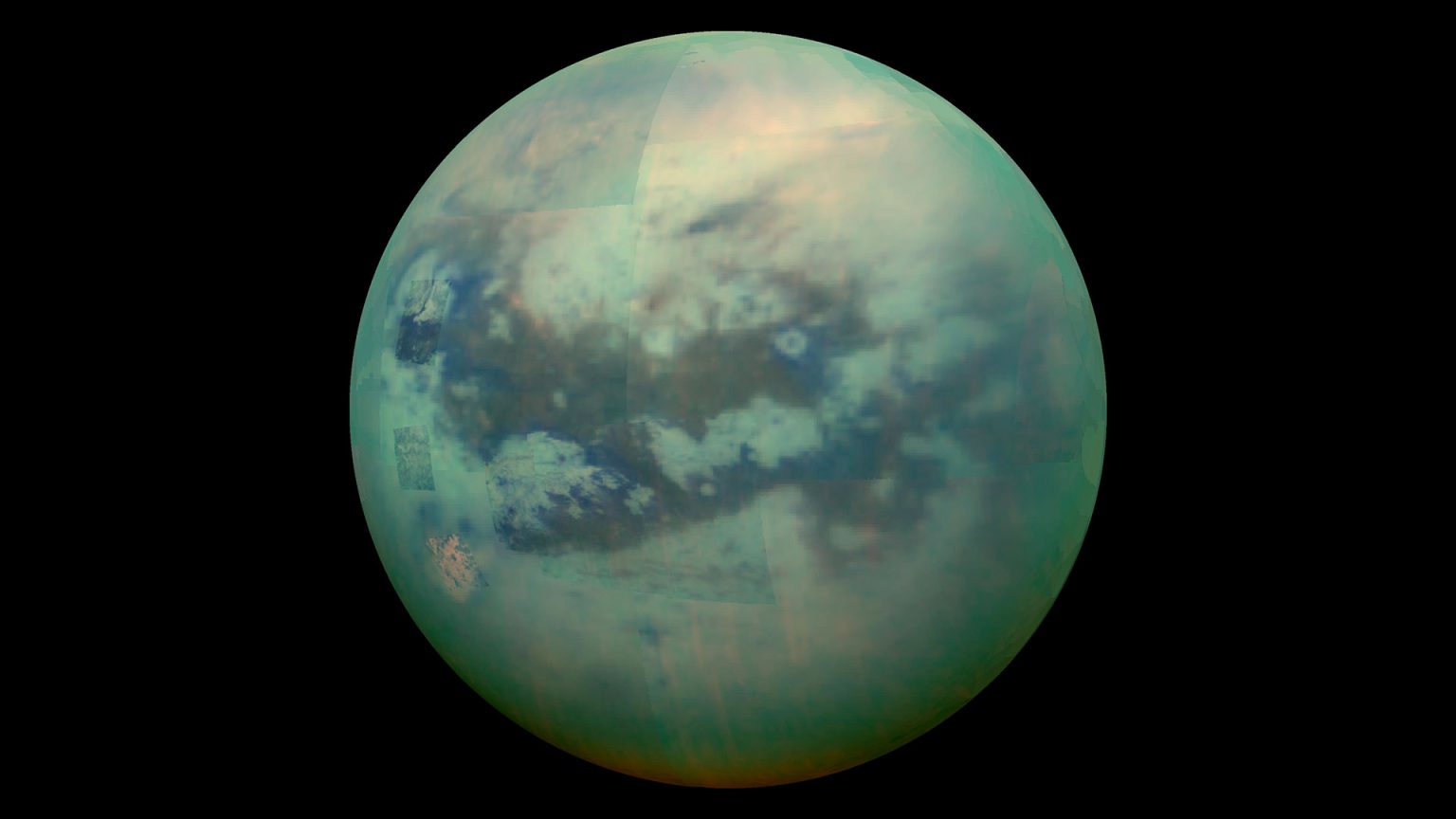
Titan really resembles Earth in the Solar System. As the largest of all the moons, it has a nitrogen atmosphere and seas of liquid hydrocarbons. That is why the idea of searching for life there has been around for several decades.
However, conditions there are still different from those on Earth. For a long time, no one could even imagine what kind of cell would be capable of surviving in those methane seas. In 2015, researchers at Cornell University used computational modeling of chemical reactions to demonstrate that acrylonitrile cyanide, which forms in the atmosphere and enters methane seas, is capable of forming spherical shells.
Scientists believe that these seas are the ideal place for the emergence of biological evolution. After all, something like this might once have existed on Earth as well, except that here such droplets were composed of fats. All of this sounds very promising, but back in 2020, another group of scientists demonstrated that such cyanide droplets would be unstable—that is, they would break down.
New study
However, the refutation was also theoretical, and to verify what was actually going on and how, Tuan Vu and Robert Hodyss of NASA’s Jet Propulsion Laboratory decided to conduct an experiment. They began by preparing mixtures of acrylonitrile with methane and ethane, and then subjected these mixtures to temperatures and pressures similar to those found on the surface of Titan. After leaving the samples for a sufficient amount of time to allow the acrylonitrile molecules to assemble into more complex structures, the researchers analyzed them using several advanced methods.
One of these was differential scanning calorimetry, which measures the amount of heat required to raise the temperature of a sample relative to a reference material. In addition, the team used Raman microscopy to obtain high-resolution images showing the molecular structures present in the mixtures.
The results of the study were not very encouraging. Although the analysis showed that acrylonitrile molecules form a stable molecular co-crystal with ethane, the researchers observed virtually no changes in the mixture of acrylonitrile and methane. All of these findings strongly suggest that azosomal structures are unlikely to form under the conditions prevailing on Titan.
However, scientists do not conclude that this in any way affects the likelihood of life existing on Saturn’s moon. They believe that future research may reveal other possible causes.
According to phys.org

