

Using the European Space Agency’s XMM-Newton space observatory and the LOFAR telescope, astronomers have discovered a burst of matter ejected into space by another star — a burst powerful enough to strip away the atmosphere of any unfortunate planet that happened to be in its path.
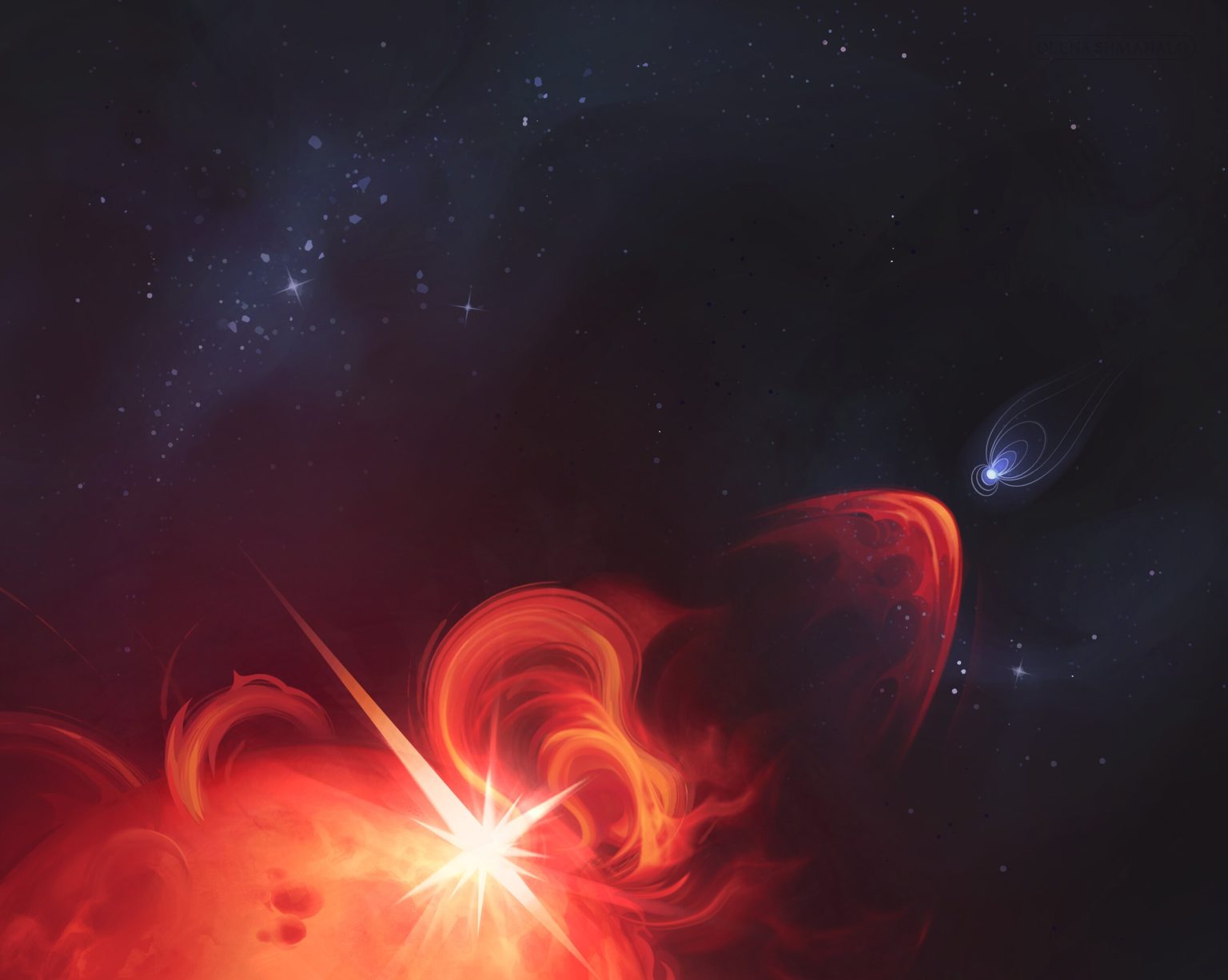
Evidence of the existence of CME on other stars
The explosion was a coronal mass ejection (CME). Such eruptions are often observed on the Sun. During a CME, huge amounts of material are ejected from our star, filling the surrounding space. These dramatic ejections shape and determine space weather, such as the dazzling auroras we see on Earth, and can destroy the atmospheres of neighboring planets.
But although coronal mass ejections are common on the Sun, astronomers have not seen any convincing evidence of their existence on other stars — until now.
Joe Callingham of the Netherlands Institute for Radio Astronomy (ASTRON), author of a new study published in the journal Nature, said that previous findings only suggested the existence of CMEs around other stars or hinted at their presence, but did not actually confirm that material had escaped into space.
However, when the CME passes through the layers of the star into interplanetary space, it creates a shock wave and an accompanying burst of radio waves (a type of light). This short, intense radio signal was detected by Callingham and his colleagues, who discovered that it originated from a star located about 40 light-years away.
Danger to any planet
The star that emitted the burst is a red dwarf, a type of star that is much dimmer, cooler, and smaller than the Sun. However, it is not at all similar to the Sun: its mass is about half that of the Sun, it rotates 20 times faster, and it has a magnetic field that is 300 times stronger. Most of the planets known to exist in the Milky Way orbit around this type of star.
The radio signal was detected using the Low Frequency Array (LOFAR) radio telescope with the help of new data processing methods developed by co-authors Cyril Tasse and Philippe Zarka from the Observatoire de Paris-PSL. The team then used ESA’s XMM-Newton to determine the star’s temperature, rotation, and brightness in X-rays. This was necessary to interpret the radio signal and figure out what was going on.
Researchers determined that the CME was moving at an extremely high speed—2,400 kilometers per second—which is observed in only 1 in 20 solar flares. The flare was so fast and dense that it could completely destroy the atmosphere of any planet orbiting close to the star.
How can coronal mass ejections affect life?
The ability of CME to cleanse the atmosphere is an exciting discovery for our search for life around other stars. A planet’s suitability for life as we know it is determined by its distance from its parent star — whether it is located in the “habitable zone,” that is, the region where liquid water can exist on the surface of planets with the appropriate atmosphere.
But what if this star is particularly active, regularly ejecting dangerous emissions and causing severe storms? A planet that is regularly bombarded by powerful coronal mass ejections could lose its atmosphere entirely, leaving behind a barren rock — a world unfit for life, despite having “just the right” orbit.
“This work opens up a new observational frontier for studying and understanding eruptions and space weather around other stars,” astronomers say. “We’re no longer limited to extrapolating our understanding of the sun’s CMEs to other stars. It seems that intense space weather may be even more extreme around smaller stars—the primary hosts of potentially habitable exoplanets. This has important implications for how these planets keep hold of their atmospheres and possibly remain habitable over time.”
This discovery also contributes to our understanding of space weather, which has long been a focus of ESA missions and is currently being investigated by the SOHO, Proba, Swarm, and Solar Orbiter missions.
According to phys.org

