

Physicists have found a way to weigh entire galaxies by using pulsars as ultra-precise gravity detectors. The new method allows them to measure mass based on the galaxies’ gravitational influence—that is, without directly observing the stars within them.
Detectors from space
Pulsars form after the explosion of massive stars. Each one is an object only the size of a city, yet more massive than the Sun. They spin hundreds of times per second and emit radio waves with the precision of an atomic clock. This stability is what makes them unique instruments. Any gravitational disturbance alters the pulsar’s rhythm by microseconds, and astronomers can detect this.
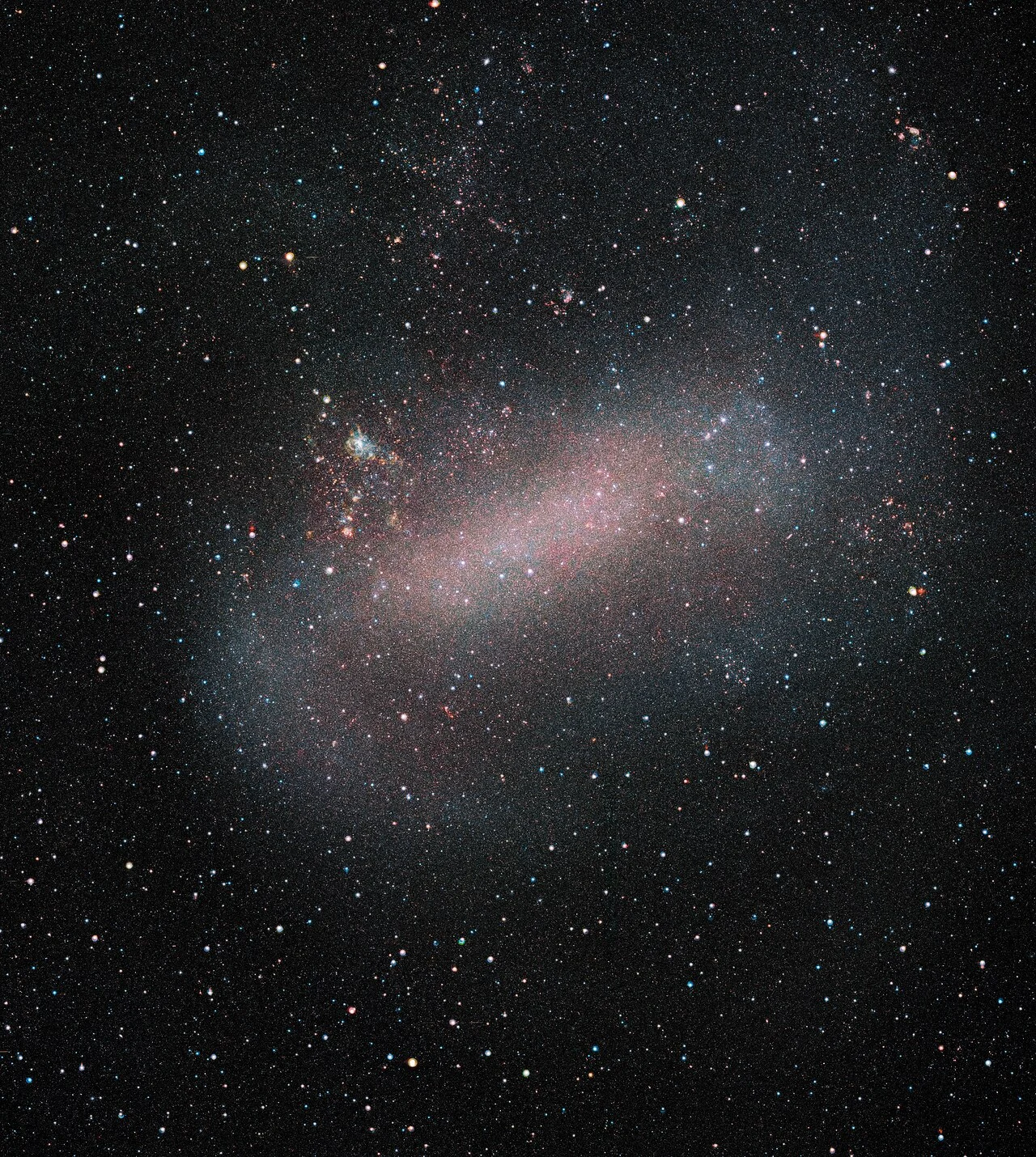
A team led by Sukanya Chakrabarti and Thomas Donlon used data from 54 millisecond pulsars located throughout our galaxy. The scientists measured microscopic asymmetries in gravitational acceleration near the Solar System and determined that these are caused by two dwarf galaxies, the Large Magellanic Cloud and the Sagittarius Dwarf Spheroidal Galaxy, which are currently influencing our region.
Why not kinematics?
The traditional method for determining a galaxy’s mass is based on observing the motion of stars and is called kinematics. The problem is that these motions carry the “memory” of billions of years of interactions: mergers, spiral arms, and gas clouds. It is extremely difficult to determine which event caused which motion.
Acceleration, however, behaves differently. The gravitational pull of a neighboring galaxy is acting right now, and the pulsar detects precisely this current influence, without any superimposition of effects from earlier eras. As Donlon explains, acceleration disappears as soon as the disturbance ends, whereas velocities persist long after it has ended.
Results and prospects
According to the team’s calculations, the mass of the Large Magellanic Cloud is about 41 billion solar masses, while that of the Sagittarius Galaxy is approximately 350 million solar masses. Both figures take into account both visible matter—that is, stars and gas—and the dark matter surrounding them.
The same method can also work on a smaller scale. With a larger sample of pulsars and more precise measurements, it could potentially allow us to map dark matter clusters throughout the Milky Way. Understanding where they are located and how much mass they have will bring us closer to answering the question of the nature of dark matter itself.
According to universetoday.com

