
Giant free-floating planets can form their own miniature planetary systems without the involvement of stars. This is stated in an article published on the arXiv preprint server.
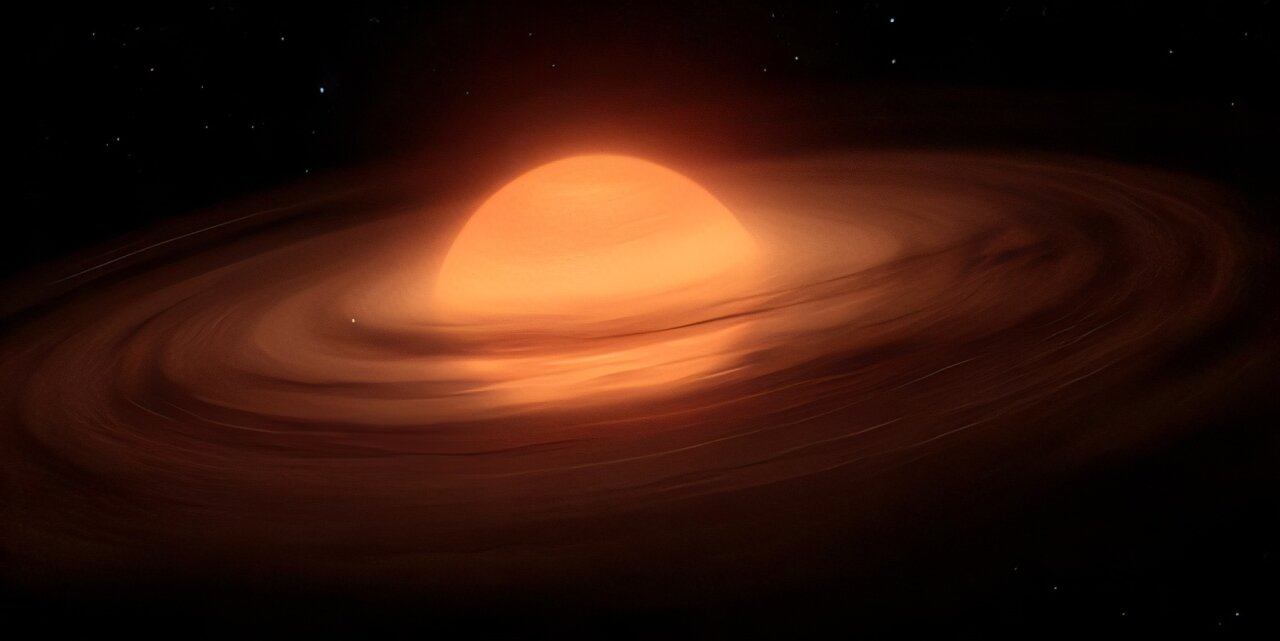
Free-floating planets that are not part of other star systems are difficult to observe because they are very faint and emit mainly in the infrared range. Nevertheless, they are key to solving important questions in astrophysics.
Recent studies show that these objects may form through the same mechanism as stars, as a result of the collapse of giant gas clouds. It is also possible that some of them are formed in star systems and then ejected from them into interstellar space. According to the third scenario, free-floating planets are formed as a result of collisions between circumstellar disks. In any case, such bodies do not have sufficient mass for thermonuclear reactions to occur in their interiors.
In a recent study, an international team of scientists used the James Webb Space Telescope (JWST) to study eight young isolated objects with masses 5–10 times greater than that of Jupiter. In terms of their properties, they are comparable to giant planets, but unlike them, they do not orbit any star.
JWST observations have confirmed that the mass of these bodies is comparable to that of Jupiter. Six of them have excess infrared emissions caused by a warm dust cloud in their immediate vicinity. This is a characteristic feature of the disks surrounding them — structures that are the birthplace of planets.
The observations also revealed radiation from silicate grains in disks with clear signs of dust growth and crystallization — typical first steps in the formation of rocky planets. Silicate radiation has previously been detected in stars and brown dwarfs, but this is the first detection in planetary-mass objects. It is worth noting that the results of a previous study showed that disks around free-floating objects with planetary masses can exist for several million years. This is sufficient time for planets to form.
According to scientists, these studies collectively show that objects with masses comparable to those of giant planets indeed have the potential to form their own miniature planetary systems. They may be similar to the Sun, only reduced in mass and size by a factor of 100 or more. However, whether such systems actually exist remains to be seen.
Earlier, we discussed the possibility of life on planets near dwarf stars and supergiants.
According to Phys.org

