

These dark formations in the photo are natural glass from the Brazilian state of Minas Gerais. Scientists have carefully studied them and claim that they are part of a debris field that formed about 6 million years ago. This is the result of a meteorite colliding with Earth at that time.
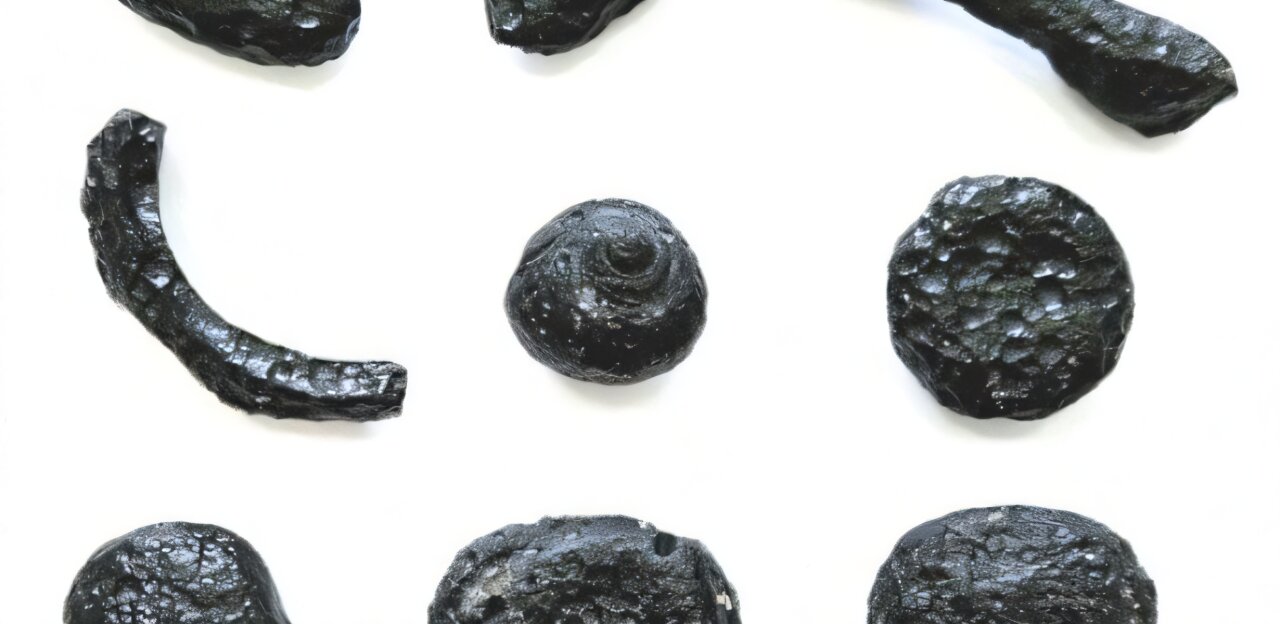
Tektite field in Brazil
For the first time in Brazil, researchers have discovered a field of tektites. These are natural glasses formed as a result of high-energy impacts of cosmic bodies on the Earth’s surface. These structures, named geraisites after the Brazilian state of Minas Gerais, where they were first discovered, form a new scattered field. This expands the picture of impacts in South America.
The discovery was described in an article published in the journal Geology by a team led by Álvaro Penteado Crosta, a geologist and senior professor at the Institute of Geosciences at the State University of Campinas (IG-UNICAMP). Crósta collaborated with researchers from Brazil, Europe, the Middle East, and Australia.
To date, only five large tektite fields have been recognized on the planet: in Australasia, Central Europe, Côte d’Ivoire, North America, and Belize. Now the Brazilian field joins this select list.
Distribution of geraisites in Brazil
The geraisites were originally located in three municipalities in northern Minas Gerais – Taiobeiras, Curral de Dentro, and São João do Paraíso – along a strip approximately 90 km long. After the article was published, new cases were reported in the Brazilian states of Bahia and, more recently, Piauí. According to Crósta, this expands the known territory to more than 900 kilometers in length.
The increase in distribution area is fully consistent with observations in other tektite fields around the world. The size of the field directly depends on the energy of the impact, among other factors,” explains the researcher.
As of July 2025, the authors had collected approximately 500 samples, which subsequently grew to more than 600 thanks to recent discoveries. The fragments vary in weight from less than 1 g to 85.4 g and reach approximately 5 cm along their longest axis. Their shapes are typical for aerodynamic tektites: spherical, ellipsoidal, teardrop-shaped, disc-shaped, dumbbell-shaped, or twisted.
Although they initially appear black and opaque, under intense light they become transparent and take on a grayish-green color. This color differs from that of European moldavites, which have been used in jewelry since the Middle Ages due to their characteristic bright green color. Their dark surfaces are marked by numerous small cavities. These cavities are traces of gas bubbles that escaped during the rapid cooling of molten material as it moved through the atmosphere — a process also observed in volcanic lava, but particularly characteristic of tektites.
Geochemical reflection of geraisites
Geochemical analyses show that geraisites have a high silica (SiO₂) content, ranging from 70.3 to 73.7%. The total content of sodium oxide (Na₂O) and potassium oxide (K₂O) ranges from 5.86% to 8.01%, which is slightly higher than in other tectitoic fields. Small variations were found in trace elements such as chromium (10–48 parts per million) and nickel (9–63 parts per million), indicating that the source material was neither pure nor homogeneous. The presence of rare inclusions of lechatelierite, a form of glassy silica formed at extreme temperatures, further confirms the impact origin.
“One of the decisive criteria for classifying the material as tektite was its very low water content, measured using infrared spectroscopy: between 71 and 107 parts per million. For comparison, volcanic glasses such as obsidian typically contain between 700 parts per million and 2% water, whereas tektites. For comparison, volcanic glasses such as obsidian typically contain between 700 parts per million and 2% water, whereas tektites are known for being significantly drier,” notes Crosta.
Dating based on the ratio of argon isotopes (⁴⁰Ar/³⁹Ar) indicates that the event occurred approximately 6.3 million years ago, at the end of the Miocene epoch. Three groups of similar age values were obtained (6.78±0.02 million years, 6.40±0.02 million years, and 6.33±0.02 million years), which is consistent with a single impact event.
No impact crater found
To date, no connected craters have been discovered. According to Crósta, this is not surprising; only three of the six large classical tectoid fields are known to have craters. In the case of the largest field, located in Australasia, it is believed that the crater is located in the ocean. In Brazil, isotopic geochemistry indicates that the molten material originates from the Archean continental crust aged between 3.0 and 3.3 billion years. This directs the search to the San Francisco Craton, an ancient and geologically stable part of the continental crust and one of the oldest areas in South America.
Scientists claim that the isotopic signature indicates a very ancient continental granite source. This significantly narrows down the range of possible areas. In the future, aerogeophysical methods such as magnetic and gravimetric surveys may reveal circular anomalies associated with buried or eroded craters.
Modeling the impact and its scale
Although it is not yet possible to accurately estimate the size of the body that caused the impact, researchers believe it is unlikely that it was small. The large amount of molten material and the wide area of dispersion indicate a significant impact event, although smaller than the one that caused the formation of the Australasian field, which stretches for thousands of kilometers.
The team is currently working on a mathematical model of impacts to estimate parameters such as energy released, velocity, angle of entry, and volume of molten rock. The model is refined as new data on the spatial distribution of geraisites becomes available. Their discovery fills an important gap in the record of impact events in South America.
Only about nine large impact structures are known there, and almost all of them are much older and located in Brazil. This discovery also reinforces the idea that tektites may be more common than previously thought, but often go unnoticed or are mistaken for ordinary glass.
According to phys.org

