

In the coming weeks, the Hera and Europa Clipper spacecraft will fly through the region of space where the tail of comet 3I/ATLAS extends. This is only the third interstellar object, so scientists would be interested to know what the particles escaping from its surface are.
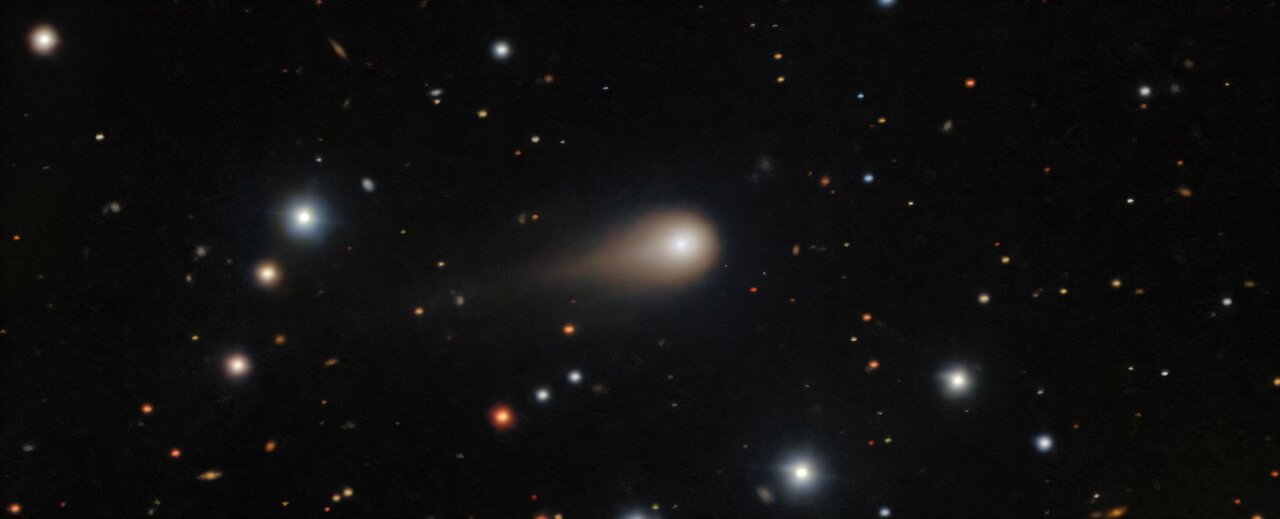
Tail of the interstellar comet
Comet 3I/ATLAS has caused a lot of excitement in recent months. This is not surprising, considering that it is only the third interstellar object known to humankind. No wonder there are many scary stories about it. However, there are some questions that are really interesting to scientists. Recently, an article appeared on the arXiv preprint server stating that scientists will have a chance to get answers to some of these questions in the coming weeks.
3I/ATLAS is currently passing through perihelion—the point in its orbit closest to the Sun. And it hasn’t just grown a tail; it keeps getting longer and longer. Significant emissions of water were detected in it, in particular OH– ions, which are a product of the decay of its molecules and can affect the global magnetic field of the Solar System.
The opportunity to explore the tail of an interstellar comet arose thanks to the Hera and Europa Clipper spacecraft. Each of them is heading toward its own target, but they will fly through the tail of comet 3I/ATLAS. And, by the way, it is not headed where most people think it is.
What the vehicles will be able to see
The fact that comet 3I/ATLAS is currently passing through perihelion, and thus beginning to move away from the Sun, does not mean that its tail is trailing behind it. It is a stream of particles that are “blown” off its surface by the solar wind. Therefore, it always points away from the sun. This is why situations where a comet flies tail-first are quite common.
But this also means that the direction in which the comet’s tail is pointing still needs to be calculated. To obtain these estimates, astronomers used a model called “Tailcatcher,” which estimates the trajectory of comet ions based on different wind speeds. Next, it calculated the minimum miss distance for a given spacecraft relative to the central axis of the comet’s tail. Unfortunately, the accuracy of the model depends on the accuracy of solar wind data, which is usually collected only after-the-fact, which is obviously insufficient to achieve the mission’s potential goal.
Hera will pass through the comet’s tail between October 25 and November 1, and Europa Clipper between October 30 and November 6. The former will be 8 million km from the comet’s nucleus, and the latter 8.2 million km.
Hera has no instruments that could potentially detect the ions expected in the tail or the magnetic “draping structure” that characterizes the influence of the comet’s atmosphere on the magnetic field carrying the solar wind. However, Europa Clipper has such instruments—its plasma instrument and magnetometer are exactly what is needed to directly detect these ions and changes in the magnetic field.
Taking advantage of this opportunity is difficult, softly speaking, but besides that, there is very limited time for it. It is unclear whether mission controllers at Hera, and perhaps more importantly, Europa Clipper, will see the messages in time to take action regarding their potential passage through the comet. But if they do, they could become the first in the history of humankind to directly sample an interstellar comet tail—and wouldn’t that be something to brag about, unrelated to their original mission?
According to phys.org

