

The interstellar object 3I/ATLAS, which is currently flying through our Solar System, continues to present astronomers with new mysteries. Initially, it was thought to be a typical icy comet. However, recent observations have revealed a surprising and rare anomaly—a so-called “anti-tail” pointing toward the Sun. This phenomenon challenges conventional wisdom about comet behavior and fuels scientific debate.
Mysterious “anti-tail”
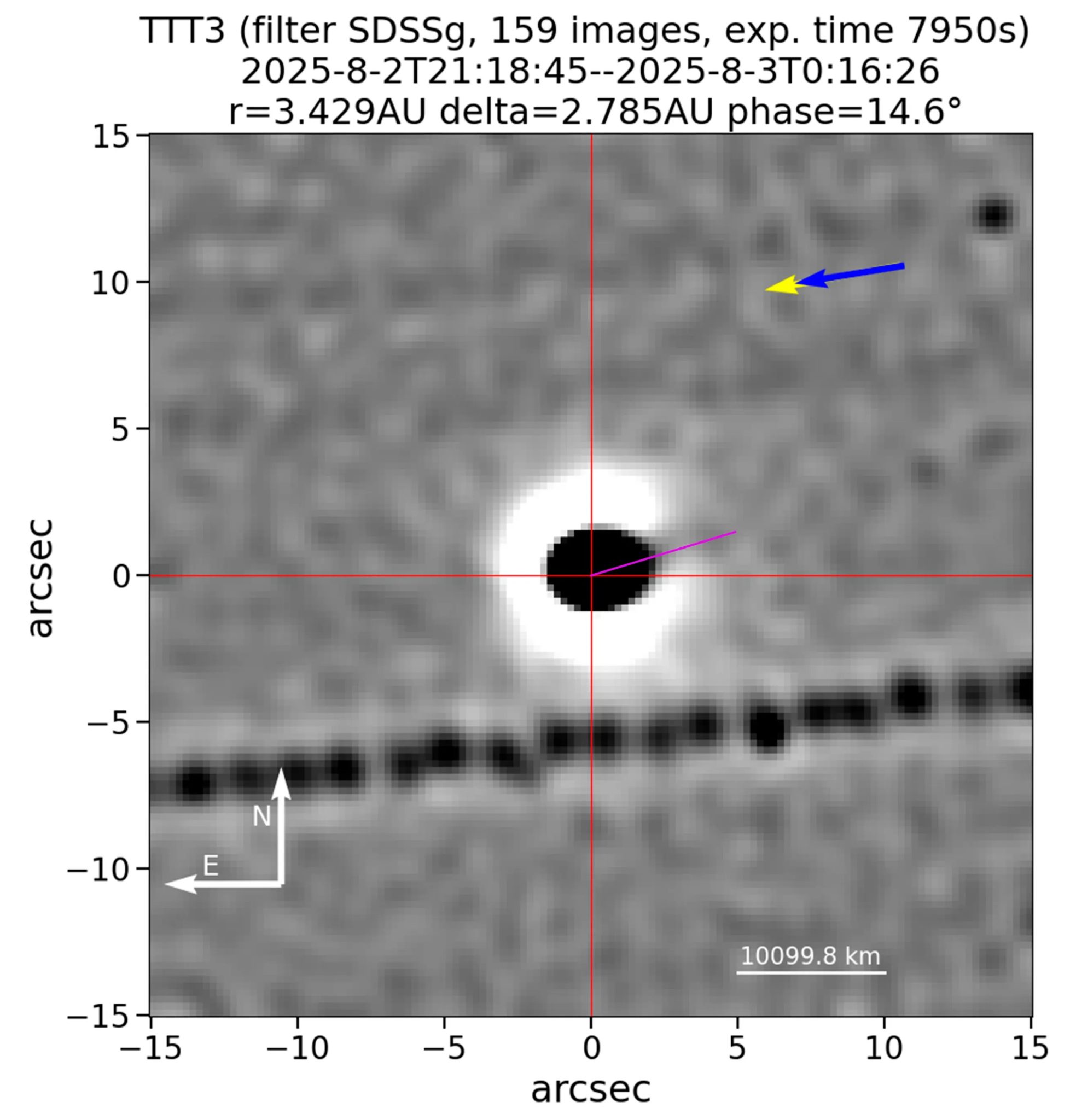
Last August, the powerful Keck II telescope in Hawaii targeted 3I/ATLAS when it was 2.5 times farther away than the distance from Earth to the Sun. The data confirmed the presence of cyanide and nickel emissions. However, the strangest thing was that these emissions were produced not only in the usual direction away from the Sun, but also in the opposite direction, i.e., toward it.
Harvard astronomer Avi Loeb, who described the observations in detail, noted that the classic comet tail, formed by dust repelled by solar wind, was virtually invisible in the images taken in normal light. However, this mysterious “anti-tail” is clearly visible.
Nature or illusion?
Scientists offer several possible explanations for this phenomenon.
- Optical illusion. Due to the Earth’s unique position in its orbit, the comet’s wide dust tail can appear to “split” from our perspective, creating the impression of two structures diverging in different directions.
- Large dust particles. The rapidly rotating nucleus of a comet can eject not only fine dust, but also larger, heavier debris. The solar wind easily repels fine dust, forming a normal tail. However, large particles remain in orbit around the nucleus, distributed both in front of and behind it. This trail of dust, directed toward the Sun, is perceived by us as an “anti-tail.”
As planetary astronomer Michael Bush explains, it doesn’t matter which side of the nucleus the ejection starts from. Small particles fly away from the Sun, while large ones remain in orbit, creating the appearance of two tails.
Object anomaly
For Avi Loeb, the 3I/ATLAS anti-tail remains an anomaly that requires attention. He wonders why experts continue to consider this object a normal comet, ignoring such strange behavior. Loeb even rated 3I/ATLAS at 4 out of 10 on his “Loeb Scale,” which measures the likelihood that an interstellar object could be the product of extraterrestrial technology. This assessment indicates the “increasingly abnormal characteristics” of the object.
Fortunately, science will have another chance to solve this mystery. Soon, 3I/ATLAS will return to Jupiter, providing a unique opportunity for NASA’s Juno and ESA’s Juice spacecraft to conduct closer observations. Perhaps they will provide the definitive answer to the question of the nature of this strange interstellar visitor.
We previously refuted the claim that 3I/ATLAS is not an extraterrestrial object.
According to medium.com

