

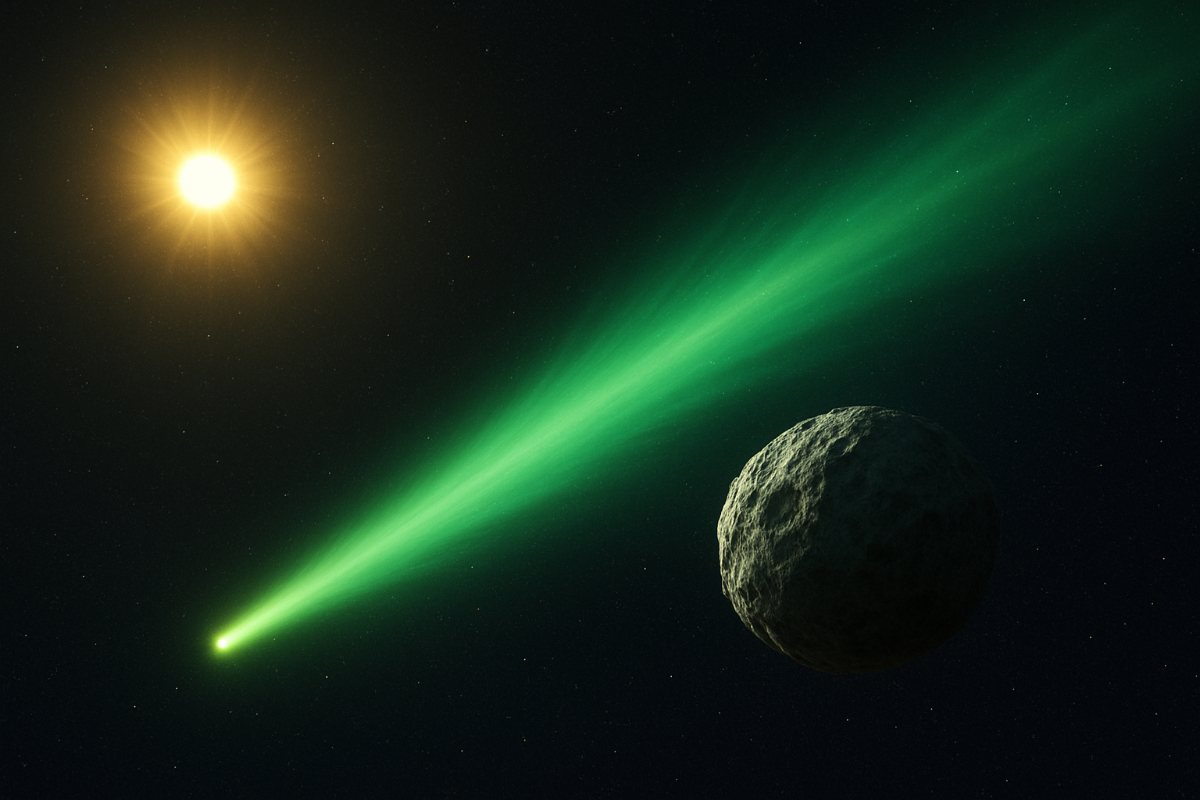
An extremely rare visitor is currently flying through the vastness of the Solar System — the interstellar comet 3I/ATLAS. This is only the third object ever discovered that originated from outside our planetary family. Astronomers were struck not only by its carbon dioxide-rich composition and chemical makeup, which caused it to suddenly change color, but also by its potentially enormous size. Well-known astrophysicist Avi Loeb from Harvard suggested in his new study that this visitor could be orders of magnitude more massive than any of the interstellar bodies found previously.
Avi Loeb, known for his research into extraterrestrial life hypotheses, analyzed the trajectory of 3I/ATLAS. He noted the non-gravitational acceleration of the object, which is less than 4.6 meters per day. This effect is partly caused by the fact that the comet, heated by the Sun, loses mass in the form of gases and dust. Knowing the rate of mass loss, Loeb was able to estimate the total mass of the comet’s nucleus.
The result was impressive. According to the scientist’s calculations, the mass of 3I/ATLAS should exceed 33 billion tons. This means that the diameter of its solid nucleus is more than 5 km. This estimate is at the upper limit of data obtained by the Hubble Space Telescope, making the comet a true giant compared to its predecessors.
Extremely rare
To understand the uniqueness of this discovery, Loeb suggests making a simple comparison. The first interstellar object, Oumuamua, was about 400 meters long. The second, Comet Borisov (2I/Borisov), is approximately 1 km in size. But 3I/ATLAS stands out significantly against them — it is tens of thousands of times more massive than either of them. This makes the interstellar traveler an extremely rare object.
The scientist notes that, based on our knowledge of the origin of heavy elements in space, we would have to discover about 100,000 objects the size of Oumuamua before finding one giant like 3I/ATLAS. However, astronomers have only managed to discover three such objects. These statistics highlight how fortunate we are to witness the visit of such a large interstellar body.
Mysterious trajectory and study plan
The comet’s flight path adds to the intrigue. It is approaching the orbits of several planets, particularly Mars, with extreme precision. According to forecasts, in a week’s time, 3I/ATLAS will fly past the Red Planet at a distance of just 2.7 million km. Loeb believes that this is an ideal opportunity for more detailed study.
The astrophysicist calls for the powerful HiRISE camera installed on NASA’s Mars exploration orbiter to be directed at the comet. High-quality imaging will allow direct measurement of the nucleus size by analyzing the amount of light reflected from it. This data will definitively confirm or refute calculations regarding its massiveness.
Alien technology or natural phenomenon
Although 3I/ATLAS is classified as a comet, Loeb does not rule out more exotic explanations. If further observations confirm that the nucleus is larger than 5 km, its origin from a normal interstellar cluster of material will become less likely. This again opens up space for hypotheses.
Is 3I/ATLAS an incredibly massive comet with a unique composition? Could it be an artifact from another civilization that has been traveling through space for millions of years? Loeb emphasizes that we should not jump to conclusions based solely on the chemical composition of the surface, just as we should not judge a book by its cover. The coming weeks and months of observation may provide us with answers to these intriguing questions.
Earlier, we explained whether an interstellar comet was an alien probe.
According to medium.com

