

Pulsars are neutron stars that rotate extremely quickly and sometimes experience a glitch in their rhythm. Observations of one of them, PSR J0922+0638, show that they can occur repeatedly over decades.
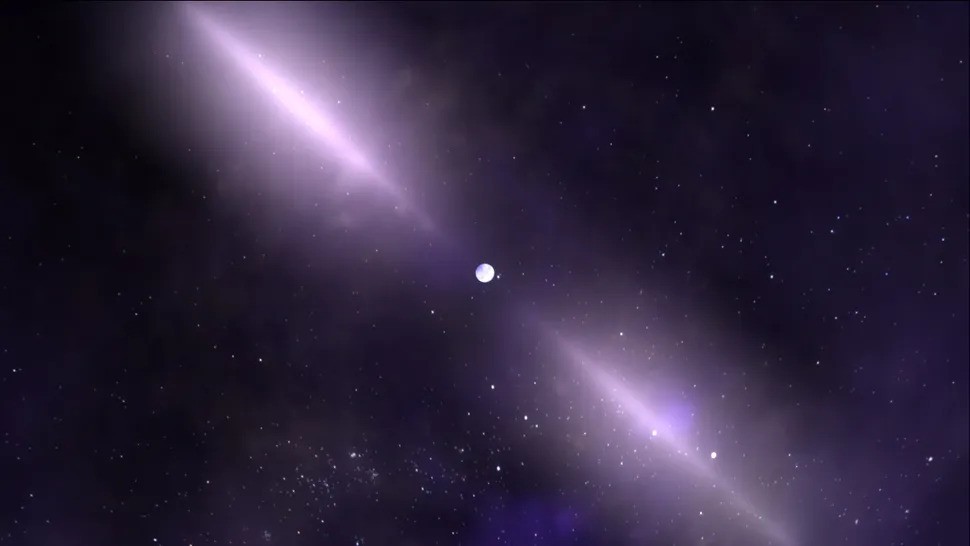
Pulsar glitches
If there is a standard of time accuracy in the Universe, it is pulsars. These neutron stars can rotate thousands or tens of thousands of times per second. At the same time, the duration of each of them repeats with incredible accuracy over several years. However, even these clocks sometimes malfunction.
They make up millions of fractions of the time it takes them to complete one rotation, because for them it is still an incredible event, accompanied by the release of a huge amount of energy.
It has long been known that glitches are events that occur quite frequently with pulsars. However, when observing them as a whole, it is very difficult to determine how much time passes between two similar events. Is it a matter of weeks, years, or tens of thousands of years?
Pulsar PSR J0922+0638
And here appeared a study based on data from the Nanshan Radio Telescope in China and MeerKAT in South Africa. Together, they have been observing this neutron star for 22 years and have a complete database of glitches that have occurred during that time.
It turns out that during the specified period of time, the pulsar failed more than a dozen times. On average, this happened once every 550 days, or about a year and a half. At the same time, glitches occurred quite regularly.
That is, this is actually quite a common phenomenon, even for a single pulsar. But this immediately raises questions about the mechanisms that lead to its emergence. Scientists have noticed that, in addition to glitches, the pulsar experiences slower and weaker cycles of deceleration and acceleration of rotation.
Thus, it is quite possible that the glitch mechanism has much in common with the cyclical nature of the magnetic field of PSR J0922+0638. Another explanation could be the presence of exotic supermatter of fundamental particles deep within the pulsar’s core. Sloshing inside it can change the rotation speed of the entire star, and when the liquid changes direction, it can cause a malfunction.
Ultimately, we do not understand where the glitches come from or what is happening inside pulsars. But these two phenomena have to be connected somehow, and only through careful, focused observation will we be able to figure out how.
According to www.space.com

