

Scientists have discovered that the fungus Aspergillus calidoustus can survive the conditions of outer space during a journey from Earth to Mars. And that’s not good at all, because no one can predict what will happen if it starts multiplying uncontrollably.
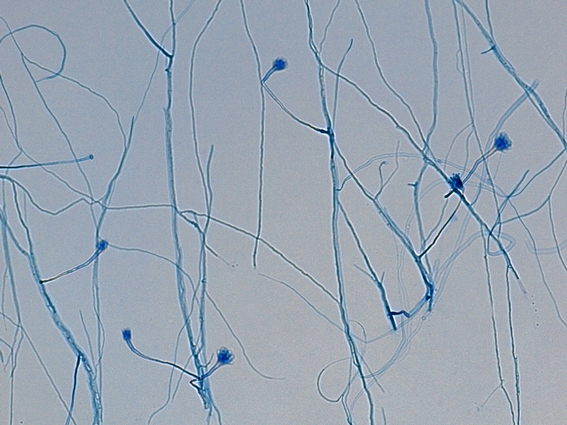
A fungus that survives in space
Scientists have long known that fungus is resilient, but a new study suggests that certain strains can survive every stage of the long and arduous journey to Mars. In an article published in the journal Applied and Environmental Microbiology, researchers isolated fungal microorganisms from NASA’s cleanrooms—facilities used for the assembly, testing, and launch of spacecraft—that had survived the disinfection process.
When simulated to the harsh conditions of pressure, temperature, and radiation typical of spaceflight and Mars, the spores of the fungus Aspergillus calidoustus, which reproduce asexually, survived.
“This does not mean contamination of Mars is likely, but it helps us better quantify potential microbial survival risks,” said microbiologist and study lead Kasthuri Venkateswaran, Ph.D. He is a former senior scientist in the Biotechnology and Planetary Protection (BPP) Group at NASA’s Jet Propulsion Laboratory.
NASA team that decontaminates spacecraft
This group implements NASA policies during various missions aimed at preventing the cross-contamination of Earth-based microorganisms with extraterrestrial ones, and vice versa. “Researchers have long sought to understand fungal survival under space conditions. This study is the first to show that microbial eukaryotes—which have a nucleus, like fungi—could persist through every part of a mission to Mars, from preparation to space travel to robotic exploration,” Venkateswaran said.
Researchers at BPP are studying how microorganisms survive and adapt to the harsh conditions of space, as well as how they can be detected and controlled. Their work involves analyzing disinfection strategies for spacecraft-related environments, although Venkateswaran noted that decontamination methods are typically evaluated using resistant bacteria rather than fungus.
Monitoring microorganisms is a critical step in the assembly process for spacecraft components and subsystems.
Testing fungus for compatibility with Martian conditions
As part of a new study, scientists first isolated conidia from 27 fungal strains collected from the assembly facilities used in the Mars 2020 mission, which culminated in the landing of the Perseverance rover on the Red Planet. The study also included two organisms—a bacterium and a fungus—that are known to be able to withstand high levels of radiation.
After that, they subjected these fungal conidia to the extreme conditions of spaceflight and Mars, including low temperatures, ultraviolet and ionizing radiation, low atmospheric pressure, and exposure to Martian regolith (loose, dusty rock material on the planet’s surface).
Conidia of A. calidoustus, isolated from NASA’s cleanrooms, withstood these rigorous tests, and, as the researchers discovered, only a combination of extremely low temperatures and high levels of radiation was able to destroy the fungus.
Possible contamination of Mars by Earth-based microorganisms
In the study, A. calidoustus was identified as a likely candidate for a microorganism capable of surviving in the extremely sterile conditions characteristic of spacecraft environments, entering a spacecraft, and surviving on robotic systems exploring the surface of Mars. It is based on preliminary studies in which bacteria and fungus were found on surfaces associated with NASA spacecraft after they had been disinfected.
“Together, these investigations help refine NASA’s planetary protection strategies and microbial risk assessment approaches for current and future space exploration missions,” Venkateswaran said.
According to phys.org

