iPhone 17 launch and expansion of satellite connectivity
In September 2025, Apple introduced the iPhone 17, a new smartphone that continued to develop the idea of satellite communication for ordinary users. Starting with the iPhone 14, the company introduced the ability to make emergency calls via satellites when there is no cellular signal. Now, according to Apple, the iPhone 17 supports a whole range of off-network communication features: sending messages via satellite, transmitting geolocation to Find My, and requesting roadside assistance in remote locations. These satellite services are provided in partnership with Globalstar and will be free for owners of new devices for the first two years. In other words, modern smartphones are learning to stay connected where there are no base stations or Wi-Fi.
How does an iPhone connect to a satellite?
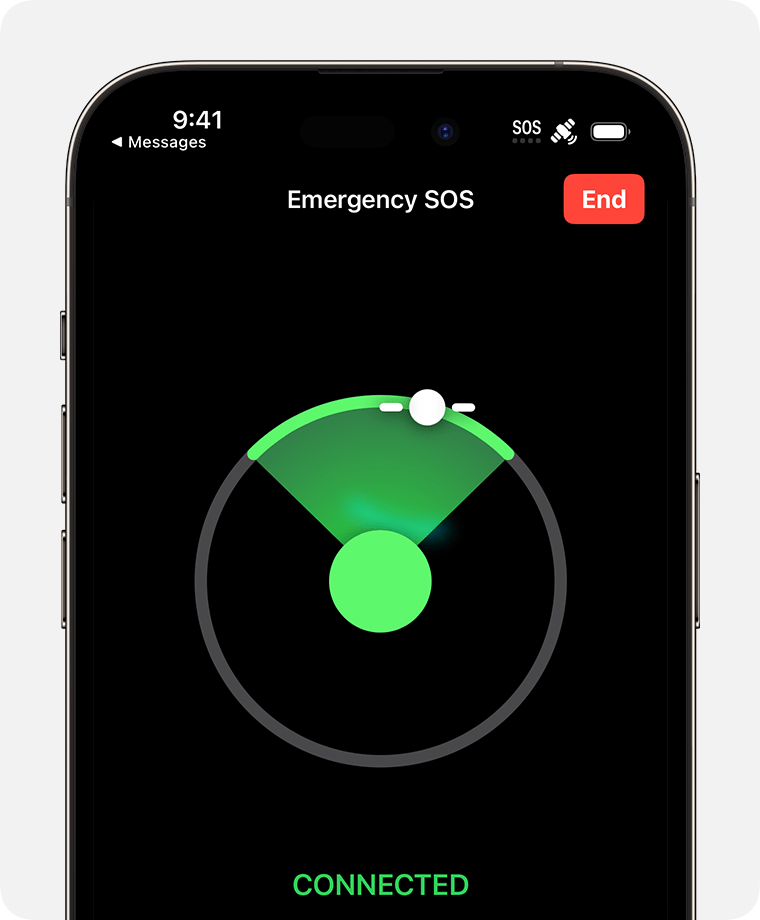
Satellite connectivity in the iPhone 17 allows you to send messages and data by connecting directly to satellites in low Earth orbit. If the phone cannot find a cellular network or Wi-Fi, it automatically activates satellite mode to call emergency services or send text messages. The feature is primarily focused on safety – for example, to call rescuers in remote areas or to transmit your location during an emergency. Apple emphasizes that these capabilities do not turn the iPhone into a full-fledged satellite phone: voice calls or surfing the Internet via satellite are not yet available. Communication mainly takes place in the form of short texts, and transmission can take tens of seconds due to the long distance to the satellite.
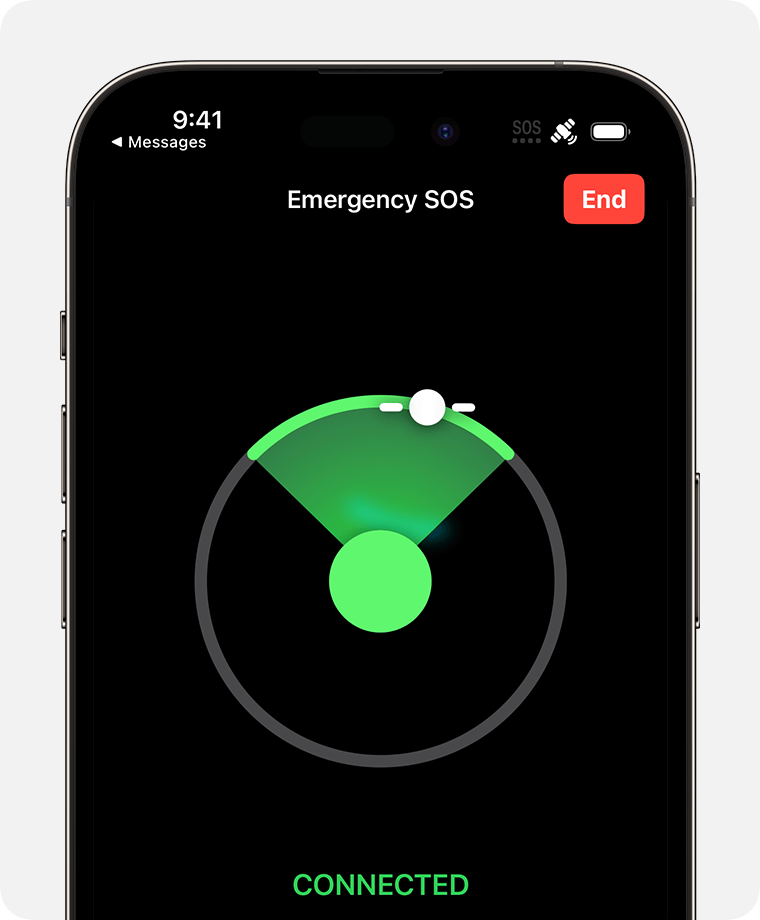
To catch a signal, the iPhone uses Connection Assistant – on-screen prompts that show you where to point your smartphone to establish a connection. In clear weather and with an open horizon, it is easier to establish contact: the phone connects to the nearest Globalstar satellite in low orbit, ~485 miles (~780 km above Earth), and transmits messages to ground stations through it. No bulky antenna is required – just hold the phone in your hand under the open sky. For example, Emergency SOS allows you to send a text message about a difficult situation: it goes from the phone to the satellite, then to the ground relay center, and from there to the rescuers. In iOS 18, Apple went further: in addition to connecting to 911, it became possible to send regular messages to loved ones via satellite directly from the Messages app (though only text and in limited regions). And although this is mainly intended for use in extreme situations, the idea of staying in touch in the mountains, the desert, or even on the open sea using a regular phone is quite encouraging.
How astronauts call from the ISS
But can these new smartphone capabilities replace special communication systems in orbit? Astronauts on the International Space Station (ISS) have been able to call Earth for many years, although not in the same way we do on our phones. There are no cell towers at the station, and a regular phone would immediately lose its signal. Instead, astronauts use NASA satellites for communication. Back in the early 2000s, IP telephony was introduced on the ISS. Essentially, a laptop with Cisco SoftPhone software connects to the station’s internal network, the signal is transmitted to NASA’s relay satellites (TDRS series), and then to ground infrastructure in Houston. This creates a space analogue of an Internet call. Astronauts can call their families and dial regular numbers, for example, through the Mission Control Center.

However, this connection has a slight delay. It is usually less than a second, but sometimes it reaches several seconds. This does not interfere with the conversation, but sometimes adds a comical echo. There have been some interesting cases: Dutch astronaut André Kuipers once tried to call the US, but missed a digit and dialed 911 – the emergency number. This raised the alarm on Earth: the system recorded a “call from space,” and the services checked to see if something had happened at the center. Another astronaut, Tim Peake, recounted how he dialed a random number and began with the phrase, “Hello, is this planet Earth?”, much to the surprise of the person on the other end. These stories show that astronauts can indeed call regular landline numbers, albeit indirectly. In fact, the ISS has private VoIP telephony for the crew, which allows them to call their loved ones or receive calls from management more or less freely. Of course, a regular smartphone does not work directly in space yet – special infrastructure is needed. But thanks to it, astronauts have not been cut off from Earth for a long time: they correspond by email, make calls on a schedule, and even hold video sessions with their families.
Direct smartphone-satellite communication: prospects and limitations
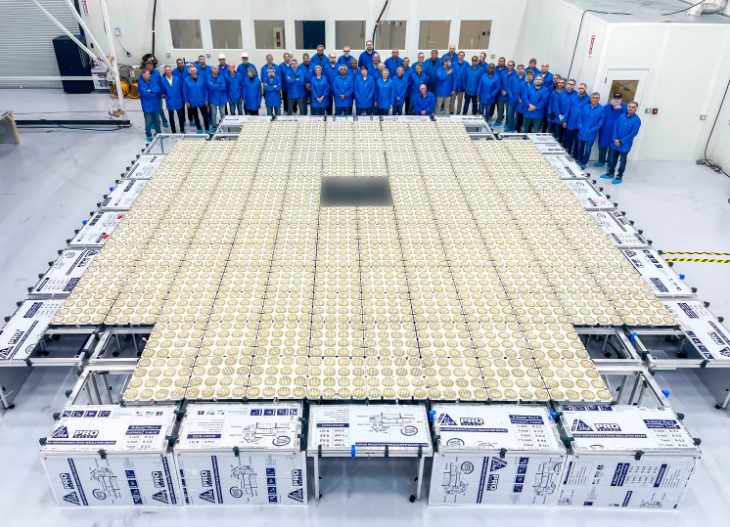
Today’s achievements, such as the iPhone 17, are only the first step toward full-fledged satellite telephony. In addition to Apple, others are also working on this idea. For example, AST SpaceMobile launched the BlueWalker 3 test satellite with a giant antenna – an orbital cell tower. In April 2023, AST made the first-ever direct call from a regular smartphone via a satellite in orbit. The test used an unmodified Samsung Galaxy S22, which connected to BlueWalker 3 in low orbit (~310 miles (~500 km)) and reached a subscriber on Earth. The call from Texas to Japan was made using a standard cellular protocol (via AT&T frequencies) – the only difference was that the base station was not on a mast but flying above the atmosphere. The company subsequently tested 4G/5G data transmission and even video calls between smartphones via satellite. This means that, technically, a smartphone can connect directly to an orbital satellite for two-way voice communication.
Another approach is demonstrated by SpaceX’s Starlink: in 2022, they announced a partnership with T-Mobile to teach Starlink satellites to communicate directly with existing phones. Initially, this system was supposed to allow SMS messages to be sent from anywhere in the US, even without network coverage. In the future, voice calls using the same scheme are also possible. Incidentally, Ukraine is one of the first countries to test Starlink Direct-to-Cell. How it works, what the advantages are for off-grid communication, and why it is important – read about it in our news article: Ukraine is one of the first to test Starlink Direct-to-Cell: what it is and why. So, although the service is still in development as of the end of 2025, the direction is clear: the boundaries between satellite and mobile communications are blurring.
At the same time, there are limitations. Direct communication between a smartphone and a satellite requires a sensitive antenna and sufficient energy. Satellites such as BlueWalker have huge folding antennas (covering tens of square meters) precisely to reach the weak signals of phones on the surface. One device can serve an area of hundreds of thousands of square kilometers, but global coverage requires an entire orbital group. In addition, satellites move quickly in orbit – to keep a phone in range, either a network of many devices or special orbits is needed. Finally, signal delays and low bandwidth can interfere with comfortable conversation: pauses and reduced sound quality are still inevitable. However, tests show that the delay can be acceptable (about a second), which is comparable to some Internet calls on Earth.
A glimpse into the future: calling from the ISS via iPhone – when?
Let’s get back to the main question: can an astronaut simply pick up an iPhone and call his wife or children from the ISS? Not yet, at least not directly. The current satellite function of the iPhone is designed for emergency messages and is intended for use on the surface of the planet. Communication on the ISS is provided by specialized NASA channels. A smartphone in space cannot connect to a terrestrial network, and its satellite mode is not configured to work in orbit (and inside the module, the signal will be shielded by the hull). At the same time, astronauts can already call home – they just do it through the onboard computer and NASA satellites, rather than directly from their pocket phones. In essence, astronauts use Wi-Fi calls via satellite, and for the subscriber on Earth, such a call is not much different from a regular one.
What will change in the coming years? There is a high probability that technologies such as AST SpaceMobile will become commercially available. If a network of orbital cell towers is deployed around the Earth, theoretically any modern smartphone (including the iPhone) will be able to connect to it from anywhere – even from orbit, if there is direct visibility of the satellite. Future generations of Apple gadgets will likely expand their satellite capabilities as well. For example, the next step could be not only text messaging, but also voice calls via satellite in an emergency. Then your iPhone will be able to not only send an SOS in the mountains, but also call rescuers directly. For astronauts, this means a backup channel: if the main system fails, why not use a regular phone as a backup option?
Satellite communication in smartphones is no longer science fiction, but reality, albeit at an early stage. The example of the iPhone 17 shows how quickly the industry is progressing: what seemed like a bold idea yesterday is now available to the mass user. Full-fledged calls from orbit using a regular phone are still the domain of specialized systems, but the technological distance between astronauts and their families is rapidly shrinking. Perhaps in a few years, the phrase “I’m calling you straight from space” will no longer be a figure of speech. In the meantime, if you find yourself on top of Everest or in the middle of the ocean, your smartphone, newer than the iPhone 14, will already be able to whisper to a satellite, “Hi, I’m fine,” and your loved ones will see it, wherever they are.