

The crews of the Shenzhou-20 and Shenzhou-21 missions set up a real kitchen on the Chinese Tiangong space station: using a new sealed ‘hot air’ oven, they cooked chicken wings and steaks right in zero gravity. The unit operates on the principle of convection with evaporation and grease filtration to prevent contamination of the module’s atmosphere and avoid risks to equipment. The event coincided with a five-day shift change, when six taikonauts were working at the station at the same time — a convenient moment to demonstrate the capabilities of the upgraded space kitchen.
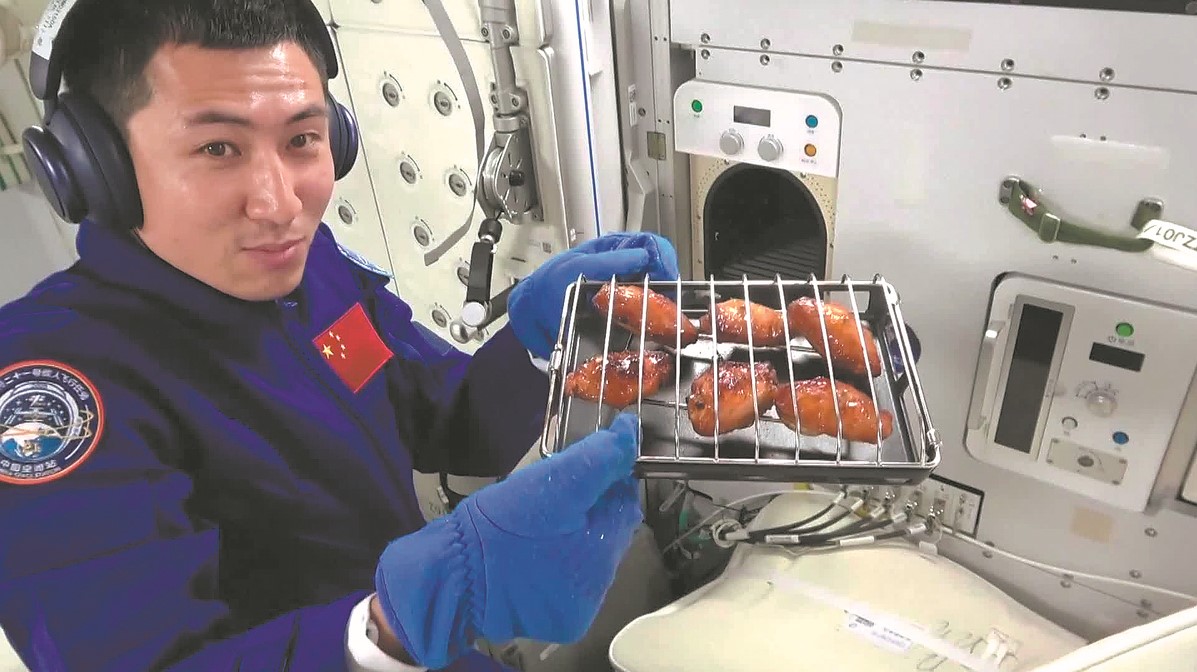
The oven was delivered together with the Shenzhou-21 spacecraft and installed in the living segment. The published footage shows the taikonauts placing wings on the rack, putting them in the oven and taking out evenly cooked meat — without smoke or soot. According to the developers, such a device in microgravity actually acts as an air fryer, combining hot air circulation and multi-stage filters. In addition to the familiar taste, this is an important test of domestic systems for long-term missions, where the morale of the crew directly affects productivity.
How does it work? In this space oven, everything depends on two things: a closed chamber and a controlled flow of hot air. In zero gravity, fat and crumbs do not fall down, but fly around the module, so food is cooked in a sealed box where fans circulate heated air around the product — just like in an air fryer. Inside, there is a mesh holder to prevent pieces from flying out, a condensate tray, and the exhaust passes through filters (mechanical + charcoal) that capture odours, aerosols and microdroplets of fat. Heating is electric and uniform, with temperature sensors and a door lock to prevent it from being opened during operation. The secret is simple: forced convection and multi-stage filtration allow food to be cooked without flames, smoke or mess — safe for the station and pleasant for the crew.
Why is this important? Proper food processing in orbit is not entertainment, but an element of autonomy. Such systems reduce dependence on ready-made rations, expand the menu, and improve sleep, mood, and cognitive endurance of crews during months-long shifts. For future expeditions — from lunar stations to flights to Mars — this is part of life support, along with water regeneration and waste processing. For astronomical programmes, this means more stable long shifts and fewer risks of errors during complex observations and experiments in microgravity.
Would you like to witness Saturn without its rings and a bright comet with your own eyes? Our November guide has everything detailed: exact dates and times of events, where to look, what is visible to the naked eye and where binoculars will come in handy, as well as life hacks for the city sky. Save the calendar of events and don’t miss the most beautiful nights of this month, all in the article ‘Astronomical events of November 2025’.
According to chinadaily



