

Astronomers have made the most accurate assessment of interstellar comet 3I/ATLAS. They used the Hubble Space Telescope to do this.
The interstellar comet 3I/ATLAS was discovered in early July. It became only the third confirmed object in history to arrive from interstellar space. According to some estimates, it may be the oldest object flying through the Solar System. Analysis of the trajectory shows that the comet may originate from the thick disk of the Milky Way. This means that it is at least 3 billion years older than the Solar System.
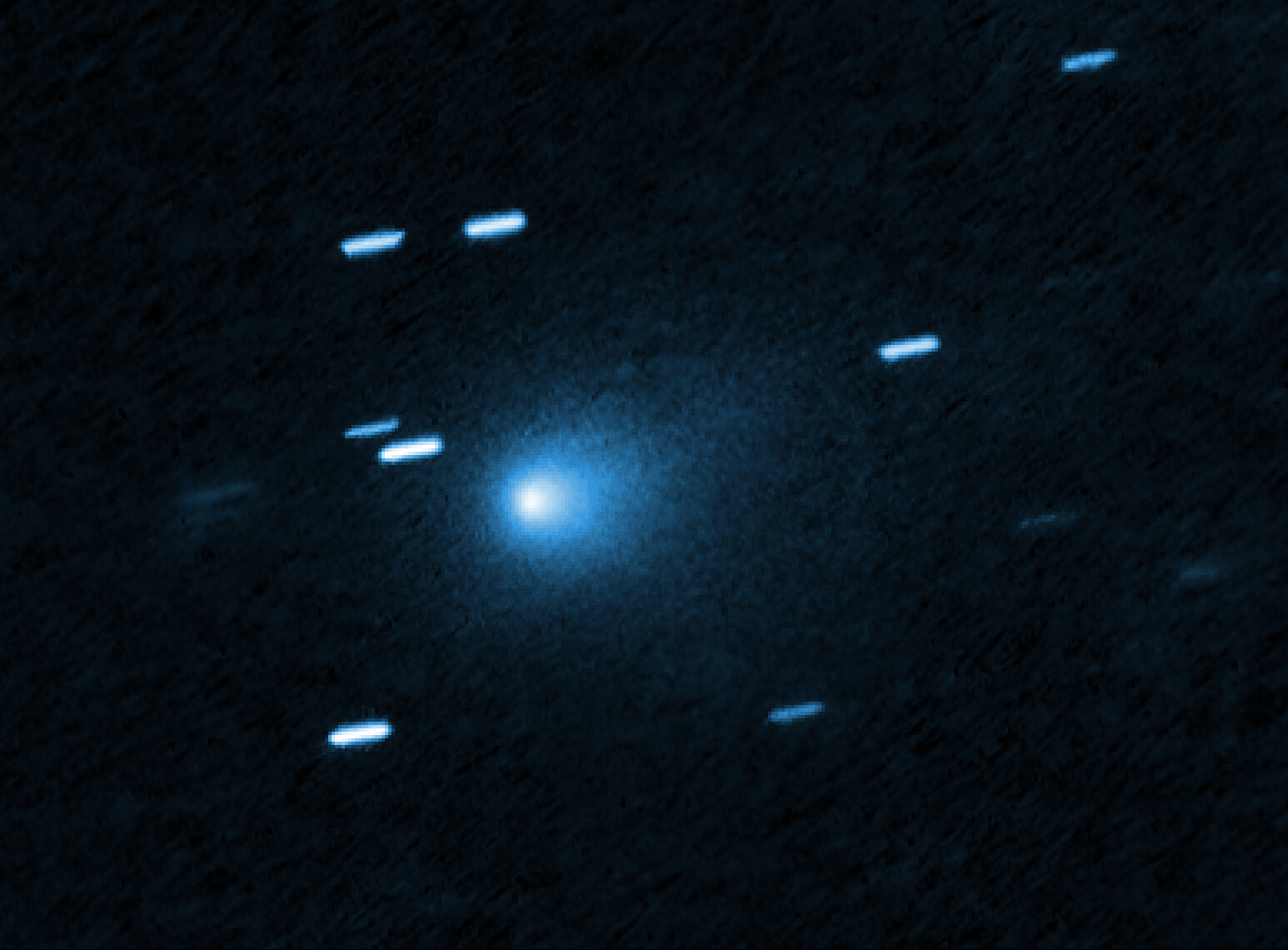
It is not surprising that astronomers are keeping a close eye on 3I/ATLAS. Hubble is also participating in these projects. Recently, it photographed an interstellar comet. These images have made it possible to assess its characteristics much more accurately.
Shortly after its discovery, 3I/ATLAS was thought to have a diameter of up to 20 km. Observations by Hubble have significantly revised this figure. It turned out that the upper limit of the comet’s nucleus diameter is 5.6 km, while the lower limit is only 320 meters. It is not yet possible to give a more accurate estimate, as even Hubble is still unable to distinguish the nucleus of the icy visitor.
Hubble also captured the dust trail ejected from the sunlit side of the comet and a hint of a dust tail extending from the nucleus. The telescope data show a dust loss rate consistent with comets that are first detected at a distance of about 480 million kilometers from the Sun. This behavior is very similar to that of previously observed comets that originated in our Solar System. The key difference is that 3I/ATLAS formed in some other system and was then ejected into interstellar space.
Currently, 3I/ATLAS is moving through our Solar System at a speed of approximately 58 km/s, which is the highest speed ever recorded for an interstellar object. This confirms that the comet drifted through interstellar space for many billions of years. The gravitational pull of countless stars and nebulae that the comet flew past gave it a boost, significantly increasing its speed.
3I/ATLAS should remain visible to ground-based telescopes until September, after which it will come too close to the Sun to be observed. The comet is expected to become visible again in early December.
You can learn more about how interstellar objects form in our article.
According to Esahubble

