

NASA has released a new image captured by the Hubble Space Telescope. It shows the reflective nebula NGC 1333, which is home to many young stars.
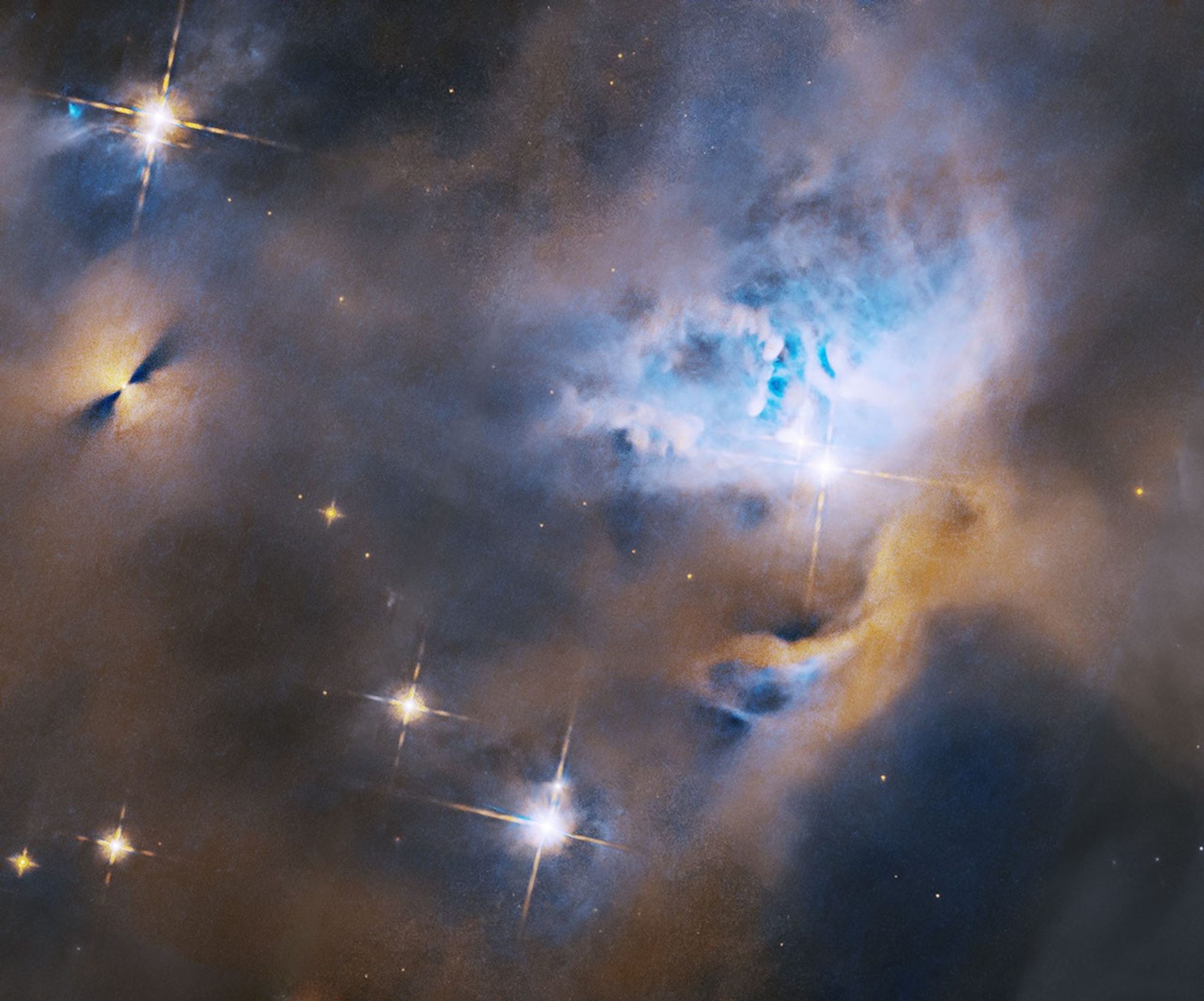
NGC 1333 is located about 950 light-years from Earth in the Perseus molecular cloud and is a region of active star formation. It was photographed by the Hubble Telescope to study newborn stars, their surrounding disks, and the emissions they create.
The photo shows a diverse collection of young stellar objects. On the left side, you can see an actively forming star (protostar) that illuminates the surrounding gas and dust, creating a reflection nebula. The two dark bands on opposite sides of the bright point (top left) are the protoplanetary disk, an area where planets can form, and the shadow of the disk falling on the large shell of matter around the star. The protostar is fueled by material from this disk, which was formed by the collapse of a gas and dust cloud. Where the shadow ends and the disk begins is currently unknown.
In the center right, the cavity of the outflow reveals a fan-shaped reflection nebula. The two stars at its base, HBC 340 (bottom) and HBC 341 (top), are sources of powerful winds. They interact with the surrounding molecular cloud, forming cavities in it. Their radiation illuminates the gas and dust, creating a reflection nebula. The brightness of this nebula fluctuates over time, which researchers attribute to changes in the brightness of HBC 340 and HBC 341. HBC 340 is the main source of the fluctuations, as it is the brighter and more variable star.
HBC 340 and HBC 341 are classified as Orion variable stars. This is the name given to forming stars that change brightness irregularly and unpredictably, possibly due to stellar flares and ejections of matter from their surfaces. After reaching the main sequence, they either lose their variability or become regular variables.
In this image, the four bright stars at the bottom and the one in the upper right corner are also variable stars in Orion. The rest of the cloudy landscape is dotted with other forming stars.
According to NASA

