

Astrophotographer Satoru Murata has published a photograph of interstellar comet 3I/ATLAS. It shows its tail and anti-tail.
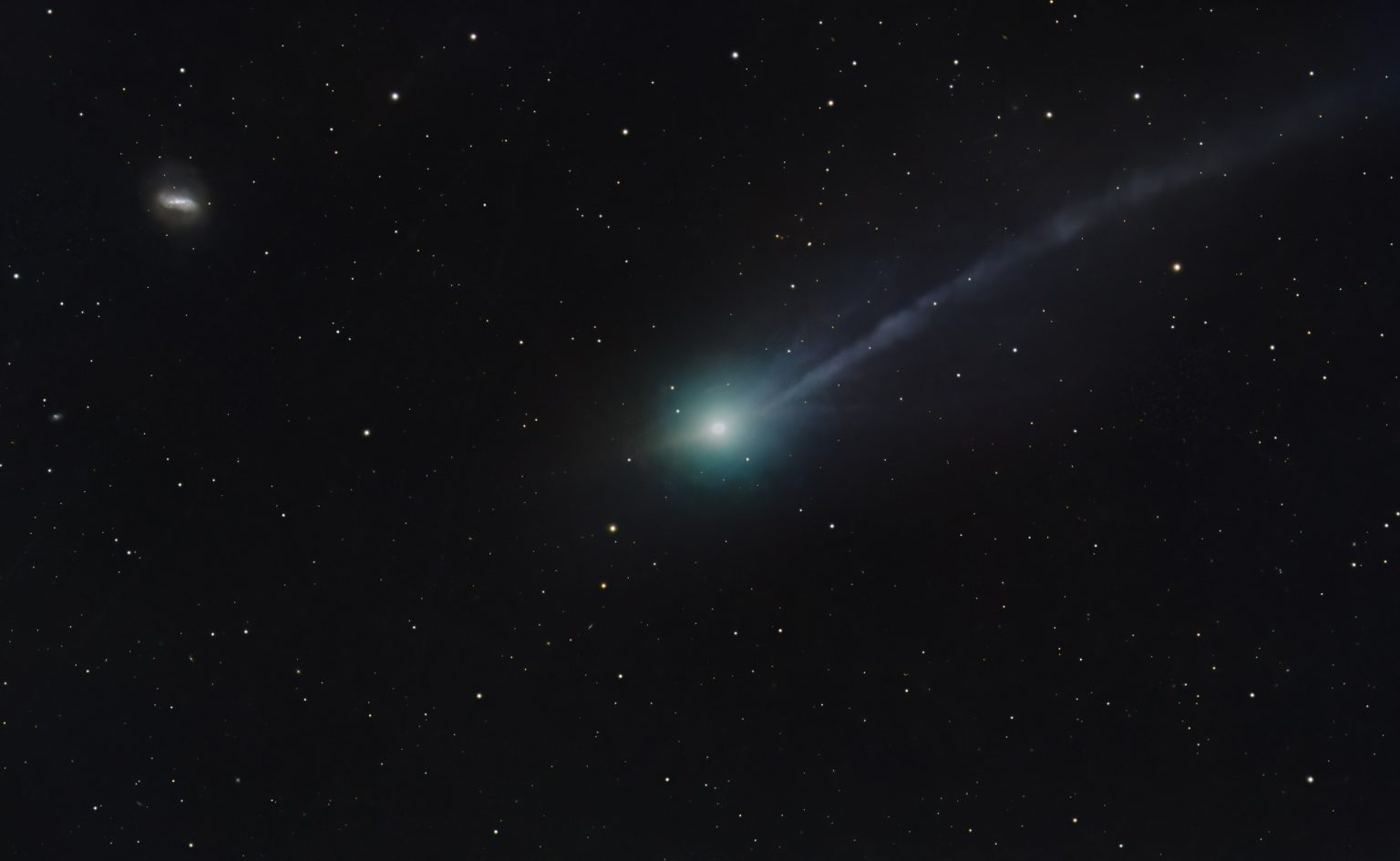
The 3I/ATLAS image was taken on the morning of November 16 in New Mexico. To capture the image, Murat used a Celestron EdgeHD800 telescope and a Touptek ATR2600C camera. The image he published is composed of 24 frames taken with a 60-second exposure.
The photograph shows the complex structure of the tails of 3I/ATLAS. They consist of volatile substances that have sublimated from its surface. Observations have shown that 3I/ATLAS is unusually rich in carbon dioxide. Astronomers have also detected substances such as water ice, carbon monoxide, carbonyl sulfide, and cyanide. It is the molecules of the latter that are responsible for the characteristic blue-green color of the interstellar comet. Earlier it was reported that 3I/ATLAS changed color as it passed through perihelion, but as it turned out later, this was incorrect.
In addition to its main tail, the ATLAS comet also has an anti-tail. In the image, it looks like a small spike. The anti-tail consists of larger dust particles that are less affected by the Sun’s radiation pressure and tend to remain roughly in the plane of the comet’s orbit, eventually forming a disk along its orbit. When Earth passes through the plane of the comet’s orbit, this disk is visible from the side and looks like a distinctive spike.
In addition to the comet, the photo also captured the galaxy NGC 4691. It is located 70 million light-years from Earth in the direction of the constellation Virgo.
Earlier, we reported on how the Mars mission helped to pinpoint the location of comet 3I/ATLAS.

