

The GOES-19 satellite, owned by the US National Oceanic and Atmospheric Administration (NOAA), photographed the interstellar comet 3I/ATLAS hidden in bright sunlight. The images confirm that it has not changed its orbit and behaves like comets in our Solar System.
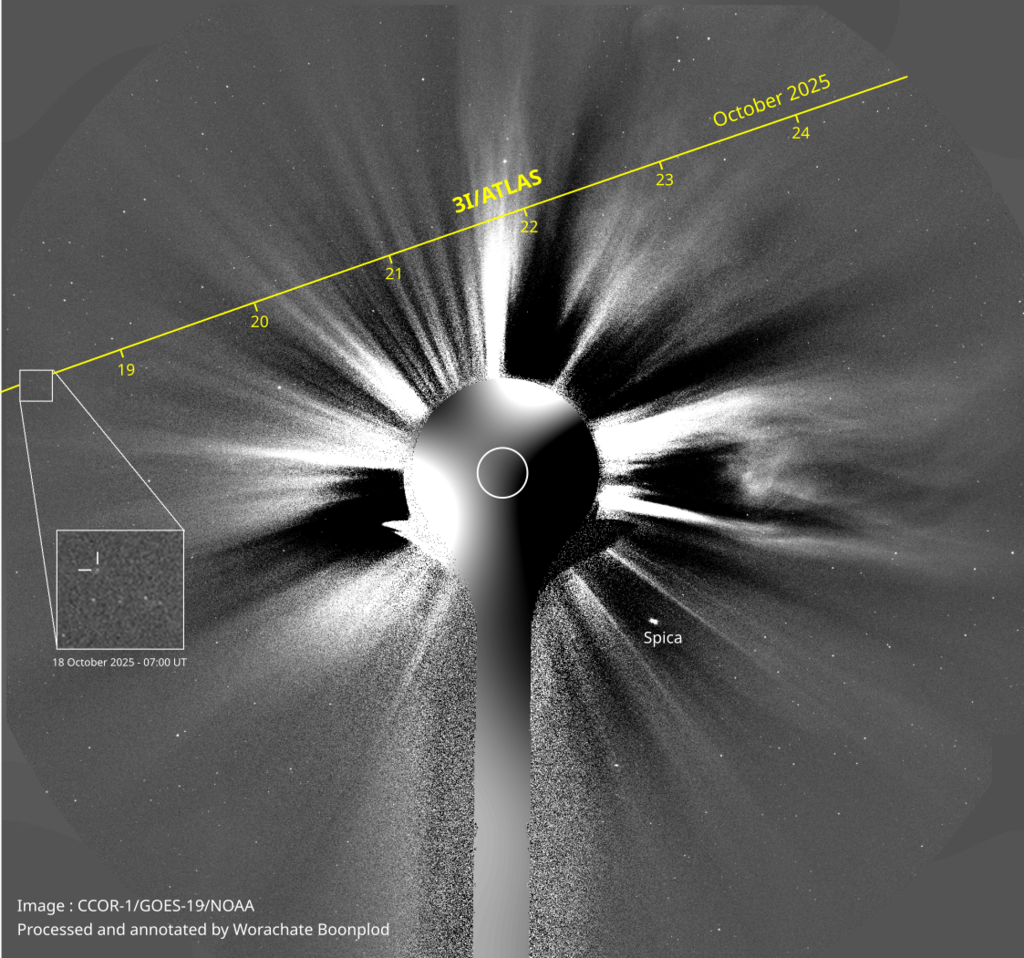
3I/ATLAS has become the third object of interstellar origin ever found in the Solar System. It is currently approaching the Sun. On October 29, the comet will pass the perihelion of its orbit, closing to a minimum distance of 1.35 AU. Because of this, it is currently almost impossible to observe the interstellar visitor from Earth.
Many tabloid media outlets, internet accounts, and bloggers took advantage of this circumstance to generate more traffic, once again speculating that 3I/ATLAS is an alien spacecraft. The internet is full of misleading articles with clickbait headlines such as “Mysterious object hidden behind the Sun is up to no good” or “3I/ATLAS has grown a tail — a possible sign of an alien maneuver.” However, in reality, 3I/ATLAS did not hide anywhere and did not perform any “maneuvers.” Although due to its position in the sky, the comet cannot be seen with ordinary telescopes, it can be observed by spacecraft equipped with coronagraphs (devices that block out sunlight).
One such device is the GOES-19 satellite, equipped with a CCOR-1 coronagraph. Thai amateur astronomer Worachate Boonplod analyzed its images and discovered an interstellar comet. It is located exactly where it should be in the Solar System. The comet is also being observed by NASA’s four PUNCH spacecraft and the SOHO observatory, which monitors the Sun.
“If 3I/ATLAS does not fade significantly in the next couple of days, we will be able to track it all the way to its perihelion,” said coronagraph expert Carl Battams.
Tracking a comet is not easy because it is very faint. Battams explained the process: “Objects on the edge of detection, such as 3I/ATLAS, pose a challenge for coronagraphs. We often have to use image superimposition techniques. For this to work, we need to understand the direction and distortion of the telescopes very precisely in order to find the exact pixels corresponding to the comet. It’s quite laborious, but we cope.”
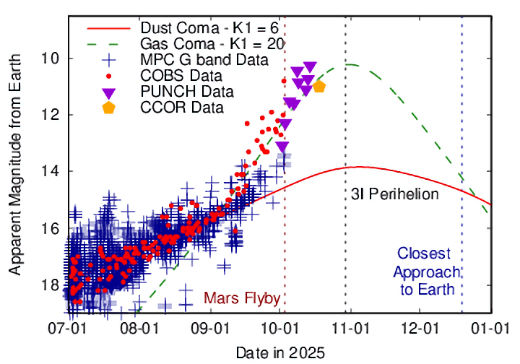
If 3I/ATLAS changes direction or brightness, astronomers will know immediately. But it behaves like a normal comet. Marshall Eubanks of Space Initiatives Inc. has drawn up a brightness curve, including the latest data from CCOR-1 and PUNCH. The available data confirm that 3I/ATLAS follows a fairly standard comet brightness model, taking into account the gas and dust it emits. And although this is sad news for ufologists and conspiracy theorists, it does not make 3I/ATLAS any less interesting: after all, it is only the third interstellar object known to us, which is most likely several billion years older than our Solar System.
According to Spaceweather.com

