

The interstellar comet 3I/ATLAS is once again visible from Earth. Ground-based telescopes managed to capture several images of the tailed visitor after it passed its perihelion.
On October 29, comet 3I/ATLAS passed the perihelion of its orbit, flying at a distance of 203 million km from the Sun. On this and previous days, it was inaccessible for observation with ground-based telescopes, as the Sun obscured it. At the same time, the comet could be observed by spacecraft equipped with coronagraphs.
This led to an interesting discovery: in September and October, the comet’s brightness increased dramatically, and it turned blue. Scientists attributed this to a massive gas emission that blocked the reflection of its reddish dust. At the same time, reports that the comet has performed some kind of “inexplicable maneuvers” and is therefore an alien spacecraft are not true. 3I/ATLAS is moving exactly as a comet should move and is in its proper place.
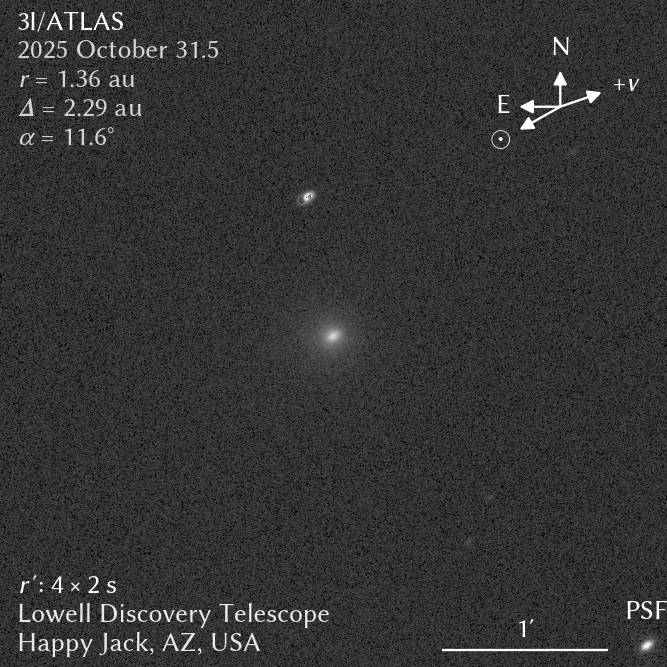
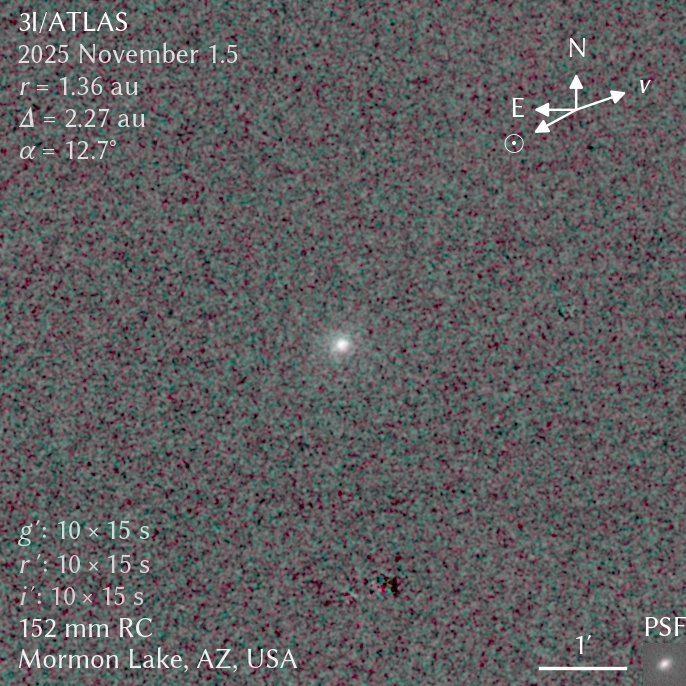
After passing perihelion, the comet became visible again to ground-based observatories. On October 31, astronomer Qicheng Zhang photographed it using the 4.3-meter LDT telescope installed at the Lowell Observatory. And on November 2, he photographed it using a 152-millimeter Ritchie-Chrétien reflector, proving that the interstellar visitor could now be observed with smaller telescopes.
In the coming days, the visibility of 3I/ATLAS in the Northern Hemisphere will improve, allowing for comprehensive observations of the comet. Spacecraft, such as the European JUICE probe, will also participate in these observations.
On December 19, 3I/ATLAS will approach Earth at a minimum distance of 269 million km. In March 2026, the comet will fly past Jupiter at a distance of 53 million km. After that, 3I/ATLAS will head into deep space and never return to the Solar System.

