

Radar satellites operating in Mars’ orbit regularly detect strange bright reflections under the planet’s ice caps. These are usually interpreted as pools of meltwater, but scientists have recently begun to question this interpretation.
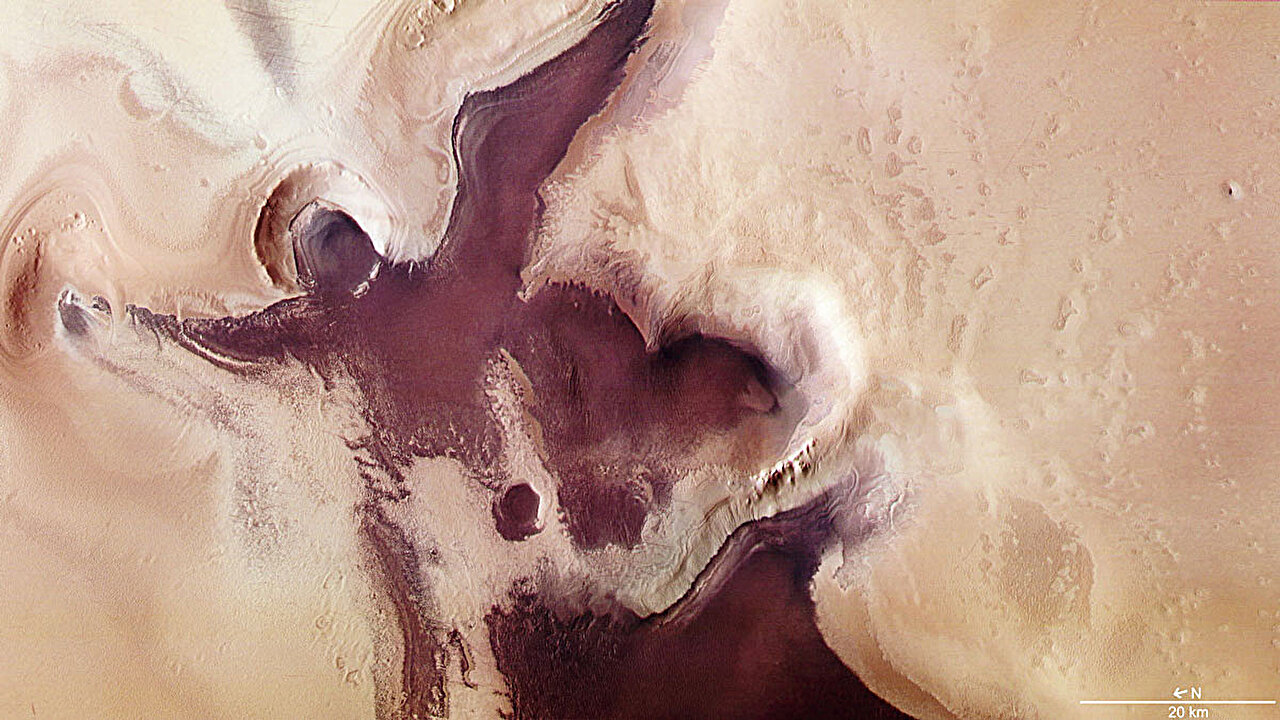
MARSIS radar discovery
Ancient Mars boasted abundant water, but the cold and dry conditions of today make liquid water on the Red Planet seem far less probable. However, the Mars Advanced Radar for Subsurface and Ionosphere Sounding (MARSIS) detected strong radar reflections from a 20-kilometer-wide area over the base of Mars’s southern polar ice cap, hinting at the possibility of liquid water below the icy surface. Such a finding would have major implications for the planet’s possible habitability.
But sustaining liquid water underneath the ice might not be feasible without very salty brines or localized volcanic heat. Scientists have deliberated about other possible “dry” explanations for the bright reflections detected by MARSIS, such as layers of carbon dioxide and water ices or salty ice and clay causing elevated radar reflectivity.
Penetrating signals of the SHARAD device
Aboard the Mars Reconnaissance Orbiter, the Shallow Radar (SHARAD) uses higher frequencies than MARSIS. Until recently, though, SHARAD’s signals could not reach deep enough into Mars to bounce off the base layer of the ice where the potential water lies – meaning its results couldn’t be compared with those from MARSIS.
However, the Mars Reconnaissance Orbiter team recently tested a new maneuver that rolls the spacecraft on its flight axis by 120° – whereas it previously could roll only up to 28°. The new maneuver, termed a “very large roll,” or VLR, can increase SHARAD’s signal strength and penetration depth, allowing researchers to examine the base of the ice in the enigmatic high-reflectivity zone.
Most likely not liquid water
Gareth Morgan and colleagues, for their article published in Geophysical Research Letters, examined 91 SHARAD observations that crossed the high-reflectivity zone. Only when using the VLR maneuver was a SHARAD basal echo detected at the site. In contrast to the MARSIS detection, the SHARAD detection was very weak, meaning it is unlikely that liquid water is present in the high-reflectivity zone.
The researchers suggest that the faint detection returned by SHARAD under this portion of the ice cap is likely due to a localized region of smooth ground beneath the ice. They add that further research is needed to reconcile the differences between the MARSIS and SHARAD findings.
Provided by: phys.org

