

In March 2022, the scientific community was shocked by a discovery made by the Hubble Space Telescope, which detected a star at an incredible distance of 12.9 billion light-years (z ≈ 8.0). The object was given the poetic name Earendel, which translates from Old English as “morning star.” It instantly earned the title of the oldest and most distant star ever found in the Universe. However, new data from the most advanced James Webb Telescope is forcing scientists to significantly revise this discovery.
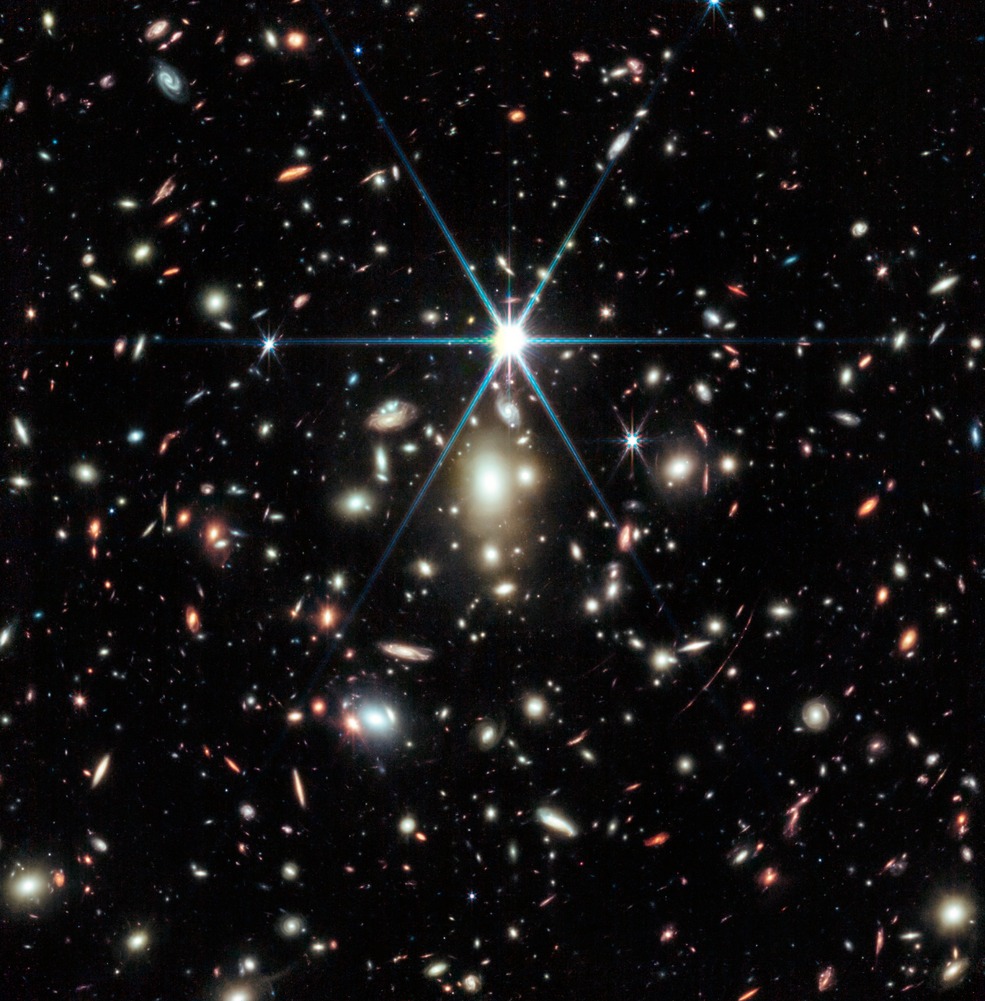
The key to discovering Earendel was a unique phenomenon known as gravitational lensing. The gravity of a massive object located between us and the star bent and magnified its light, acting as a powerful cosmic magnifying glass. Precisely in this manner, it has been possible to observe what is typically only a tiny, indistinct speck against the backdrop of deep space. The galaxy containing Earendel has been distorted and stretched into a long structure that astronomers have named the Sunrise Arc.
New data — new doubts
A team of scientists who reanalyzed the object using the James Webb Telescope published their unexpected findings in The Astrophysical Journal Letters. It turned out that Earendel’s characteristics — its size and brightness — are extremely similar to those of a globular cluster. These are tightly bound groups of stars that are often found in galaxies. The analysis showed that the gravitational lens could have magnified the object more than 4,000 times, creating the illusion of a single super-bright light source.
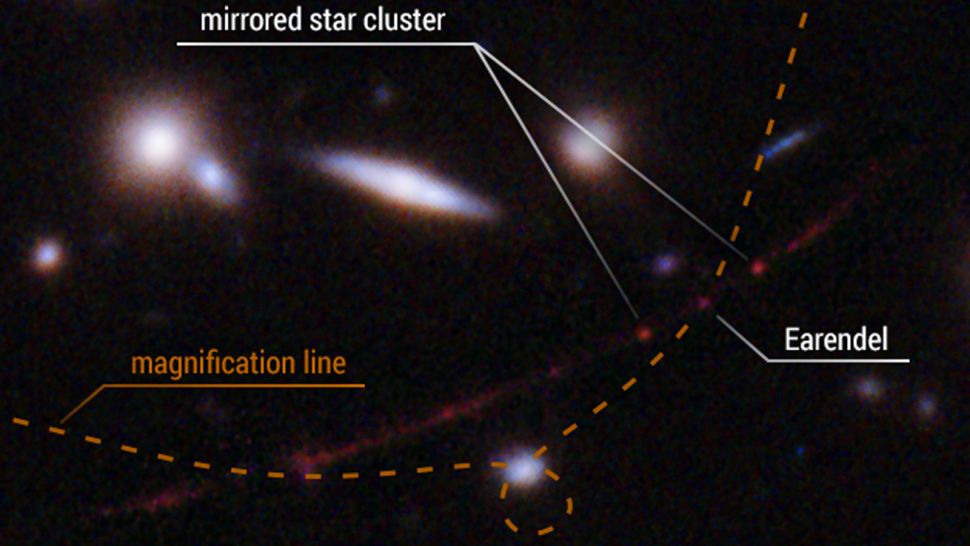
The theory of clustering was proven by comparing Earendel with another object in the same galaxy — the well-known star cluster 1b. They turned out to be similar in age, chemical composition, and properties, resembling ancient clusters that we observe nearby. This seriously challenges the theory that Earendel is a single massive star.
Additional evidence
Scientists are not ready to completely abandon the theory of the most distant star. Further observations are needed for definitive proof. The key will be analysis of light fluctuations. A single star should be measured consistently, whereas light from an entire cluster of stars will have a characteristic twinkle due to its complex structure. This is precisely what astronomers plan to study using the James Webb Telescope in the future.
Thus, Earendel may not be a single star, but rather an entire star cluster — which, in any case, makes it one of the oldest and most amazing objects ever discovered in the Universe.
Earlier, we reported on how James Webb replicated the iconic image taken by the Hubble Telescope.
According to Gizmodo

