

Scientists have published the results of their study of the star Epsilon Eridani using the James Webb Space Telescope. For several decades, there has been debate about whether it has one or more planets. Unfortunately, it was not possible to find reliable evidence of their existence this time either.
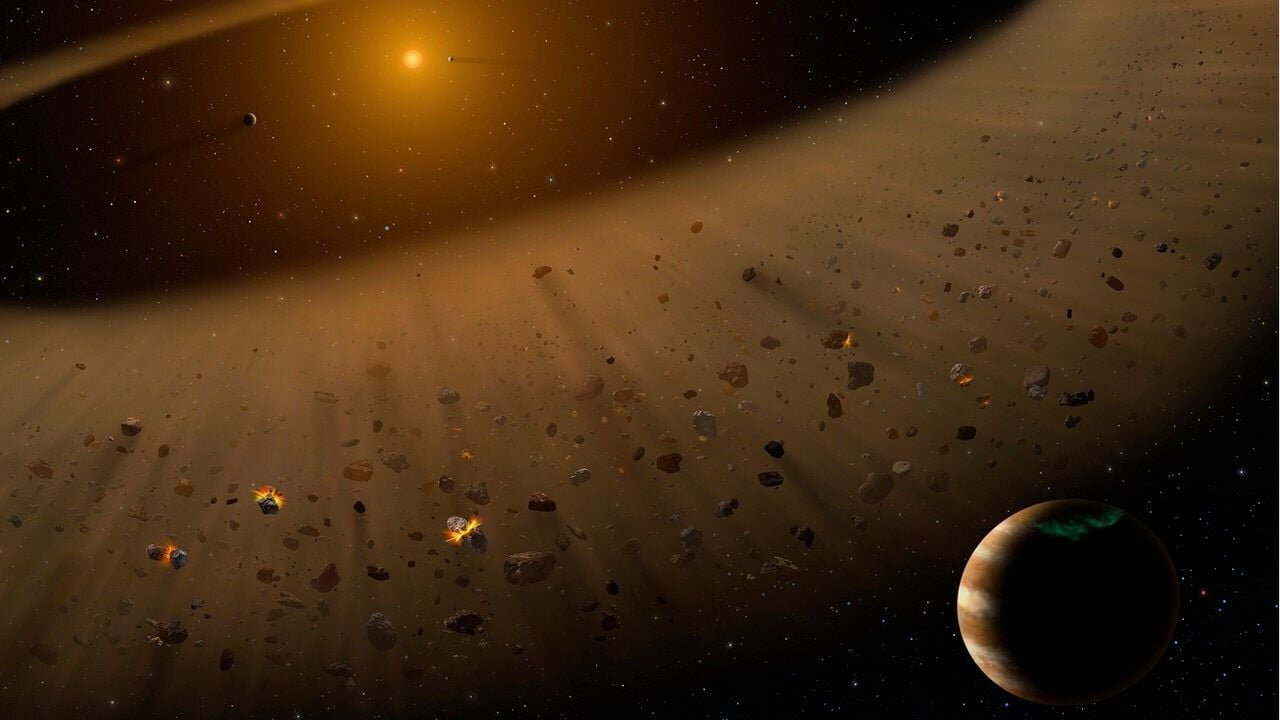
Epsilon Eridani
For many years, scientists have been debating whether the star Epsilon Eridani, which is close to us, has planets or not. The results of a study of this system using NIRCam, an infrared camera installed on the James Webb Space Telescope, were recently published.
The existence of planets orbiting Epsilon Eridani was first announced in 2000. At that time, research showed that one of them was about the size of Jupiter and orbited the star at a distance of 3.5 AU. The other orbited at a distance of 45 AU from the star.
However, since then, no telescope has been able to confirm their existence. And since NIRCam is one of the most advanced instruments available today, high hopes were placed on it. While searching for the first planet, Epsilon Eridani b, NIRCam saw a “spot” that looked very much like a planet, exactly where researchers expected to find it. However, it was also very close to the “hexpeckle,” an artifact of the coronagraph that filled the planet’s region with noise. In the end, they couldn’t statistically claim that the planet was definitely there, despite the promising “spot” of light, given the excessive noise of the instrument itself.
The second potential candidate was eliminated much more convincingly. Although the statistical data was insufficient to definitively rule out all planets, it was sufficient to assert that there are no Saturn-sized planets more than 16 AU from the star. In other words, there appears to be no ring shepherd around Epsilon Eridani.
Observing the dustiest disk, NIRCam found a faint signal on the “eastern” side of the star. This appears to be the side facing us directly, and therefore the signal is most likely just dust from the disk scattering starlight, rather than a planet, similar to how gas and dust can envelop stars themselves in some parts of space.
New telescope observation techniques
All this work was done using a new technique for JWST called the “three-role” observation strategy. Until now, during observations, the telescope had “rolled” at two different angles to ensure that it was capturing light from the observed object in slightly different ways. For these observations, it attempted to do so for the third time and achieved a rather significant improvement in observational capability.
The authors suggest that this technique could improve the JWST’s ability to see faint objects by 20–30% compared to the traditional two-roll method.
Although some may consider the lack of definitive detection of the planet a failure, science is still moving forward, and these JWST observations have allowed certain constraints to be placed on both the potential presence of a planet in the outer reaches of the Epsilon Eridani system and the size and location of an inner, Jupiter-like planet. But most importantly, it has opened up a new methodology that will increase the possibilities for observing faint objects in the future. Given the JWST’s long operational life, this is certainly worth noting.
According to phys.org

